
By Doug Draper
Ontario Transportation Minister Kathleen Wynne calls it a “a cultural shift.”

Ontario Transportation Minister Kathleen Wynne
Others may call it ‘about time’ after decades of everyone from the late and legendary advocate for sound urban planning Jane Jacobs to other respected voices in the field of planning and transportation in North America, not to mention countless citizen groups across this region and continent, pressing governments over and over again to forge more environmentally friendly and economically sustainable transportation plans.
But at least we gave a transportation minister in Ontario who finally seems to be interested in taking seriously a ‘cultural shift’ away from building ever more roads and highways for ever more trucks to cars, to a transportation system that places more emphasis on rail and buses, biking and walking, and other modes of moving around and through our communities and regions.
We will probably never seen the end of cars, said Wynne during an interview with Niagara At Large in Niagara-on-the-Lake, Ont. this June 21 where she was about to meet with representatives in the marine transportation industry. But the province, at long last, has to get past putting so much emphasis on building more highways and roads, and move to other, more sustainable environmental alternatives.
“We have thought for generations that we have endless resources and endless space, but we can’t just keep building roads,” said Wynne during the interview. “That is old thinking. We know now that we don’t have and that our footprint (with all the road and highway building) is having a negative impact on the environment.”
Wynne’s transportation ministry has already demonstrated that cultural shift away from so much of dependency on cars and trucks over the past hundred years by placing the idea of constructing a new ‘mid-peninsula highway’ through Niagara’s rural heartland so far back on the burner, it will probably never again be taken seriously. (Click on Niagara At Large at www.niagaraatlarge..com for another recent story on the virtual discarding by the province’s transportation ministry of the mid-pen highway proposal.)
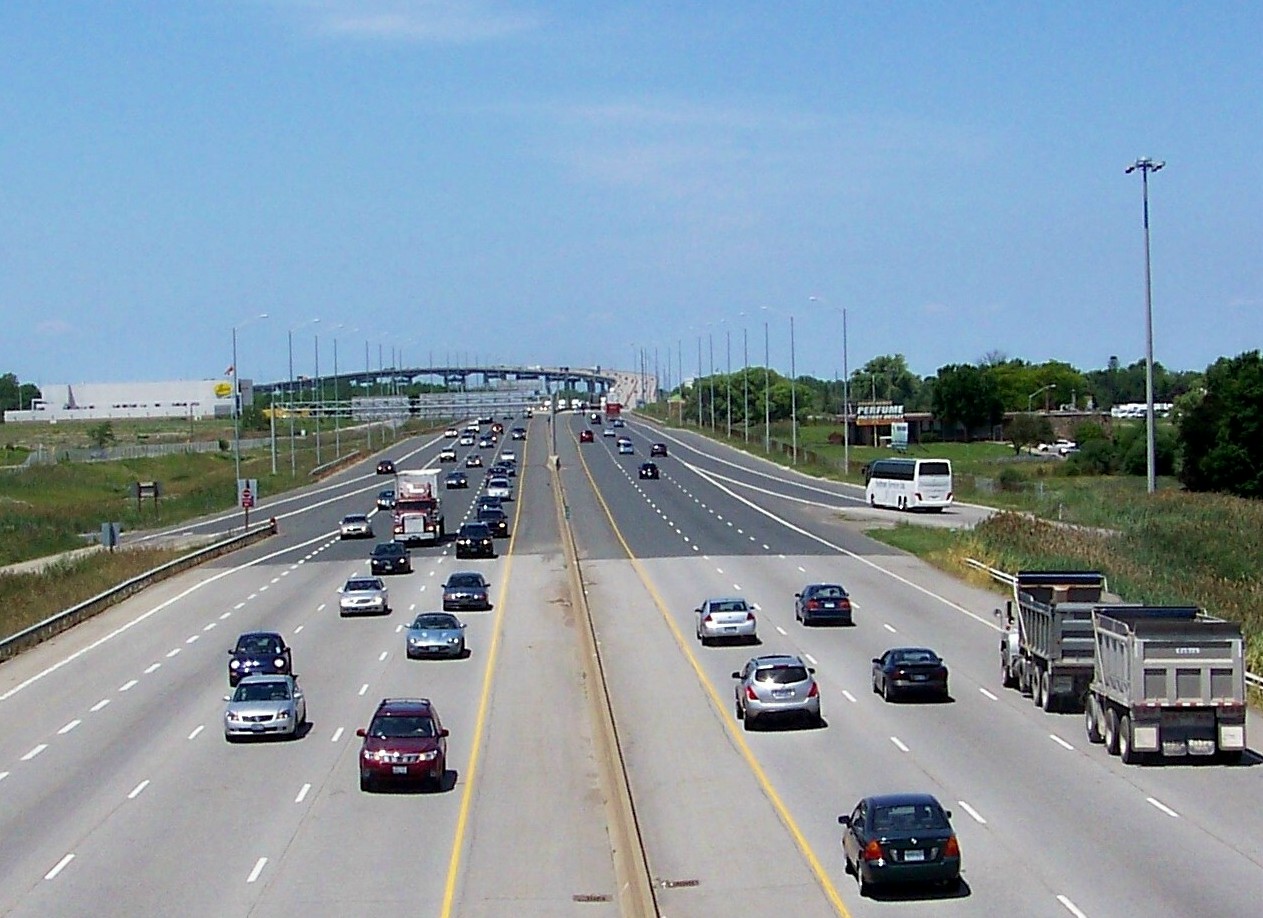
Ontario transportation minister sounds determined to balance this with other sustainable transit alternatives. Photo by Doug Draper
Asked if the cost of building ever more highways is the main reason plans like the mid-pen are falling off the tree, Wynne said, cost is a factor. Having said that, the cost of building transit can be high too, but the cost of not doing that can be higher” in terms of the potential damage a continuation of the past century’s dominance of cars and trucks and roads and highways is doing to air quality and our environment in general.
So Wynne said she’s determined to do what she can as a minister to build and promote more public transit and more car-pooling, as another key strategy for getting those single-occupant vehicles off our congested roads. It is a job that has its challenges, she said, since she also needs the support of regional municipalities like Niagara to do their part to build transit alternatives, and the federal government to work with the province on rail, cross-border bridge improvements and other services.
Wynne’s words during the interview might have the likes of Robert Moses, the builider from New York State from the middle decades of the last century who thought nothing of ripping up rail tracks and leveling old neighbourhoods to build another road or highway, spinning in his grave. And that is good!
That’s because her words should come as welcome news to those who long for a more environmentally and economically sustainable transportation systems for the 21st century. Wynne talks like the first transportation minister in Ontario to take alternative transit strategies for regions across the province seriously and, given the push back she may likely be facing from so many others in municipal, provincial and federal government who would be pleased just to move forward with the status quo, she will need all the support she can get from the public.
(Click on Niagara At Large at www.niagaraatlarge.com for more news and commentary on matters of interest and concern to our greatern binational Niagara region.)
 Niagara At Large
One of the great strengths of the North American way of life is the liberation that the automobile has provided. Individuals can decide where they wish to go when they wish to go and this freedom is what allows the flourishing of the entreprenurial spirit. I wish to point out that lack of this mobility has kept many societies back. Only with the explosive growth of self determination have countries like China and Brasil started to emerge from serfdom. One need only look at repressive societies to note they have one thing in common … the general population lacks cars and the freedom of movement they represent.
One really has to question the anti-car agenda of certain politicians and activists. The car culture and the personal vehicle generally is the liberating zeitgeist that separates free people from serfs.
LikeLike
Chris – are you joking? Curbing the negative externalities of a car-dominated transportation system (smog, congestion, sprawl, highway expansion costs, etc) by providing better options for transit / cycling / walking is the road to totalitarianism? Sounds like you’ve been reading a bit too much Hayek’s “Road to Serfdom” lately, and a few bolts are coming loose.
There are many types of freedom, and not all of them are compatible. The freedom of SOME people to drive whenever and wherever they please compromises other freedoms – eg. to breathe clean air, to have a liveable urban environment, to get around and meet your needs when you can’t drive or don’t have access to a car. Giving people better transit options, bike-lanes and sidewalk is hardly an affront to liberty. Indeed, it would give greater freedom to lots of people, even though it would require people like you (who think that they are entitled to all road space and all public transportation dollars) to share a bit. Most of us learned the importance of sharing in nursery school, but I guess you were at the Ayn Rand kiddie boot-camp until your home-schooling began.
Achieving a more efficient transportation system that doesn’t rely on the single passenger car is the only way to make cities work in the future, and to avoid environmental disaster. You cite China (which is now banning bicycles from many roads – another great example of ‘liberty’) and other emerging economies as great examples, but fail to realize the potential danger of them using cars at the rate that we now currently do. If all countries had rates of car ownership similar to North America, there would be over 4 billion cars on the road in the world – a possibility that would lead to massive energy shortages, widespread death from air and water pollution, the loss of huge amounts of farmland, the sapping of public funds to build new highways, and so on. Unfortunately, economic libertarians like you have no concern for such collective problems. As long as ‘individuals’ (ie. people like you) can do what they want (assisted by massive public subsidies for highways, auto companies, oil drilling, etc), then all is ok.
LikeLike
Oh Dennis, please think your statements all the way through.
“Giving people better transit options, bike-lanes and sidewalk is hardly an affront to liberty. Indeed, it would give greater freedom to lots of people, even though it would require people like you (who think that they are entitled to all road space and all public transportation dollars) to share a bit.”
Share a bit? You mean give up a lot. You’re taking from some to give to others. That’s not liberty; it’s theft.
Your straw man about car drivers wanting “all road space and all transportation dollars” isn’t true and you know it.
Fact remains that Niagara does not require public transit.
If demand for public transit existed, an entrepreneurial spirit — possibly Community Care or other charity — would establish a car share program… similar to those in large cities.
In 2004 a study established that buying poor people cars was less expensive than building a public transit bureaucracy staffed with unionized public workers.
http://www.heartland.org/policybot/results/15340/Why_Not_Just_Buy_Them_Cars.html
This whole public transit scheme is merely a bureaucrat’s empire building exercise. We don’t need it, and we can’t afford it.
LikeLike
Dennis is correct … in a static world. However, he presupposes that gasoline will remain the definitive portable fuel. China is a very good example of looking beyond the present. The City of Shanghai is replacing diesel with DME as a fuel for all their buses. They are building an infrastructure to support DME as a general fuel to see if they can get away from imported oil. DME is a methanol variant and can be made cheaply enough from most renewable organics, is non-toxic and has 1/16th the carbon footprint of oil.
But I digress…
Apocalyptic visions of death, pestillence and sterility seem oddly remeniscent of 1348. I don’t recall any demon cars back then. Nor is it writ that the concept of the personal vehicle needs to equate despoiling the environment. Frankly, cars are quite an improvement over the days of the horse. That’s when you REALLY had pollution, pandemics & the like. Check out the Great Epizootic of 1872. Check out Eric Morris’s article called “From Horse Power to Horsepower”. Then you will really see what polution is all about.
We’ll all have better technology soon enough.
As for bicycles, try commuting from Welland to Wainfleet or Bismarck with your lunch pail and toolbox in February on your Canadian Tire utility bike.
Returning back to the premise, what we are starting to witness with McGuinty’s program is the beginning of forced urbanization and conformity of life. Is it ethical for this government to thwart the viability of our communities under the pretext of saving money? The decline of South Niagara as a sustainable environment, the closure of hospitals and the marginalization of our way of life is part of this erosion of our rights. Take away our cars and you might as well roll up the sidewalks anywhere South of St. Davids Road.
Dennis, although I don’t know if you actually read Hayek or Rand, the way you personalized your rebuttal shows that you certainly have had a brush with the work of Saul Alinsky. As for me, I’ll refrain from ad-hominem remarks.
LikeLike
Dave – give me a break. The budget for bike lanes in St. Catharines last year was about $50,000. The city spent more than that grinding the bike lane off of Welland Ave after the Canadian Tire manager complained. The city has cut its funding of transit, but is going ahead with plans to build a $30 million parking garage downtown. The province has spent almost $200 million on widening the QEW, but refuses to pay for sidewalks over highway bridges. See a pattern? I like to think of hard-core motorists as examples of what psychologists call the “authoritarian personality” – any slip in their sense of control, and they act like the world is falling apart and that they are the persecuted ones. For decades, public funds and public space have gone overwhelmingly towards automobile transportation. Now that public money and public space needs to be shared a bit more, drivers act like the world is ending.
Chris – yes, I have read Hayek and Rand, so I’m well aware of the broader philosophy underlying your overblown road-to-serfdom arguments and your blustery defense of cars as the ultimate expression of individual liberty and progress. Pointing out that philosophy, and to your over-heated rhetoric, is not the same as an ad hominem attack.
Your point about south Niagara is interesting – although I’d argue that South Niagara is a victim of automobile oriented planning and land-use decisions. The assumption underlying the reorganization of the NHS is that everyone can / will simply drive to Welland or St. Catharines (primarily) for services and that there is no need for community-based institutions. This is the same reason that local retail has suffered, and people now have to drive to ‘smart centers’ to get an apple or loaf of bread, and that the LCBO in downtown Thorold closed in favour of a superstore on Glendale.
I also find your comment about rolling up sidewalks near St. David’s road ironic, since – as you know – there are no sidewalks or provisions for non-motorists on this long stretch of road, even though Brock has been around for decades and students walk / cycle this route at their own risk all the time. Take off your blinders and you’ll see that motorists are not some persecuted minority, and that your liberty won’t evaporate if the needs of non-drivers are taken into account once in a while.
LikeLike
And, oh yeah, Chris: your attempt to paint me as a “the end is nigh” nutjob was a bit far-fetched. The number of deaths attributable to smog has been well-documented by the CMA and other bodies, and would of course grow more serious if the number of cars on the world’s roads more than quadrupled. You, on the other hand, look at the fact that the Ontario minister of transportation is talking about possibly devoting more attention to non-car travel options, and come to the conclusion that the Gulag is upon us. Who is being more alarmist?
LikeLike
Again the point is missed.
Distraction no. 1
The connection between cars and smog has become tenuous as technology moves forward. Much of the CMA smog-death statistics are based on computer modelling and assumptions. This junk science has been soundly exposed by Dr. Ross McKitrick as unsubstantiated. Or as the press would say, where are the bodies?
Distraction no. 2
Where is it written that cars need to emit polutants? Is it so easy to be dismissive of technological improvement in personal transportation? Should we detect an ideological bias against the “car”?
Distraction no. 3
Port Colborne was in existance prior to the invention of the car. The car replaced the horse & buggy. Roads were improved from dirt roads to paved accessways. Real simple. No conspiracy.
Distraction no. 4
Should we detect a bias against distributed living, blaming the disenfranchisement of South Niagara on people foolishly chosing to living where their families have grown roots? Are we blaming the victim for the avaricious over-reach of big-time bureaucrats who place no value on the “small people”?
Distraction no. 5
People don’t get sick according to a bus schedule. Bureaucrats are adopting the “whole life” approach, basically marginalizing the old, the poor, the uneducated, those without access, those without the power to complain their rights have been violated. The carless utopia will quickly devolve into a distopian nightmare of crowded urban centers of stultifying conformity. Favelas-R-Us is not my vision of social justice.
Distraction no.6
What do people know of Gulags? Easy enough to throw the word around. Does using the word impart weight to the arguement? Would most people know a Gulag from a scout camp? Millions didn’t and still don’t. Revisionist history has seen to it. My uncle died in one. Some of us know the existential difference. To use Gulag as a boogada-boogada word is so jejune.
Lets get to the point:
Chosing a bike path here or a bus route there is not the agenda. In context it is the politically correct incremental precursor to questioning the legitimacy of the personal vehicle. And the use of the word “choice” has the same hollow ring that it has when used in women’s rights. “You have the choice to do the politically correct thing as you are told, or face the consequence.”
Demonization of personal transport, the hallmark of equal justice and egalitarianism, is in the same category as the demonization of the family, demonization of people of faith, demonization of certain ethnicities, demonization of the pursuit of excellence. Why may you ask? Personal vehicles are an affront to the imperative of the “planned” society.
LikeLike
Chris, your list of my alleged distractions is a distraction. No one is “demonizing” personal transport. I am drawing attention to the effects that automobile traffic has when it is the overhelmingly dominant mode of travel and our communities and landscapes are fashioned (with public funds) to suit its needs alone. Your guileless idealization of the car as a talisman of justice and egalitarianism (against a lot of contrary evidence) is the real issue here – and the only real explanation for your silly attempt to link bike lanes, sidewalks and transit with Stalinist terror (and the attack on the family, ethnic minorities, ‘excellence’, etc – wtf?). It is also behind your tendency to paint any criticism of car-centered transportation systems as archaic, apocalyptic, superstitious, part of a fanatical quest for a “carless utopia”, etc.
Your faith in technology to solve social problems is quaint (I assume you feel a similar confidence in BP’s technological abilities in the Gulf, where our current auto fuel continues to leak?), but I think that the solutions you allude to (emissions free cars that run on rainbows and baby smiles, etc) are quite far off, and you don’t account for either the non-tailpipe related environmental costs of car-dependence, or the new problems that simple technological substitutions can create. For instance, fuelling cars with bio-fuels would limit our dependence on oil, but would require most of the world’s farmland be devoted to fuel-crops instead of food. Similarly, electricity doesn’t come from nowhere, and electric cars will need to ultimately rely on sources of power (coal, nuclear, etc) that have their own environmental and public health costs / risks.
Finally, your attempt to position the car as somehow at odds with a “planned society” fails to realize the extent to which the entire infrastructure on which it depends requires a huge amount of planning and state intervention. You don’t have a personal highway for your personal vehicle, do you? Do bridges and off-ramps just spontaneously grow from the soil? Has the QEW widened itself in the past couple of years? Are we born with car licenses? Who cleans up after accidents and treats the victims? The question isn’t planning vs. no planning, but planning for what end. Your freedom to drive everywhere wouldn’t exist without the massive state intervention, planning and public subsidies that create, sustain and expand auto infrastructure. You simply don’t want any of that planning and intervention to incorporate a concern for people who aren’t in cars. Like most dogmatic free-marketeers, you’re blind to the ways in which your own activities are facilitated in this way, and are only against “planning” when it goes against your own immediate interests. Having a community in which people weren’t compelled to drive for each one of their daily needs (school, food, work, socializing, recreation, etc) would require far less planning, and create freedoms for lots of people who are now marginalized in a auto-dependent society. That was my point about South Niagara. If the emergency rooms were kept open there, people’s ability to seek help / stay alive wouldn’t depend on their access to a personal car. That is hardly ‘blaming the victim’.
Anyway, I think that this conversation is generating more heat than light. Your Hayek / von Mises ideological convictions are so extreme that you simply seem unwilling or incapable of acknowledging any problems associated with state-planned, automobile-oriented transportation systems. I fully realize that cars afford some people a sense of personal freedom and empowerment, but that doesn’t trump all of the other points I’ve tried to raise with you.
LikeLike
Bravo, Dennis Soron. Perhaps those that can afford to drive can afford to pay road tolls, cover their parking costs anywhere and everywhere, and pay for all the consequential damage to the environment, as opposed to relying on people like me to continue to pay taxes that go towards roads, highways, traffic lights, parking lots, “free parking” at big box stores, etc. The amount of subsidy received by the automobile far exceed any subsidy given to transit on a per capita basis.
LikeLike
As for the statement that Niagara does not need public transit, perhaps Dave Chappelle may to suggest how the 35% of Niagara residents that do not drive or own a car can get around. Perhaps, he can offer up his phone number and pick people up and drop them at will.
LikeLike
Dear Angela
You must mean the vast majority of the public that actually does drive. I am certain that in the 35% you refer to that don’t drive, you include those that have not reached the age of majority and are nor eligible to drive.
I believe drivers are very well represented on the tax rolls. I suggest it is in fact the drivers who underwrite the “subsidies” with their fuel tax, most of which end up in general revenue to the tune of net $6 Billion and not spent on roads.
If you are not a driver, chances are you don’t pay taxes either, income or fuel.
So if you are receiving any government support
at all, even an HST rebate, thank a driver.
And if you prefer not to drive, that’s what freedom of choice is all about.
LikeLike
Chris, the 35% figure is all persons of driving age. If you don’t like it, take up your fight with the Ministry of Transportation and the Census people, where I got the information.
There is no reason I should be paying YOUR bills either, if you carry an attitude like that about transit. I think many drivers will stop driving if they did indeed pay the full freight of driving unsubsidized by other taxpayers.
LikeLike