
By Doug Draper
As I gathered early this June with a few hundred others in the old St. Thomas Anglican Church in St. Catharines, Ontario, I felt like I was saying farewell – once again and possibly for the last time – to the last real daily newspaper residents on the Ontario side of our greater Niagara region had.
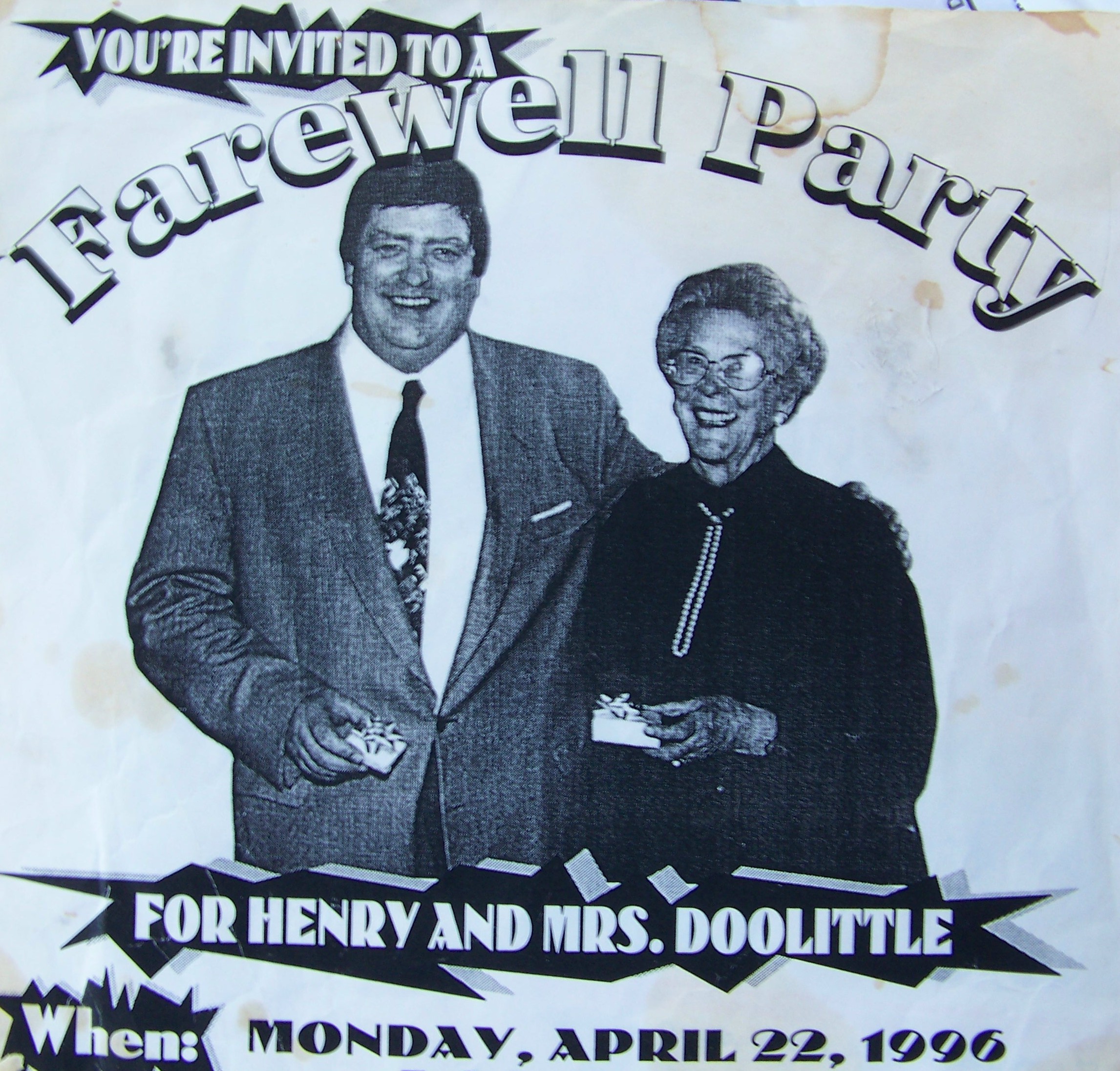
Henry Burgoyne, the last publisher of The St. Catharines Standard when it was a newspaper, with his mother, Dorothy Burgoyne Doolittle, offering a farewell party to those of us who enjoyed working for them.
The gathering was, in and of itself, a sad one. It was for Dorothy Burgoyne Doolittle, who passed away this May 31 in her 90th year.
And for those who may not know, Dorothy Burgoyne Doolittle was the last matriarch of the Burgoyne family when that fine family still owned The St. Catharines Standard up to the time it sold the paper in 1996.
I said my first farewell to that paper a couple of years later, in 1998, when along with many other journalists, who had love working there for years, I blasted my way out of the place in disgust after Lord Conrad Black of Crossharbour (then a newspaper baron and now a jail bird) ripped the heart and soul out of the newsroom, along with a bunch of sycophants that have bowed to their knees to every corporate boss man that has run the place like a sausage-making factory to this day.
Damn right. I found myself running out of a newsroom I once loved running into, and I have never been back. I won’t even walk or drive my car down Queen Street, past the front doors of the red-brick building still housing what’s left of The Standard, and I feel as sad about that as I did when I heard the recent news that Dorothy Burgoyne Doolittle had died.
The Burgoynes, who virtually founded that newspaper in 1891 and built it for more than a century into a formidable voice for St. Catharines and the surrounding region, exemplified the kind of owners of newspapers that are all but gone. Unlike the corporate chains that own most of the newspapers on this continent today (carpetbaggers, I often call them) the Burgoynes lived in and cared passionately for the community where they owned and operated a newspaper and, even more than that, they loved newspapers – not just as a business but (as corny as it may sound) as a public trust.
They still believed in newspapers as not simply a business, but as a public trust! Can you imagine that? The Burgoynes, when they owned that paper, took what news they published seriously. Not that there weren’t the crossword puzzles, the cartoons and everything else. And not that the paper didn’t make mistakes or print the odd what-the-hell-is-this-doing-in-here story from time to time. What mattered, at the end of the day is that they lent the newsroom the resources it needed to get to the bottom of important stories on the environment (in my case), health care and everthing else.
What mattered is that they used words and phrases like “stories” and “columns” and “readers” and “editorial policy” to frame the newspaper’s purpose – not words like “product” and “customer” and “business plan” that the carpetbaggers due, as if all a newspaper is today is another faceless other that sells widgets. I was fortunate enough to work for (and I always felt it was more like working with) the Burgoynes from 1979 when I graduated from a journalism program at the University of Western Ontario until 1996, when the paper was sold to the Southam family, which had a pretty long and respectable record of its own when it came to newspapers.
The Burgoynes had reason to believe, as they bid their farewell, that they left a legacy they so passionately built over a century in the hands of a Southam company that still gave a damn about newspapers when it came to delivering news that had meaning for the communities those papers served. Unfortunately, Conrad Black’s Hollinger corporation gobbled up Southam within a year of the sale, chopping off the heads of most of the Southam executives who were more inclined to care a little about newsrooms, and the rest is history.
A once fine newspaper I worked for has been circling the drain ever since. If you don’t believe me, check out the Friday, June 18, 2010 edition of The Standard, stuffed in our mailboxes in the north end of Niagara whether we want any exposure to this rag or not, and check out the front section. Above the fold on the front page of the June 18 edition is a story advertising the possibility that, according to the Lotto Max gambling corporation, “a whopping $95 million (is) up for graps.”
You have to read down four awfully written paragraphs of this rancid front-page advertorial to find out that the chances of you winning this ‘whopping’ prize is about one in 28 million. The idiot sheet this paper has become probably won’t tell you this, but you’d probably be better off working in your garage or basement on some new gadget you can market to Ronko for cutting toe nails or ear hair. As if smearing this lotto feces across the front page isn’t enough, this rag goes on to run one of those ask-people-out-on-the-street things on page four of the front section where they ask people on the street what they might do with the winnings from the lottery. “I would buy a new house and a new car. Probably, I would start with a Mazda,” said one of the eight people asked.
How illuminating! And how helpful to us all at a time when media in this region could and should be spending more time and resources covering the interests and concerns of people across a region that is experiencing serious challenges around finding affordable housing, jobs decent enough to support a family, access to public transit, health care and so many other issues.
But that paper that I once worked for and would continue to work for 18 hours a day, even if they only paid me half of what I made then to do the kind of journalism we once were able to do there is a long time gone. I thought about this loss again as I embraced Henry Burgoyne, the last publisher of that paper when it was independently owned at his mother’s memorial service, and said to him that he and his family gave me the best years in journalism I’ve had in my life to date. He said they were some of his best years too.
Now I got to quit this to wipe away a few tears.
And there is some reason, I think, why all of us who mourn the loss of papers that once cared about quality journalism in this region ought to cry. All I can say in passing, is thanks to Henry and and his family, and thanks to Dorothy Burgoyne Doolittle, for giving me and so many others the opportunity to do some journalism in this region that really mattered. I’m sure I am not the only one across this region that misses you!
(Click on Niagara At Large at www.niagaraatlarge.com for more news and commentary of interest and concern to residents in our greater binational Niagara region.)
 Niagara At Large
What a great letter Doug and you are so right. It was a paper worth reading years ago, but now they seem to be too political and too critical to write about what is happening, in and around Niagara. They censor stories happening in “their own back yard” and letters to the editor are edited so drastically that they leave out the writers intent.
I thought newspapers were supposed to be non partisan and unbiased in their reporting.
Glad you left there Doug, their loss is our gain.
LikeLike
Great article Doug.
Here’s hoping that your little “personal paper” is helping to cut off the corporate chains at the knees.
I cancelled the Standard when their biased coverage of the Port tower story went way over the top. I will never subscribe again.
LikeLike
My problem with the Standard was, it did not care much fot my union #199 but a young man did a helluva good job, covering enviromental issues, clippings of which I still have on Operation Clean, by that young feller Doug Draper
LikeLike
Nicely done Doug, with an excellent comparison on language – reader vs. customer. Big corporations do poorly on capturing the news that matters….. and better with news collected at the lowest cost that sells to well enough to make a profit. Fast food.
LikeLike
Doug
Your article is a very emotional yet powerful tribute to yesteryear when morals mattered and people like this “Great Lady” were the vogue when it came to investigative news and genuine concern for their community and the people.
As usual you are right in feeling a sense of bitterness towards those who have corrupted the noble profession of Journalism and I stand with you in the knowledge that the City, Region, Province, Country and yes the World’ s sad state of affairs is due to the silencing of the purveyors of truth and honesty, the proud Journalists of this world.
God Bless Canada or better still God HELP Canada for our elected bodies do not represent the people anymore than our media
LikeLike
Doug:
Tell us how you really feel. lol. Well said. Way to keep reminding people that quality journalism is still just as important as it was back when the Burgoynes were involved. As much as things have changed in the industry, people still pick up a paper to read the editorial content that accompanies the advertising. I’m sorry you’ve had to see such a drastic transformation, but thank your lucky stars that you got to be part of those glory days. Keep the faith Doug. I know there are still journalists out there who work those long days you speak of to produce the best paper news they can.
LikeLike
Good personal reporting Doug, as usual.
There are 2 sides to all newspapers – the News to attract readers, and the Advertising to pay for the reporters to get the News to attract readers to….
Wasn’t the Standard forced to sell by a single employee who sabotaged both her employer and fellow employees, by embezzling millions of dollars?
A former editorial staffer of the Welland Tribune told me that Conrad Black did Nothing to interfere with the news they wrote. (Compare that to Canwest’s Asper family!) However, he did save many Canadian community newspapers by his technological and news re-organisation. He made the local papers mainly local, and created the National Post for national news. Black also used satellite & internet connection to feed all of papers, replace local lead-type composers, and save money. (And yes, Conrad Black is pompous and elitist.)
We’re in a similar troublesome time, where advertising has dried up, reporters are being laid off, and newspapers are folding all over North America. Perhaps we should run a pool on when our 3 local Niagara papers will disappear?
Who will provide us with news then? What will we do to find objective reporting? Let’s hope that blogs such as Niagara-at-Large can do it. But let’s remember that they’re quite different from The Standard of yesteryear.
LikeLike
Thanks for this very eloquent perspective, reinforcing what we have lost with the corporatised culture of modern media. I have no other words, you said them all.
LikeLike