
A Commentary by Doug Draper
In the 1970s Academy Award- winning film ‘Network’, there is a scene where the head of the corporation that runs one of America’s major TV networks calls the news anchor in to the boardroom for a bit of a dressing down.
“You get up on your little screen,” says the corporate head, “and howl about America and democracy. There is no America. There is no democracy. There is only IBM and ITT and AT&T and Dupont, Dow, Union Carbide and Exxon. Those are the nations of the world now.”
This lesson for the news anchor crossed this commentator’s mind over the past couple of months as we have all watched, on our little screens at home, the disaster unfolding off the U.S. shores of a Gulf of Mexico that is a major habitat for wildlife and one of the most productive sources for seafood on this continent. It came to mind over and over again as it looked like BP, one of the largest petroleum corporations in the world and the perpetrator of what is now recognized by the White House as the worst environmental catastrophe in U.S. history, was (and still is) calling most of the shots on trying to control this monumental mess.
Even this June 15, as U.S. President Barack Obama went on the air from the Oval Office for the first time to address the disaster, his words about BP’s “recklessness” and one of his crowning lines; “Now is the moment for this generation … to embark on a national mission … to seize our destiny” were seductive, but seemed to fall short of any real detail or substance.
Where, in particular, was a fledged-out plan and a deadline (the same kind of call the late U.S. president John F. Kennedy made in the early 1960s to put a man on the moon before the end of the decade) to embark on a new path of energy conservation and greener energy alternatives – ones that may finally place a century old reliance on dirty oil at the bottom of the list of the energy we need to fuel our 21st century communities?
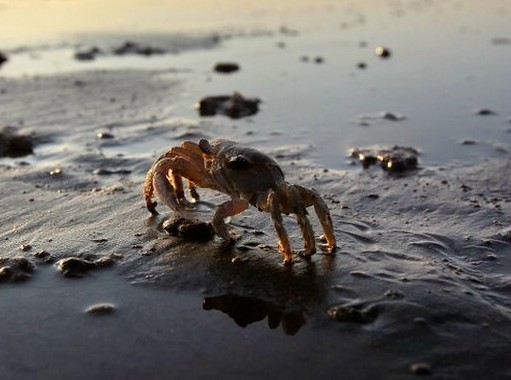
Hey BP. Take this oily crab and eat it!
On that score, Obama’s address was thinner than the oil sludge washing up on the Gulf shores, and all of us (Canadians included, because our federal government won’t do anything progressive on energy alternatives unless the U.S. does it first) are worse off for it. Once again, it looks like we have an elected leader – in this case a pretty powerful one in the form of the president of the United States – falling short of saying too much that might upset a powerful oil corporation lobby and its allies.
Obama had a chance with his Oval Office address this June 15, and he may still a chance, to make a milestone call for a new energy future for his country and a neighbouring Canada that is so closely tied to the U.S., economically and politically.
What is so disappointing to this point is that Obama, when he was running for president and during the first months of his presidency, emphasized, so rightly, that those nations in this world that will be among the first to tap into newer, more environmentally friendly sources of energy will be the leading nations in the 21st century.
Yet, the U.S. and Canada seem stuck in oil, whether it is the drilling of wells in the Gulf or the tar sands (let the mainstream media bow to their corporate masters and call these ‘oil sands’ if they want) in Alberta. There seems very little real courage on the part our elected governments to stand up to an entrenched oil lobby and set a new course.
So here we are. You can turn on your computer and navigate to the webcam of the continued gushing of oil from the bottom of the Gulf. Maybe, there will be the same video opportunity in Canada if an even deeper offshore well, now being drilled by Chevron off the shores of Newfoundland, should lead to a cataclysm.
All of it looks, quite sadly, that even after two months of petrol sludge swamping fisheries, beaches, bird habitats and possibly destroying forever the livelihoods of millions of people in the Gulf area, the oil industry still rules.
Obama missed a moment in history this June 15 to inspire North Americans to chart a new energy course, and we will all continue to pay for it.
(Click on Niagara At Large for www.niagaraatlarge.com for more news and commentary on this and other matters of interest and concern to residents in our greater binational Niagara region.)
 Niagara At Large
Can the governments of Canada and the US learn a lesson from this disaster? the citizens already have, they are seeing all their lively hoods diappear in a whirlpool of toxic sludge,drilling an oil well, one mile down in the ocean, without a shut off valve is not a good idea the pressure of this oil gusher is off the guage,this is a Pandoras box situation for sure, everybody is pointing fingers at each other.I blame profit, profit at all costs are too blame for this toxic nightmare.
LikeLike
People are complaining – half of them because of the moratorium on drilling and their resultant loss of income – the other half who rely on the sea and tourism about their loss of income. Something has to give. Do we keep the same catastrophic policies for immediate gain and forge myopically ahead or do we finally realize their is no future unless we change. The oil companies have run the world and it’s governments for years. They have caused senseless wars, financial monopolies and limitless damage to the planet. Their regulations were self created so they could run rampant. It’s ridiculous! Some of these people including the likes of Bush and Cheney (who waged wars for their interests, with other peoples’ lives of course) and other oil and business barons should be tried and hung for crimes against humanity. (and crimes against the natural world if there were such laws).
We are only seeing the surface effects too. What is going on beneath the Caribbean surface can’t be seen but is likely many fold more devastating. It’s like the proverbial iceberg, you only see the tip. That area of the sea will be a deadzone for a hundred years at least and who knows how far it can still spread!
LikeLike
Canada is an energy super-power, as Prime Minister Harper has said. So we’re hanging our hats on jobs for the next few decades coming from that sector of mining for coal, oil and gas. (Mind you, he did eliminate the tax subsidies for oil companies.)
OTOH, under George W. Bush, oil baron, the USA has been handing out 25% tax credits to Americans who install Renewable Energy on their homes & businesses … in order to improve ‘Security of Supply’. This was matched by California, New Jersey and now New York and others, so that while a Canadian pays full price (no subsidies), Americans pay half-price.
In short order, we’ll never be able to compete with our largest trading partner, who will soon have lower energy costs than we do.
Obama merely plans to expand what Bush began. Unfortunately, it looks as if he’ll use either Carbon Tax or Cap and Trade, which will let big corporations create another financial disaster in North America, and personal ecological disruption for subsistence people in the developing world. (There are stories of Cap & Trade investments from Norway driving people off their traditional lands in Uganda, in order to plant mono-forests of non-native Australian eucalyptus trees.)
Only the dedicated -or wise- Canadian will even think of installing Renewable Energy today. Do you think that will change with hydro prices rising ~25% in 2010?
Let’s face it, we’re all addicted to oil, and we love it!
LikeLike
Have you ever wondered whether mining the Tar Sands disrupts our ecology more or less than BP’s Gulf oil spill?
It appears that the tar sands technology
1. hasn’t prevented downstream pollution
2. has changed river flow so that marshes have disappeared, and wildlife habitat has disappeared (or was that from building the ‘clean’ Peace River hydro dam?)
Maybe the few birds which somehow escape the oil spill and fly north, won’t have places to breed anyway. Why worry?
Besides, my family still owns 2 cars … I need the oil, don’t I?
LikeLike
We are not “addicted” to oil but rather need transportation in this day and age. With the intractability of the car companies refusing to provide and develop alternative fuels in sustainable (and available) quantities we must use the only thing provided as fuel. Of course the tar sands are polluting and our use of oil and gasoline pollutes – period. Most of us know this but have no control over what is available. Today’s society necessitates travel for work, etc. and many areas do not have ecologically friendly or ANY public transit. I couldn’t bicycle 25 miles to my job. If there was an alternative fuel vehicle I would buy it! Since retiring, I drive very little and often walk or bike miles, since I live in a rural area, rather than take the car.
Greedy corporations need to realize their short term gain could be magnified multifold by getting the jump on other corporations in the development of eco friendly alternatives but our society is all ME and NOW.
Waste is immense. I just have to look out my window to see the high voltage street lights illuminating the sky and not just the roads. Low voltage night sky friendly lights would save energy +++ in every town and we could actually see the stars. Why do buildings have to be lit at night? Why do people leave their cable receivers and computers on? Why do people heat their house to 70 instead of putting on a sweater? It goes on and on.
LikeLike