
By John Bacher
Currently there is a lull before the storm of the planned Ontario Municipal Board hearing on the Fort Erie Canadian Motorway Speed
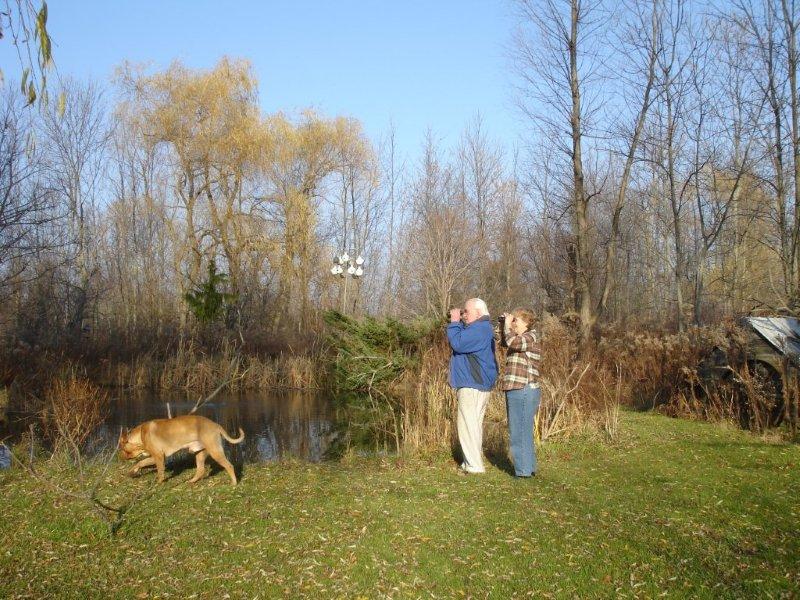
Fort Erie residents enjoy nature walks around wetlands near lands planned for mammoth motor racing facility.
way.
This scheme, facilitated by the amendments to the Fort Erie and Niagara Region Official Plans which are under appeal, would designate some 817 acres of land that are now protected as “Good General Agricultural Land”, into a “Special Policy” area.
The delay in the OMB hearing is because the Town of Fort Erie and the Niagara Region are seeking to develop new zoning categories to replace the agricultural designation which now prohibits motorways. At the same time, proponents of the motorway are likely engaged in arm-twisting with the province over the fate of a predominately Pin Oak Swamp Forest. This is an area the developer seeks to cross with a bridge that would allow motorcars to race over the forest below.
In its original wording, an amendment to the Fort Erie Official Plan to approve the motorway blessed the bridge over this provincially significant wetland. It is now marked with a slash, and then identified as Modification #3, “Reword.”
Before the province and the Niagara Region objected, Fort Erie had no problem with the breaching of the wetland. The original amendment by Fort Erie permitted “a suitable crossing of a wetland hedgerow as approved by the Niagara Peninsula Conservation Authority.” This wording was slashed out only after the authority itself indicated that the proposed crossing was a violation of provincial policy regarding the prohibition of site alterations of provincially significant wetlands.
Despite being slashed out of the Fort Erie Official Plan amendments, the crossing of the rare Pin Oak Forests, disparaged as a mere “hedgerow”, is still in the working plans for the Fort Eire motorway. All environmental studies being generated by the proponent show this design. Unless the track is not moved north, cutting in to potentially lucrative commercial space near and QEW highway, the motorway would still have to slash above the forest in a bridge. This would violate the Provincial Policy Statement, which prohibits such site alterations on such provincially significant wetlands.
Five years in the works, a new biological inventory by the Niagara Peninsula Conservation Authority sheds some more light on the importance of the Miller Creek Provincially Significant Wetland, which the motorway’s proponents seek to alter in violation of provincial policy. This illustrates the importance of these Swamp Pin Oak Forests for the watersheds of Niagara.
One of the most important aspects of the bio-inventory concerns watershed hydrologic characterization. This notes that “by area, Niagara is covered by more swamp wetlands than any other type. A swamp is a wetland, which has temporary or permanent inundation of large areas of land by shallow water. Swamps generally consist of scattered dry hummocks containing the vegetation, surrounded by aquatic c vegetation, and area therefore characterized by rich biodiversity.
The bio-inventory of the NPCA notes that “even small isolated seasonal pools which contain standing water for only a short period in the spring and summer can provide vital habitat for rare and specialized species such as frogs and salamanders which rely on fish-free sources of water to survive and are often found in no other habitats.”
The NPCA bio-inventory explains how historically, most of the area south of the Welland River was originally swamp wetlands. It notes that “by studying old aerial photography it is easy to see the dark slough patterning across the southern landscape even in some areas which had recently been converted to agriculture.”
The remaining swamp forests of Niagara, the NPCA bio-inventory notes, contribute “significantly to the flood storage capacity of the watershed. The tree cover and leaf litter intercept rain and snow and lower the amount of water reaching the ground, and natural groundwater helps to take up water and slow its movement across the landscape The sloughs hold pack water and during peak flow periods such as the spring freshet, and contribute to local groundwater and watercourse base flows as water slowly soaks into the ground over a period of weeks or months.”
The bio-inventory laments how in the past, Niagara’s swamp forests were seen as being of “low economic value.” It vows that “the importance of wetlands for flood control, water quality protection, groundwater infiltration and habitat are better understood, development is being regulated by municipalities, the regional government and the NPCA, to ensure their benefits remain on the landscape over the long term.
The Fort Erie motorway has many disruptive elements, being located for instance, on an important recharge area, which could lead to disastrous consequences from and oil or solvent spill. This makes the stubborn refusal of the proponents to re-design their course away from a rare Pin Oak Swamp Forest, all the more disturbing. It has refused to go along with the requests by the NPCA that this ecosystem be protected. Studies such as noise impact that are being prepared for the OMB, are all based on the motorway breaching the provincially significant wetland in violation of provincial policy.
Recently, the Minister of Municipal Affairs, James Bradley, refused to meet with motorway opponents, saying that the matter is before the OMB. Bradley should however, get the province into the hearing, through a declaration of provincial interest, based on both wetland protection, and the violation of the provincial growth plan by this proposal.
(John Bacher is a St. Catharines resident and long-time conservationist and researcher for the public-interest group Preservation of Agricultural Lands known to many as PALS.)
Visit www.niagaraatlarge.com at Niagara At Large for more news and commentary on matters of interest and concern to our greater binational Niagara regoin.
 Niagara At Large
Thanks John for reminding us about the fragility of our environment and of the major threat to the local bio-inventory in Fort Erie.
Your article comes on the heels of the recent plea from the motor racing industry to the Canadian government seeking an extention for leaded gas use exemptions, mainly for the benefit of participants from the USA, to use leaded gas in race cars.
Add lead particles from the exhaust of the race cars to the other contaminants that could leach into the headwaters of the creeks in Fort Erie via the activities at the speedway.
How timely that the NPCA is holding a public information session June 3 on the Niagara River Remedial Action Plan and the cleanup efforts accomplished to date, the “Niagara River RAP Stage 2 Update” report.
One does not need a map to realize that the contamination in the creek systems of Fort Erie eventually flow out to the Niagara River.
Public support must rally behind environmental efforts initiated by conservation and environmental groups such as the NPCA to perserve our landscapes and wetlands otherwise politicians will be all too willing to give into developers and sacrifice our environmentally sensative lands for the promise of tax dollars.
If we as citizens do not stand up for the quality of our communities and impacts on our health from the environmental erosion and pollution, no one else will.
LikeLike
I don’t see any protest about the car factory in St. Catharines. Has anyone figured out the carbon footprint of one CAW job in the Garden City?
LikeLike
Since the GM car plant is to build more fuel efficent tramsmissions, it will have a net postive impact on the environment.
LikeLike
As far as using fuel to make a ton of steel, glass and plastic move at 60 mph on the highway, the car factory in St. Catharines might have less of a harmful affect than it did before. How much of a “net positive impact” does one CAW job in St. Catharines have on the environment?
LikeLike
The effect would be positive if we just consider all the taxes that the workers will be able to pay to protect the environment and the taxes on the related business activity that is generated. The investment, quite unlike what is happening in Fort Erie, will be used to keep an existing, properly serviced industrial establishment going- instead of a new polluting impact on an area that is important for both agriculture and wildlife
LikeLike
Oh goodie – loud, noisy, polluting cars driving in circles. How exciting can you get? Do I have to pull a few of my front teeth to attend?
LikeLike
What if I had a government infrastructure investment that would rehabilitate an industrial brownfield, use “green” building materials and techniques, raise funds for an historical park and create waterfront access year round for the citizenry.
Additionally, it would create jobs – and the payroll taxes Bacher likes – both during and post-construction and boost our local economy for years to come – raising even more government revenue through sales taxes?
Brownfield rehab, “green” construction, job creation, economic boost and all without smokestacks! Sounds right up his alley….but wait – he doesn’t like the Project Niagara.
LikeLike
Project Niagara is not a brownfield rehabitlation project. It is proposed to move a sewage lagoon and replace it on lands that are currently regenerating forests. These lands, if left alone to regenerate, will help to buffer and enhance the largest remaiing Carolinian forest on Lake Ontario.
LikeLike
Really Mr. Bacher, have you ever been on the site!
The current lagoons are sited too close for any form of expansion to take place..they simply must be relocated.
The new facility is expected to use the same footprint – 9 ac. – as the current phys/chem treatment area – while over 50 ac. of stinking, failed lagoons will disappear!
Trading 9 ac. at one end of a plus 250 ac. site to rehabilitate a 60 acre sewage lagoon treatment area and turn it into a low-impact, “green” designed music festival concept hardly seems like the disaster you would have it seem to be.
For over 80 years this ENTIRE site was used as a tank range, rifle range, grenade range, small arms range, bivouac area and more.
If 100 ac. is converted to an historical park, 70 ac. is used as a music festival, 30 ac. preserved as a woodland and the rest – 60+ ac. is meadowland, park, picnic area and waterfront – well, I am good with that.
Honestly, is it really your plan to convert every open space in Niagara Region into “regenerated” forest lands? And at whose expense? Are you fund raising to purchase these private/public lands for your hobby? Or do you simply feel your voice is better suited to set public policy as to land use than every level of government and many, many NGO’s who support the Project Niagara concept.
I am starting to think that other posters here who have described you as a “statist” might be onto something!
LikeLike
Ok, now I’m on a rant..but ….really!
The problem with some folks is that their knee-jerk negativism to every new idea that comes along is tiresome.
Really….not every inch of open space in Niagara will be converted to a bunny den! It just isn’t on.
So lumping a green, no industry, eco-designed state of the art cultural vision like Project Niagara in with your problems with the Fort Erie racetrack and the NHS just doesn’t cut it.
Why not fight a few important battles – and focus on winning them – and let a few visionary artists lay down the foundation for a new cultural centre for Ontario – think of tourism as a green industry if you like.
The problem with opposing everything is that you end up opposing nothing!
Even a lifelong lefty like me stops listening after a while!
LikeLike
I have been on the site during a tour of the late Edgar Lemon’s constructed wetland in company with him and employees of Parks Canada that was conducted under the sponsorship of the Niagara Chapter of Canadian Organic Growers. While Dr. Lemon’s plans then were experimental they have subsequently become a proven technology and are employed in reastaurent wineries in Niagara in order to deal with their sewage treatment, without the need for an extension of water and sewer lines.
Yes, I am a supporter of the reforestation of lands that are already publicy owned. I will be speaking on this matter Monday at St.Catharines City Council, to support the reforestation of vacant lands owned by Brock University adjacent to the Glenridge Landfill Rehabilitation Site.
LikeLike
Sadly, Dr.Lemon’s sub-surface, vertical drainage flow wetlands are still “experimental” – according to the MOEE. The Region will not undertake a treatment method that requires a redundant backup system – nor will they set up the monitoring regime that would be required – it is simply too expensive. A quick call to the Region or the MOEE will confirm this.
Wineries use constructed wetlands to treat their process water – and possibly small scale septage – but not municipal scale sewage volumes – again Mr.Bacher makes statements but has no backup.
Pilot projects are in place throughout Ontario – but the Region could not even see fit to install a CW to treat the LINE 5 Landfill leachate in NOTL – preferring instead to pump leachate for miles and then uphill to Niagara Falls. What makes anyone think the Region will even consider a treatment wetland on this site – given their history – is beyond me.
And again, reforestation might well be a noble goal – but to insist that every vacant acre become a forest is somewhat myopic, and unrealistic!
LikeLike
Mr Bacher is the Chair of an agricultural lands preservation group (PALS) but when he presented to the Town Council meeting he was more concerned that the proprietors of the motor speedway wanted to “plant trees” on a neighbouring property which he stated as being good agricultural land.
John I’m confused as to whether you are defending the environment, the wetlands or the agricultural landscape. The motor speedway was not protesting the land constraints to the wetlands and agreed to work around them, requested input from the group that the Cars Chairs “Mr White aka Sandy Vants husband” claimed to be in love with (Bert Miller Nature Club).
The CMS will be utilizing land (for the bowl) that has not been farmed for years with the exception of goldenrod thistle and burrs. The CMS would be taking several old septic systems offline and creating an ideal habitat with the moving of a section of a Miller’s Creek which is currently silted in due to poor agricultural practices.
I won’t argue a net gain for the environment but I will argue a positive offset for the community that is worth the environmental sacrifice. These people have asked the environment community for ideas for any environmental gain and received nothing but resistance. Was this approach not what the environmental sector wishes for all the worlds development? They have followed every environmental initiative available and still search for more from within the community. This speedway has received nothing but the “not in my backyard” response from these so called environmentalists who if they really looked at the land would realize this is a better placement for such a project then so many other locations it could be proposed for. These “CARS” people along with “PALS” have given zero positive input should the project go through.
The question again Mr Bacher is assuming that this project does go through, what can Macerace do to better re-ensure a positive environmental impact? How about planting some trees on a neighbouring property to contribute to a Frenchman’s Creek Natural Heritage Corridor or is it asking too much to replace soy and corn crops with trees?
BTW I have another property downstream on Miller’s Creek where the trout do spawn and not only does it need a clean up and fish barriers removed but it has agricultural land that hasn’t been farmed for over 10 years. If you receive full rights to this land would you clear the trees now growing there or plant soy crops? It’s practically next door to Sandy Vant so maybe her husband can tend the crops and give a place for meat ducks to live out their lives.
LikeLike