
By Doug Draper
Trains rolling into Niagara this spring and summer will feature cars that offer passengers more room than ever – especially on weekends – to bring their bikes with them.
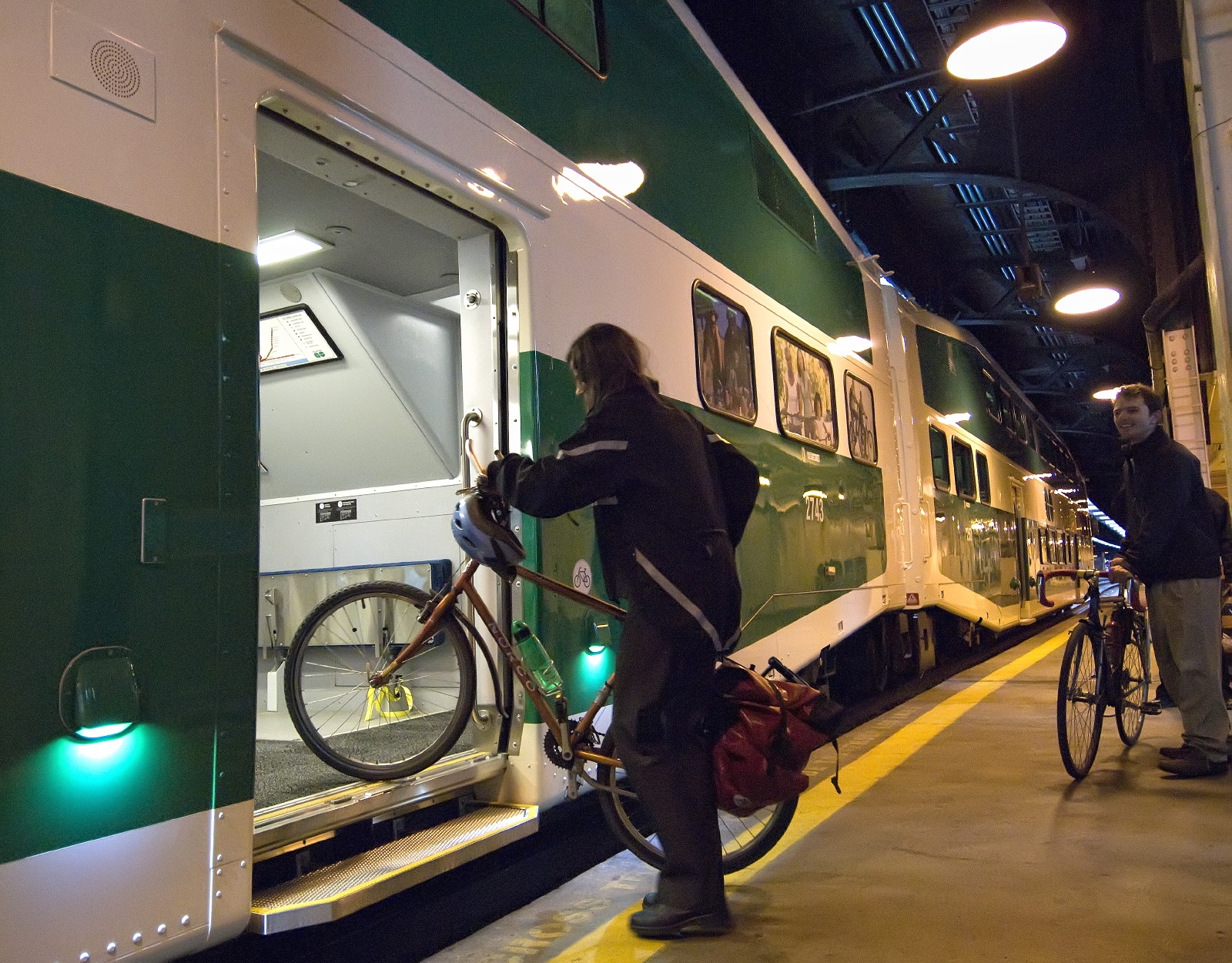
Go Transit riders, enroute to Niagara from the Greater Toronto Area, bring their bikes. And they may very well need them in Niagara with the sparcity of transit options we have here.
“GO listened to its passengers (riding passengers back and forth between Niagara and the Greater Toronto Area) and has converted a few passenger cars into bike coaches so (riders) can bring their bikes with them on their weekend getaways,” said Niagara Falls MPP Kim Craitor in a recent media release.
To which I would add that it is a damn good thing those bike coaches are there because, depending on where those riders disembark in Niagara, they may very well need a bike if they hope to explore very much of our region. We sure don’t have the bus links here to help them do it.
And believe it or not, it still remains to be seen whether we will have those bus links any time soon.
This May 12, regional councillors and the mayor’s for Niagara, Ontario’s 12 local municipalities gathered once again to discuss a plan on the table for launching an inter-municipal transit system in this region. And once again, a decision on moving forward with anything resembling the kind of transit services already available in other regions of Ontario and Western New York has been delayed for at least another month.
The stumbling block this time was a proposal Niagara’s regional government staff and area politicians received only hours before the meeting from Niagara Falls, Welland, St. Catharines Fort Erie and Port Colborne to let the transit representatives in those municipalities take the lead in implementing an any kind of an inter-municipal system. It is a proposal that is fundamentally different than the plan the politicians were about to vote on in the sense that it would not require the creation of a “Niagara Inter-municipal Transit Advisory Committee” that would place more control for the operation of the system in the hands of the regional government.
Now if this is beginning to make you wonder if there may be a little bit of a turf war going on in the background here between the region and local municipalities, over which level of municipal government is going to have jurisdiction over what, you may not be very far off. We’ve been here before – with specialized transit services for folks with physical challenges before the region was finally allowed to take over and launch a service that has been growing by leaps and bounds, and earlier on, with waste management before the region was finally allowed to take that over and provide a service for waste collection, disposal and recycling that none of Niagara’s local municipalities would have been able to offered to offer to their residents individually.
That’s why smart regions in Ontario and Western New York have long ago bit the bullet and turned the responsibility for transit services over to upper-tier county and regional governments, knowing full bloody well that they have the resources to operate them more efficiently and economically, in the best interests of residents across the entire country or region.
But moving forward progressively with services that are in the best interests of our whole region has too often, over the years, been stymied by parochialism of the worst kind – and I mean the kind that says something like; ‘hey, if this means it will take away from my fiefdom or possibly cost my job, I’ll do everything I can to drive it into a ditch.’
Well, at the risk of sounding a little unsympathetic to those kinds of parochial concerns, the first goal should be to build the best transit system possible for our residents and for visitors to our greater Niagara region for the 21st century – not to protect and preserve their fiefdoms and jobs. In fact, more jobs will likely be created and the economy of the region may likely grow if we have a transit system that begins to measure up to those that have already been built in regions around us.
So when Niagara’s area politicians meet again in June to discuss transit options, hopefully they will have their regional hats on and say no to any obvious, last minute attempt by local operators to place self-interest above building the best possible transit system for the region.
(Click on www.niagaraatlarge.com for Niagara At Large and more news and commentary on this matter and others of interest and concern to our greater binational Niagara region.)
 Niagara At Large
Again Doug Draper is a hero for his advocay of better tranist. At least with the last minute counter-proposal by the three municipalities- a terribly delayed proposal- it is hoped that the gaps in tranist will finally be filled in some fashion. If they were serious about this however, it should have been proposed much earlier, to avoid the delay that Draper rightly protests.
LikeLike
Oh please… As if Niagara taxpayers need another frakkin bureaucracy with overpaid unionized staff, moving a handful of people around the region.
If a real need for inter-municipal transit existed, some enterprising entrepreneur would have started a car sharing program.
LikeLike
Every service the region provides costs more than it is worth.
Turn this “government” into a service board, run as a business, and regional transit is a great idea – but not if it is funded for those who use it by tax dollars from those who don’t!
Almost 4 million taxpayer dollars annually and no service outside the big three cities for years and years…no thanks!
LikeLike
Fred: your logic seems to be that “your” tax money should only go to services that you directly use, instead of being pooled with general tax revenues and used for a range of social needs. Do you also think that people who use transit should get a refund on the portion of their taxes that go towards automobile infrastructure, road maintenance, the health costs of tailpipe emissions and smog, the costs of accident clean-up, enforcing traffic rules, building and expanding highways, etc? The OECD actually estimates that between 5 and 7 percent of national GDP in industrial nations now goes to paying for the costs of automobile travel not covered by drivers. Why does your concern only apply to public transit? Probaby because you, like many others, think that your own driving is not heavily subsidized by taxes we all pay, and enabled by externalities that we all have to cope with – like smog, accidents, loss of farmland and greenspace, etc. Not to mention that you get to freeload on the benefits arising from the (often inconvenient, time-consuming and expensive) use of transit by others: eg. cleaner air, less congestion, a freer path for your own vehicle, etc.
I don’t have cancer, diabetes, etc, so I’m assuming that by your logic my taxes should not go towards treatments received by others. I’m not in school now, either, so those little leeches known as “kids” better renounce their claim on my tax dollars. Forgive me if I think that this kind of thinking is really selfish and backward, and pretty much undermines any hope we might have for a more decent and compassionate world. We are not just individuals who happen to live side by side; we’re a society defined by mutual ties and responsibilities.
LikeLike
Dennis, while I’m sure Fred can fend for himself, I must comment.
If the 75% fuel taxes only went to road maintenance, we’d be driving on perfectly smooth roads that were geo-thermally heated and wouldn’t require salt. Fuel taxes go into the general slush fund to pay for all kinds of vote-purchasing plans not associated with transportation. Same goes for the 75% alcohol taxes… tobacco…
“We hear of crack cocaine babies born with the addiction of their mothers. But the social impact of that addiction is hardly a measurable phenomenon compared to the addiction of each generation of taxpaying workers. Each generation believes that it has a valid mortal claim on the output of the ones coming up. A legal claim will not knowingly be surrendered when it is perceived as a moral claim.” – Gary North
LikeLike
Hey Dennis;
You make a good argument – Im sold!!.
What say we all take all of our money, not just the tax part, and throw it into one big pot and let Big Daddy Region fulfill our every wish?
LikeLike
Doug, your headline says it all: “A Regional VISION.” Let’s hope the plan gives a drivers a real alternative. “Filling the gaps in some fashion” is not going to get cars off the road. Is it too much to ask our politicians to work towards that goal?
LikeLike
Fred, I would LOVE to NOT pay for automobile infrastructure, which would actually reduce my property tax bill on its own by about 30 – 40% … which would leave me more money to cover the cost of taxis, because I am one of many people in Niagara who are not able to drive. Save me your commiseration on this, because I might just start a campaign among non-drivers to withhold that portion of our taxes and start making drivers pay the true cost of their choices.
LikeLike
Doug, thank you again for your fervent advocacy on regional transit, something Niagara has not been willing to do, when all other regional municipalities of Ontario have, including those with even less population than our own. Maybe if General Motors decided to pull up stakes and move south of the border, we might have more to talk about too.
LikeLike
Dennis, you are so right! The subsidy that taxpayers pay for automobile infrastructure that is not covered out of pocket by drivers is approx four to five times the amount that pays for transit … the U.S. subsidizes transit much more than Canada does. Farebox revenue and advertising and other revenue sources comprise almost 70 – 80% of the better transit systems, with the lower amount being 60 – 65% in some communities.
LikeLike
Spare me from more political boondoggles ,,,We are asking for a complicated solution for a transit problem from the same bunch who can’t figure out how to get Go Trains across a canal without being on a collision course with sporadic boats.
LikeLike
Dave: I don’t know the precise details, but the specific ways in which fuel taxes are allocated is not really relevant if (as I’ve pointed out) the total costs imposed upon society by private driving are greater than all the costs that drivers pay directly (fuel taxes, registration, etc). If some portion of fuel taxes go to some other purpose, that is simply made up elsewhere from taxes that all of us pay, whether we drive or not. I always find it bizarre that many motorists act like they’re benefactors of society or philanthropists simply because they pay fuel taxes, which (as I’ve said) cover only PART of the aggregate cost of a transportation system predicated on the single-passenger car (not to mention other serious environmental and social costs that this system foists upon us).
Fred: your outburst about paying all of our money to “Big Daddy” is pretty juvenile, and doesn’t even try to address what I wrote. Obviously, you’re not against ALL forms of public expenditure. I assume that you don’t flush your toilet into a private sewer system, get your water from a private spring, drive on private highways, have your romaine lettuce flown into a private airport, etc. I assume you’re ok with pooling our resources and spending them on some things – eg. highways . Where we seem to differ is in your belief that those who don’t drive should pay for the highways you use, whereas you shouldn’t have to contribute to public transit that you don’t (but could, and probably should) use.
LikeLike
Well, Dennis, I’ve been a juvenile for over fifty years now, taking care of myself, my family, helping out my neighbours and so on…watching the world long enough to know that all the professorial theories in the world don’t account for much, as far as reality goes.
As for transit use – not applicable where I am, and won’t be until I have paid you all in the big three cities for four years and more – at a rate of taxation double the regional average, I might add – and then I doubt we will see anywhere near the service level that would make up for the massive draw you folks will be creating.
Transit is fine by me – there, I said it again – if operated privately, user pay, etc.
The municipal tax base was never meant to carry the load for social services – and by the sounds of your projected user base, that is what it is.
If the province supplements fare revenue via gas tax, or income tax subsidies, great, go for it! The overburdened property tax payer simply cannot, and does not want to, pay for it!
LikeLike
I can’t help but wade in with a point or two around all of the comments we are getting here on public transit.
It just to me that for decades, since the middle of the last century, governments across North America have spent billions of public dollars building and mainting roads and highways and bridges to accomodate trucks and cars, we have more or less accepted that as a given.
Yet when we begin to talk seriously about the need for more public transit – buses and trains, for example – there is always a critical mass of people out there who say that the infrastructure and possibly even the operating costs for that kind of transportation not be subsidized by public dollars, but should be paid for 100 per cent by the users and/or the private sector.
Why is it that so many feel it is okay for this region, for example, to continue spending tens-of-millions of our taxdollars every year on roads for cars, but there is so much blockback from them on spending a fraction of that on launching a public transit system?
I would be willing to bet that if the building and maitnentance of roads and highways was completely privatized, and the car and truck industry had to being incorporating an unsubsidized bill for all of that into the cost of doing business, trains and buses would begin to look a heck of alot more attractive as transportation alternatives.
Whether you agree or disagree with my commentary on this or other subjects, keep your comments coming. They all contribute discussions we need to have in this region to find answers to the many challenges we continue to face as we move forward.
LikeLike
As I sit comfortably aboard my green GO train heading into Toronto with friends for the day, we are shaking our heads in disbelief on this topic. Most folks who spend time in or around the GTA cannot for the life of us understand what’s taking Niagara so long to move into the 21st century with a transit system.
But here’s one theory – lack of leadership and vision, pure and simple. If laid out logically and factually, public transit wins out on so many levels.But when you have leaders who don’t truly buy in, or don’t fully understand the issue and the objections, they are unable to successfully sell the vision to their citizens. Consequently, stalling, thwarting and parochialism reigns.
Perhaps this issue needs a dedicated champion – a “go-to” person to explain and clarify all the misinformation out there. (ie. David Miller and Transit City in Toronto). Maybe there is someone and I’m just not aware of them. I confess I don’t follow this issue intimately because it’s such a no-brainer for me and virtually everyone I know.
Gotta go, this is our stop!
LikeLike
Fred: I did not mean to suggest that YOU were innately juvenile in all areas of your life – I was just referring to your “outburst” suggesting that I want all of our money to be given over to “Big Daddy” so he can do with it as he sees fit. Anyway, I don’t want to personalize these debates or resort to name calling – my apologies if it came off that way.
Doug: you pound home the very points that I was trying to make really well. Thanks for all your work in educating the public about transit issues and providing a forum in which to debate them.
LikeLike
Dennis;
Final analysis, we agree transit is a worthwhile objective – we disagree on how to fund it!
The “social services” (health, social and family) provided by the region are funded, more or less, directly by the province – and are not raised through property taxation.
This is as it should be, as property tax is not “progressive” inasmuch as property values bear no relation to income. ( check the region’s policy on taxpayer affordability) Sadly, since the days of Mike Harris, an increasing burden of service has been placed on them municipal tax rolls – and this has proven to be an unsustainable load, especially on many seniors.
The reversal of much “downloading” by the current government at queen’s park has been helpful, although many feel the region simply uses these returned monies to disguise their real budget increases and profligate spending.
Find a way to flow provincial monies – raised through income tax, gas tax etc. – to cover costs in excess of revenue from ridership and you will have no argument from me.
In fact, via the gas tax, you will even have motorists footing the bill – that should cheer you all up!
LikeLike
The last time I checked, a large chunk of my property taxes fund roads, parking garages, two-way traffic, etc. and I don’t benefit from any of it … and drivers are the first to complain when a single penny of their taxes go to transit. Like, who is subsidizing who?
LikeLike