
By Doug Draper
One of the most significant steps Ontario’s Liberal government has taken to protect our natural heritage over its more than six years in power – and possibly the only significant one – was the creation of the “Greenbelt” in the greater Golden Horseshoe of this province five years ago this March.
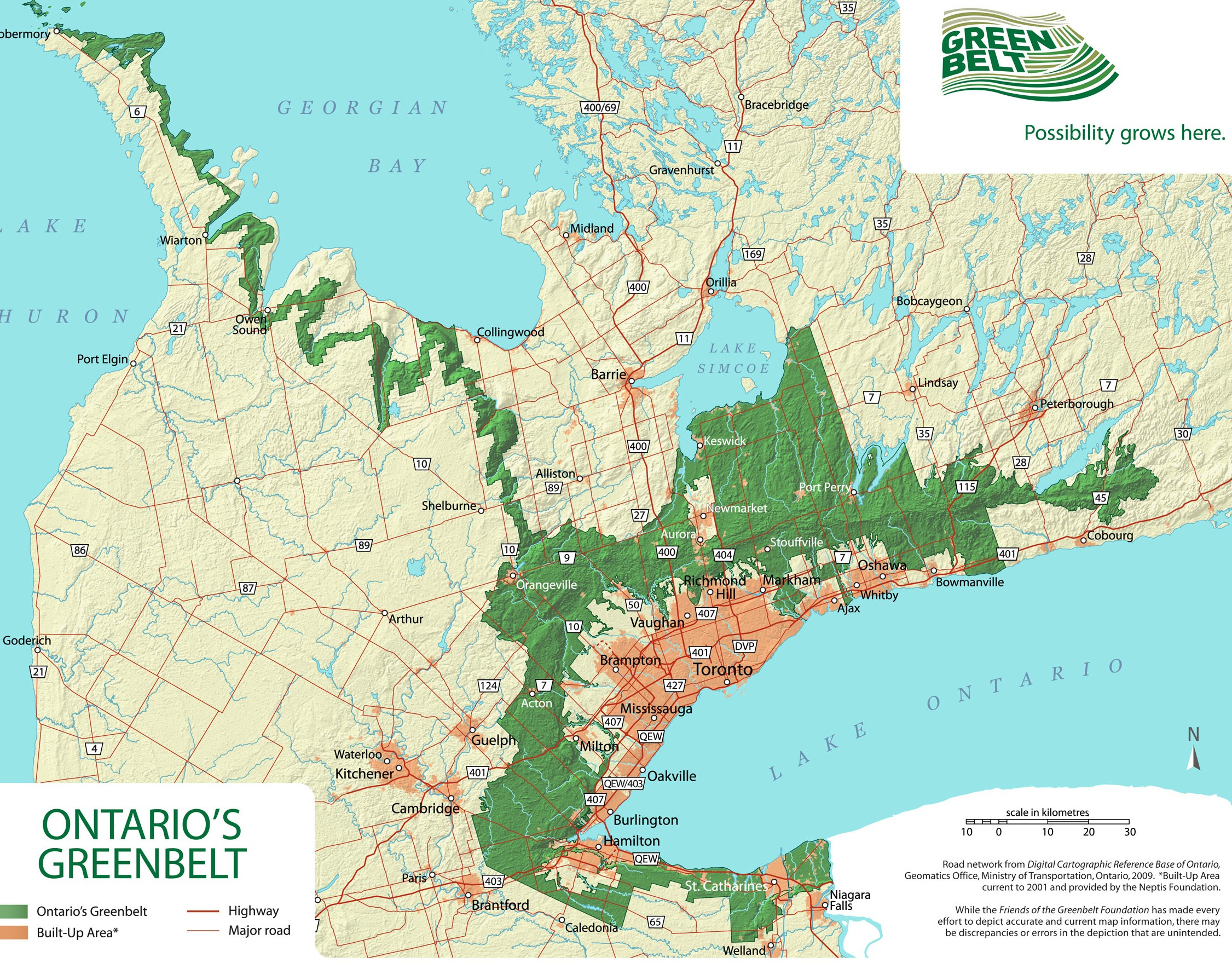
The areas in green highlight Ontario's Greenbelt, where agricultural and other lands are intended to be off limits to urban sprawl.
Ontario’s Greenbelt – protecting some 1.8-million acres of agricultural and environmental sensitive lands stretching east of the Toronto area above Lake Ontario and around the lake to the shores of the Niagara River in our greater Niagara region – received a prestigious award from the Canadian Institute of Planners two years ago as a model for protecting and preserving what is left of some of our most precious rural lands from continued, low-density urban sprawl.
Yet it has also been an ongoing bone of contention and it has even been vilified by some as an assault on the rights of farmers and others within its boundaries to do what they want to with their land, and as an impediment to development for municipalities that find themselves, to use one of the words of some municipal leaders, “locked” in it.
This March 31, Niagara’s regional government is hosting what it is calling a “Greenbelt-After-Five Years Summit at the Four Points Sheraton in Thorold, Ontario, and a day-long summit that involves a registration fee of $100 and features a host of speakers from this region and beyond. This site will include more details on the summit agenda and how and where to register later.
But before that, just a few more words about the significance of a Greenbelt plan that is possibly the only thing that may have stopped the eventual paving over of most, if not all that is left of some of the best growing lands for prime grapes, tender fruits and other crops in all of Canada.
The Greenbelt’s very existence as a preserve for our rural lands owes an awful lot to decades of advocacy by individuals like the late Mel Swart, a former NDP provincial representative for Niagara, and groups like the Niagara-based Preservation of Agricultural Lands Society. It also owes a lot to St. Catharines Liberal MPP Jim Bradley and the NDP’s Welland MPP, Peter Kormos who, in their case, tabled a private members’ resolution in 2002 for creating a preserve for these lands.
“I think it would be a national tragedy to lose this farmland,” stated then opposition MPP Bradley at the time the resolution was tabled. “I think we have a chance to preserve it for future generations.”
“We have a historic and national interest in preserving this agricultural land,” added Kormos. “New Democrats call, once again, for the establishment of a land easement system that will preserve this agricultural land, not only in the short term but, quite frankly, forever. …. Anything less is mere tinkering. Anything less is less than a sincere commitment to the preservation of this unique, scarce and valuable asset of Ontario and, indeed, all Canadians.”
Others are not quite as embracing in their support of a preserve that essentially means banning any further urban-like development within its boundaries.
Municipal leaders like Lincoln Mayor Bill Hodgson, whose community falls within the Greenbelt, has expressed continual concerns about how a municipality can survive inside what is essentially a no-growth zone. Many farmers feel the province should be doing more to help them make their farms economically sustainable if it is essentially saying to them that all they can use lands inside the greenbelt for is farming.
Back in 2002, Bradley said in the provincial legislature “if you don’t preserve the farmers, if you don’t assist the farmers in ensuring that they get a reasonable return, whether it’s through programs from the government or the prices that are paid for the products, then you won’t save the land. … I want to save the farmers as well as the land.”
Five years later, farmers inside the Greenbelt are still questioning whether the province is doing enough to save them. It is a question that will quite likely be raised more than once at the March 31 summit.
For more information on the summit, keep scrolling down below and be sure to click on www.niagaraatlarge.com for Niagara At Large for more news and commentary on this and other matters of interest and concern to our greater binominal Niagara region.
Greenbelt Summit
WEDNESDAY, MARCH 31, 2010
FOUR POINTS BY SHERATON
3530 SCHMON PARKWAY, THOROLD
_______________________________________________
Registration Fee
$100 – includes continental breakfast & lunch
Payment
Cheque (payable to Niagara Region)
VISA / Mastercard (provide card number & expiration date)
Invoices Provided on Request
Registration
E-mail: florrie.neufeld@niagararegion.ca
Phone: 905-685-4225, Ext. 3453
Fax: 905-641-5208
Include name, job title & contact information when submitting registration
Registration Deadline
Friday, March 26, 2010
Dietary / Mobility Requirements
Please advise by March 26, 2010 if you have any dietary / mobility restrictions
Parking
Free parking available on location
8:30 a.m. Registration & Continental Breakfast
9:00 a.m. Welcome – Regional Chair Peter Partington
Outline of the Day – Councilor Bill Smeaton
Margaret Walton, Partner, Planscape
Policy Changes, Lessons Learned & Insights
Dr. Jim Brandle, Chief Executive Officer
Vineland Research and Innovation Centre
Patrick Robson, Commissioner, Integrated Community Planning
Regional Value-Added on Farm Policies
Refreshment Break
10:30 a.m. Panel Discussion – Facilitated by Debbie Zimmerman
Successes & Challenges of the Greenbelt After Five Years
* Burkhard Mausberg, President, Friends of the Greenbelt Foundation
* Len Troup, Chair, Ontario Fruit and Vegetable Growers Association
* Peter Lambrick, Chair, GTA Agricultural Action Committee
* Howard Staff, Prominent Niagara Grape Grower
* Bill Hodgson, Regional Councillor and Mayor, Town of Lincoln
Panelist Questions from Audience
12:00 p.m. Lunch & Networking
12:50 p.m. Group Work: Taxes & Agriculture
Introduction by Councillor Barbara Henderson
Final Thoughts & Next Steps
2:15 p.m. Networking & Safe Trip Home
 Niagara At Large
Does anyone realize that the huge development proposed by Project Niagara (The Toronto Symphony Orchestra and the National Arts Centre Orchestra) is proposed for Parks Canada land, within the Ontario Greenbelt, on busy Lakeshore Road, next to two established residential communities in the little town of Niagara on the Lake, ……..an outdoor amphitheatre capable of seating up to 10,000 people, with land paved over for 2,000 vehicles, and three outdoor concerts per week for seventeen weeks, during the busy tourist season. This is only the start of it, as anyone can see if they read the feasibility study of Project Niagara. What kind of conservation is this?
There must be a better use for this property, which is proposed to be funded one third from the federal government, one third from the provincial government and and one third from private funding , one which everyone can have access to and enjoy, and one that doesn’t just provide a summer works program for the TSO and the NCO. and bring more vehicular traffic and pollution into the area, one that will be financially sustainable instead of depending on government largesse for present and future funding. The voters of Niagara Region should be concerned about this proposal for a piece of Parks Canada land, within the Ontario Greenbelt. I believe that the mandate of Parks Canada is “to preserve and protect?
What kind of a legacy do we want to leave for our children on this precious piece of property?
I would hope that someone at this conference will address this issue.
LikeLike