
By Doug Draper
Why would anyone want to sit down on the cold pavement, locked up in a steel cage in downtown St. Catharines in the middle of February?
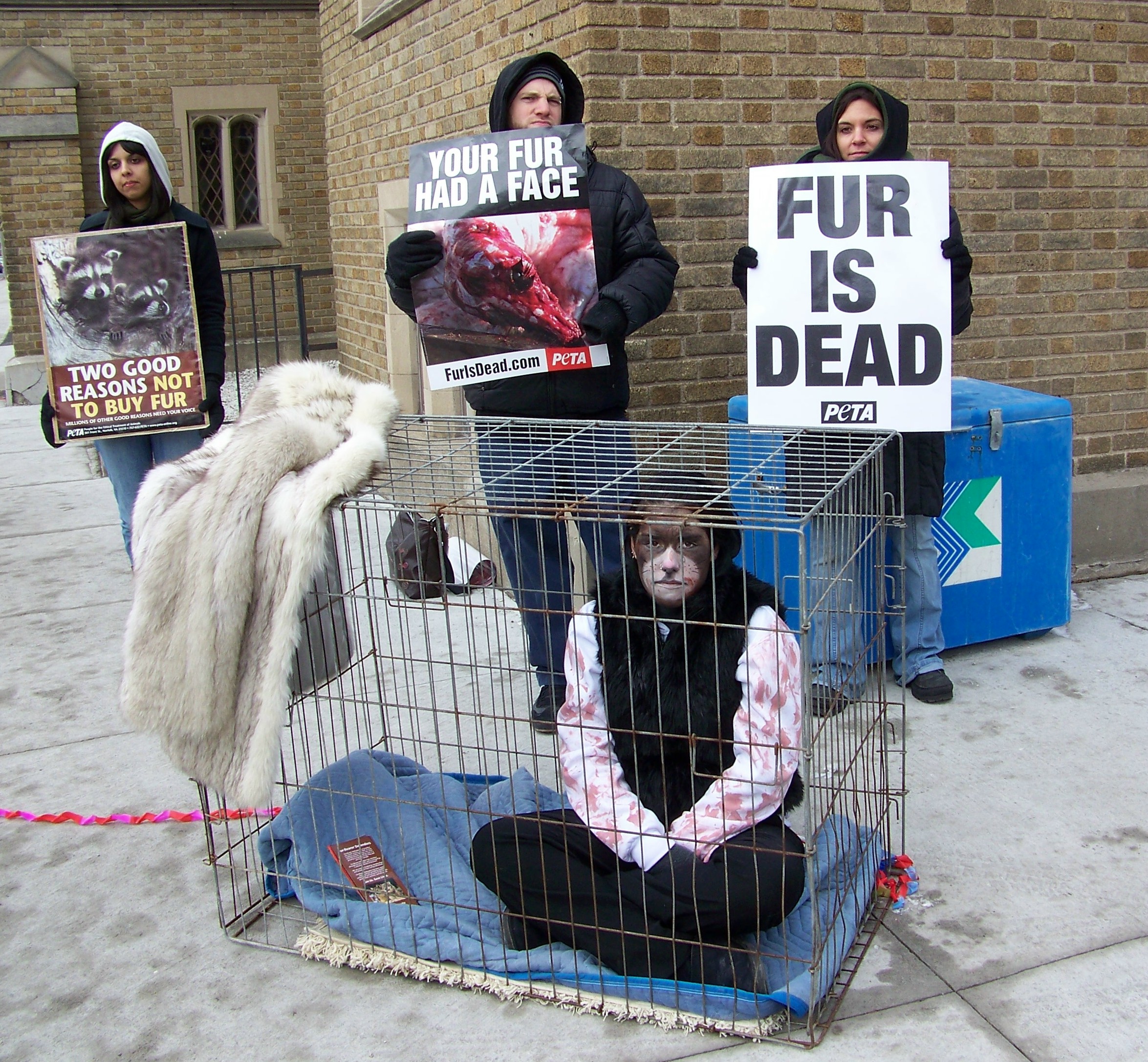
Tayler Staneff is caged while from left, behind her is Sarat Colling, Chris Shaperon and Kimberly Costello. On the cage is a fur coat that is the product of 15 foxes. Photo by Doug Draper
“We’re just trying to put out a message,” said Talyer Staneff as she talked to me through the mesh of that cage with animal make-up she had on.
“A lot of people who buy and wear fur coats probably don’t know how much suffering animals have to go through for them to get them.”
As I talked to her, an old fur coat hung over one corner of the cage, made from the pelts of 15 foxes. Staneff was one of more than 20 animal rights activists in Niagara who participated this February 13th in Canada’s 21st national anti-fur day, not that any federal and provincial government we’ve had in power over that time – Conservative, Liberal or NDP – has done much to recognized it.
What Kimberly Costello, a member of Niagara Action For Animals (NAFA) and one of the organizers of the demonstration had to say should leave Canadians wondering how our country could continue have such backward laws on protecting animals compared to the United States and European Union that at least bans the import of garments made from dog and cat fur, and has placed stronger restrictions on the sale of fur garments and the killing of animals for fur.
“We are just out here to educate people,” said Costello, adding that the location, which happened to be in front of a store called Henry’s Furs in St. Catharines, which just happened to be closed during the protest, “is just symbolic.”
Unfortunately, she said, there are still plenty of outlets out there for fur garments and there are also too many people who don’t know or understand that the animals needed to create those garments were caught in leg traps and often clubbed or electrocuted so as not to damage the fur.
Unlike the U.S. and European Union, good old Canada – as much as we Canadians may like to think we are world leaders when it comes to humane laws – has virtually no laws when it comes to the trapping or clubbing of animals for their fur, and has no laws against the importation of dog and cat furs, mostly from China. 
Get this. Our current Conservative government does not have the guts that the United States or most European countries do when it comes to saying “no” to dog and cat furs from China because it is hoping China will be a market for the fur clubbed from baby seals on the ice floes off Atlantic Canada.
That’s because our federal government, first and foremost, doesn’t have the moral spine to say “no” to the bloody seal hunt participated in by desperate people in Atlantic Canada it will not provide any other means of support. And second, it is afraid China will say “no” to our seal fur if we say “no” to its dog and cat fur. What a helluva trade deal that is.
Why don’t we just start trading in opium and leave the animals alone. Rob Nicholson, the Harper Conservative government’s justice minister and Niagara Falls’ MP, might want to take some of this into consideration while he is busy fighting his war on crime.
If you want to know more about the inhumane use of animals in the fur trade, and about the trade in dog and cat fur visit http://www.dogcatfur.com and www.BanLegholdTraps.com.
You can also visit Niagara Action For Animals (NAFA) at http://niagaraactionforanimals.org/.
(Now click on www.niagaraatlarge.com for more news and commentary brought to you by Niagara At Large about our greater Niagara region.)
 Niagara At Large
A good turnout! Any time we can educate the public is worthwhile. I was only there for 1 hour but others braved it for 2. I salute you.
LikeLike
In this day and age there is no excuse to buy or wear fur. When you buy fur the animals pay. You can expect that an industry built on profit has little room for compassion. They will cut corners and do whatever they can to resist positive change if it would cost them more money.
A business is a business. These are not animals to them. They are ‘production units’ and ‘pelts’. The industry has spent millions trying to get people to think that what they do is humane. Perhaps if people were to look into a trapped or caged animals eyes they would realise. But the fur industry does an excellent job at covering its abuse up. And even when they are caught, it’s legal anyways.
It is so easy to make a difference: Just don’t buy fur and be an example of someone who refuses to support this abuse.
LikeLike
While I respect anyone who takes time to responsibly demonstrate for their beliefs
(and these people have done so admirably), isn’t this story a bit hypocritical?
Has anyone ever taken time to evaluate how “humanely” we slaughter domestic animals for food, leather and pharmaceuticals? We teach them to trust humans … and then lead them to the slaughterhouse! Personally, that’s far worse than harvesting wild animals, who understand the Law of the Jungle, “Eat and be eaten”.
How about what we do to domesticate animals – neutering them, so that they can live with us? Breeding them to have bodies that serve us (eg. race horses, sheep, cattle, dogs, etc). Raising them in crowded, industrial conditions?
I’m vegetarian (eat fish) but do Not tell others what/how to eat or clothe themselves.
A quicker-killing-trap Should replace leg-holds, but abolishing the fur industry is hypocritical unless we also abolish the current use of animals everywhere in human societies worldwide.
LikeLike
Lorne,
The protest that we do this past weekend was about fur because it was Canada’s 21st National Anti-Fur Day. I am not sure if you read the article… but it does state this.
You cannot protest every form of animal exploitation at one time. No one would ever get anything from it.
You are basically saying that because we protested only fur, we do not care about other forms of exploitation. You could not be more wrong. About 90% of the protesters in this demonstration were vegans. Thus, we do not agree with any form of animal exploitiation. Meat, leather, dairy, eggs, breeding etc etc etc.
We protest slaughterhouses, fur farms, circuses, rodeos, petstores and the list goes on.
We are not hypocritics, because we do not agree with any form of animal use. We do work to abolish all animal exploitation. We work together, with others all over the world, to achieve this.
Thank you for your comment, but you are misinformed on our beliefs and what we do.
(And there are no kill traps that guarantee that the animal actually dies… they suffer horrible pain, and wait to die trapped, alone and scared)
LikeLike
Congratulations to Tayler Staneff and the animal rights activists who took part in this protest. Your work and your eloquence in defending your view are admirable. Please continue the fight. It is long overdue.
LikeLike