
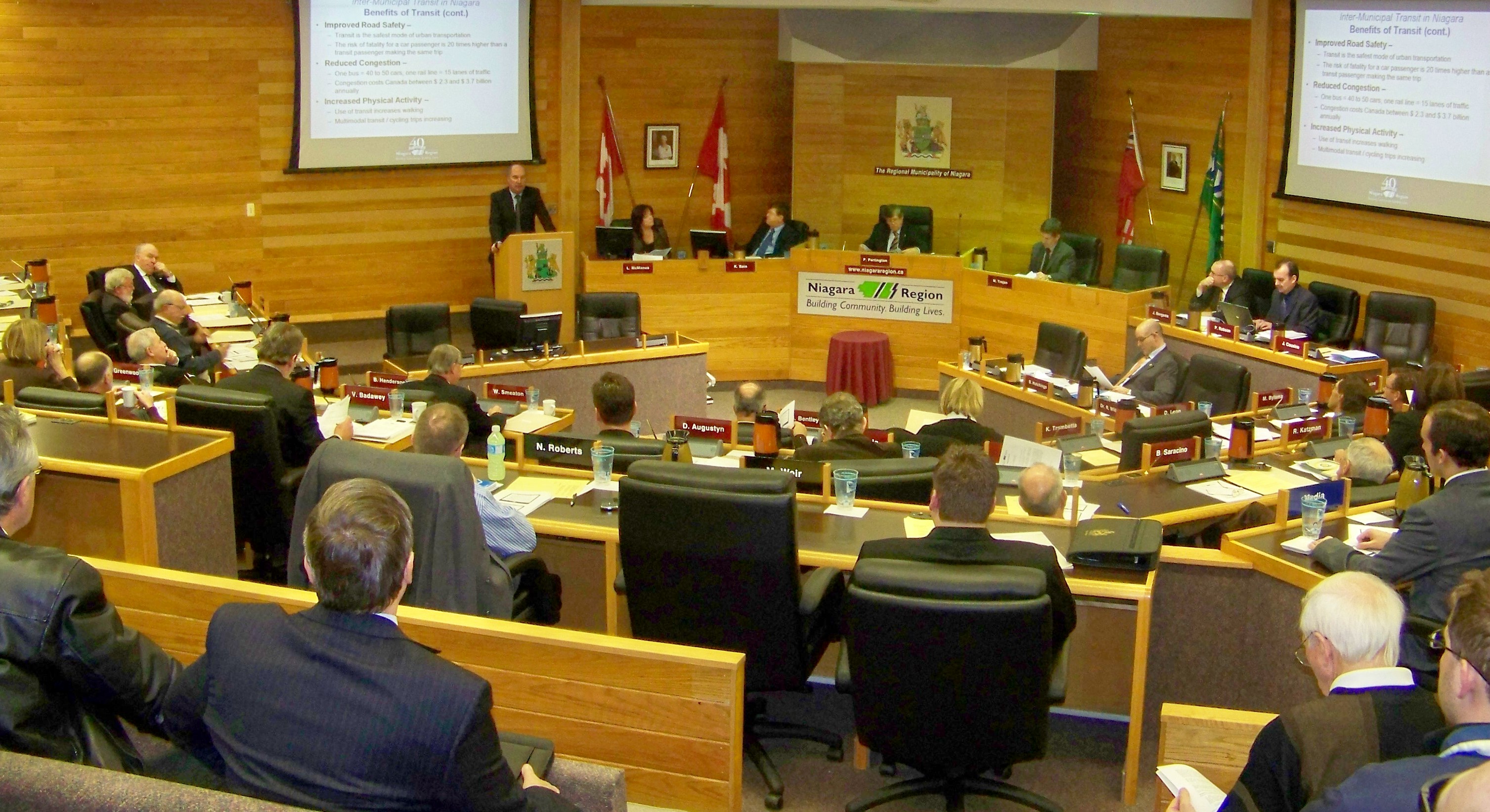
Until the wee small hours, the region's meeting on our transit future drags on
By Doug Draper
“Patience, patience,” Port Colborne Mayor Vance Badeway implored others on the regional council and dozens of us listening in the gallery as the marathon meeting over whether or not the region should play a role in cobbling together an inter-municipal transit system for Niagara dragged on and on.
Patience was not in the cards for some.
Judy Casselman, a veteran regional councillor for St. Catharines, looked frustrated as she stressed more than once that any further delay in moving forward with an inter-municipal transit system would show a “void of leadership” to far too many in the public, including students, seniors and lower-income people who’ve been waiting for years for a good, reliable transit system to get them to school, to job, to visit with a loved one in a hospital, or just get out to buy a few groceries.
St. Catharines Mayor Brian McMullan said he walked into the special meeting the region was holding on transit services this Jan. 28 expecting to participate in a “historic” session in which, after 40 years of the region running hot and cold on the idea of building a transit system for all Niagara’s residents, it was finally going to do it. Anything less that driving forward with a launch of an inter-municipal transit system amounts to “failure,” McMullan added, “and I don’t accept that.”
But Badeway, who has been one of the more vocal supporters of a region-wide transit system, warned that driving forward with a plan for a regional system without doing a few more months of study work that would give the councils of local municipalities across Niagara more details on costs and how the system would work could risk losing the support of those municipalities. And if the region doesn’t win the support of a majority of those local municipalities – at least enough to win a “triple-majority” of support required under Niagara’s municipal bylaws – the region’s decades-old dream of launching an inter-municipal transit system is going to “crash and burn,” he said.
“This is all about success. It is about achieving our objectives (for region-wide transit) and to do that, we have to be respectful” of any demands the local municipalities place on the region for more information on how much such a system would cost and how it would serve their communities, Badeway said. And that means that “the end justifies the means,” even if that means spending a few more months answering the questions the councils of local municipalities need before they climb on board the bus.
At the end of a meeting that ran on for close to five hours, a majority of the region’s councillors agreed to spend a few extra months – until this spring – preparing more detailed information for local councils. They also approved a “vision” for an inter-municipal transit system that would be “fair and equitable” for all Niagara residents and would “form an important and integral component of Niagara’s transportation system.”
But whether that vision is fulfilled remains to be seen and on that score, there is one good piece of news.
Thanks to the insistence of Grimsby regional councillor and former regional chair Debbie Zimmerman, who also chair’s the region’s transportation steering committee , deadline dates were injected into the motion the council finally agreed on at this meeting that direct local councils to vote for or against the region playing a role in building an inter-municipal transit system by this coming July 1. That is about three and a half months before you, the people go to the polls to decide who you want to serve on your municipal councils for the next four years.
In this case, the choice is relatively simple. Either Niagara grows up and joins the rest of southern Ontario and most of the rest of North America in moving toward public transit as a more economically and environmentally friendly way of moving ourselves around or we stay stuck back in the 1950s.
By the way, compared to the many thousands of dollars we personally spend each on cars, insurance for them, maintaining and improving roads for them etc, the estimated cost to the average taxpayer of expanding transit in Niagara would amount to an additional $11 to $15 per year. In other words, what on earth is the problem?
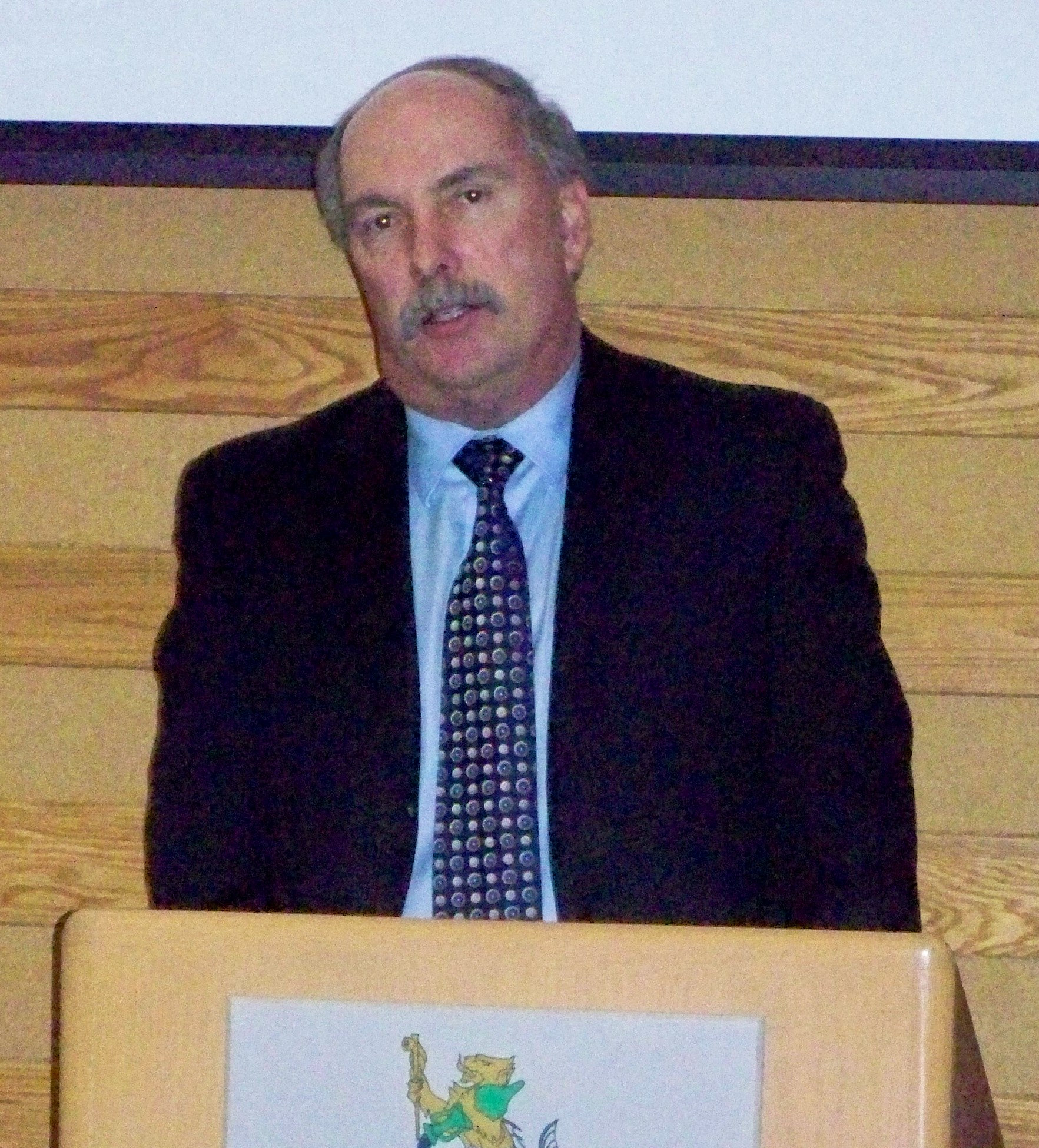
Niagara region transportation director Joe Cousins makes case for inter-municipal transit
Joe Cousins, the director of the Niagara regional government’s transportation services division, stressed some of the following key benefits of a better public transit system for this region.
A more region-wide transit system, he said, “will help enable Niagara’s low-income population access employment and other needs.” It will “facilitate travel for growing student and senior populations who have limited transportation options,” and will make thee region more attractive for potential developers and employers looking to establish residences and businesses in a region that offers transit services.
That is not to mention how much more attractive Niagara would be to tourists who come here via Go Transit, plane and other means, and would have one heck of an easier time getting around and exploring what we have to offer if we had better transit services here.
But never mind that. There are some politicians in this region who seem just as happy chewing on a straw and pulling us ever backwards as they cling to the status quo.
Let us assure you that in the months ahead, Niagara At Large will be building a list of 19th century deadbeats on our municipal councils who vote against a 21st transit system for our region. You can help by turning in names of your own to this site. If you can provide enough factual information to write them off as a deadbeat when it comes to progressive transit opportunities for this region, we will be sure to post their names before the next municipal elections. Yes we will!
(If you are a subscriber to Niagara At Large and received this article in a separate post, please support Niagara At Large by taking a few moments to visit the site at www.niagaraatlarge.com. Your visit to the site counts you down as another reader for the day and builds our efforts to draw the financial support we will need to keep an independent news venue like this alive. Thank You.)
 Niagara At Large
This delay essentially shows why the province should step in and upload transit to the Regional government, which would force inter-city transit to become a reality. It should be noted that Niagara is the only upper tier municipal government where transit services exist that this is not the case. Waterloo Region has an ecellent transit system and it was uploaded here as an alternative to a city single amalgamation. They are doing what St. Catharines’ former transit commissoner Eric Gillespie was unable to achieve and under his leadership. ( he was hired by Waterloo to run their integrated system)
LikeLike
How hard can it be to hire a few buses to provide a few express trips a day from one end of the Region to another, linking local transit hubs. It’s a prime example of how Regional government doesn’t work as advertised.
LikeLike
Yes, give me the names of each of the dinosaurs that want to keep us in the 1950’s, and then give me their billing address, so I can send them my taxi bills for trying to keep up a business through which I am lucky if I earn half as much as my peers that can readily hop in their cars and provide services wherever they want with minimal extra costs. And no, I am not a low wage worker. I am well-educated and no, I am not interested in a call centre job, which is all that is available besides the McJobs around here for non-drivers. I did not spend 10 1/2 years beyond high school to educate myself so I can work minimum or close to minimum wage somewhere. Better yet, make all the drivers pay their full freight and then let’s see how many of them choose to stay on the road afterwards.
LikeLike
Yes, John Bacher, it is time to bring the province into this fight, because any attempt at a triple majority is bound to fail because of smaller communities like Wainfleet, Lincoln and West Lincoln howling over so-called costs, while the multi-millions subsidizing drivers go unnoticed under their noses … I don’t mind paying taxes for the roads, if I knew I can get around with relative ease and make a living as well as have an equal shot at most of the jobs I am otherwise qualified to do.
LikeLike