“Tin soldiers and Nixon coming,
We’re finally on our own.
This summer I hear the drumming,
Four dead in Ohio.”
– from the song ‘Ohio’, written by Neil Young shortly after four students were killed and nine others were wounded in a shower of bullets fired by Ohio National Guardsmen on the campus of Kent State University on May 4, 1970.
By Doug Draper
Several years after writing ‘Ohio’ – a song he recorded with Crosby, Stills and Nash, only to see it banned on several radio stations in that state and others in the summer of 1970 – Neil Young commented in the liner notes of an anthology of his music; “It is still hard to believe I had to write this song. It’s ironic that I capitalized on the death of these American students. Probably the biggest lesson ever learned at an American place of learning.”
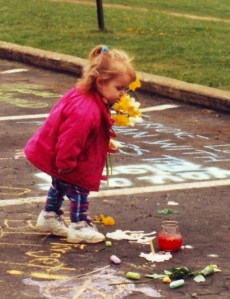
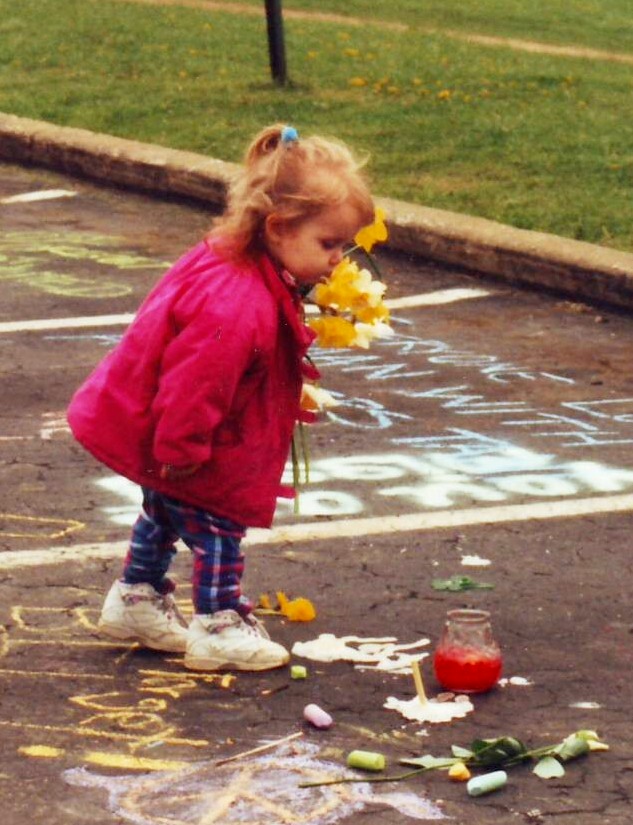
An unknown child prepares to lay flowers on a parking lot where one of four students was shot dead by U.S. National Guard troops at Kent State University in Ohio 40 years ago this May 4. Photo by Doug Draper.
Could very well be until the last couple of decades when we’ve had the Columbine High School shootings in Colorado, the Universite de Montreal’s Ecole Polytechnique shootings in Quebec, and a rash of others on both sides of the Canada/U.S. border. But the majority of those bloodbaths were carried out by random nuts – not by an arm of our government!
That is one of the reasons Young was far from the only one who expressed disbelief at what happened on that campus in the heartland of Ohio 40 years ago this May 4. As someone looking forward to finishing high school and going on to university myself that year, I recall most people my age and older, regardless of how they felt about the War in Vietnam and the student protests raging against that war at the time, expressing shock when they heard the news of this terrible moment.
After all, two of the four students who were killed at Kent State that day – Sandra Lee Scheuer, 20, and William Schroeder, 19 – were not even participating in the demonstrations that were taking place on campuses all over the country that spring due to U.S. Nixon administration’s the escalation of the Vietnam conflict into neighbouring Cambodia. Scheuer and Schroeder were on their way to classes and were shot dead with textbooks in their hands.
The other two students were participating in the protests which had turned increasingly ugly two days earlier when the campus’s old ROTC (Reserve Officers’ Training Corp.) building was burned down by a few in the crowd who were apparently never identified.
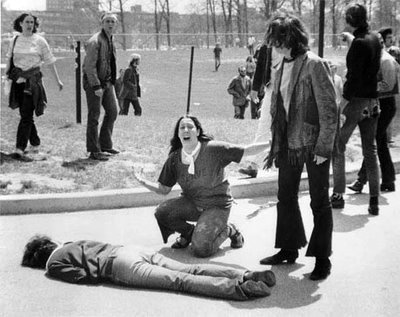
Before he was shot, Jeffrey Miller, 20, told a friend he was participating in the demonstrations because “I want to be there to be counted.” Miller, a sophomore psychology major, turned out to be the one whose bleeding body was captured in the iconic photo we are posting here of a young girl – 14-year-old Mary Ann Vecchio – kneeling in a parking lot over him with outstretched arms.
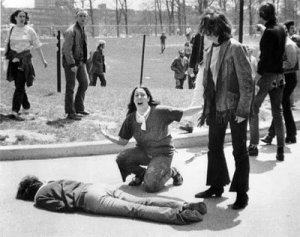
Kent State student Jeffrey Miller dies on the spot where, years later, that little girl placed flowers.
Allison Krause, 19, is remembered as the student who a day or two before she was gunned down, placed a flower of a rifle of one of the National Guard troops brought in to quell the protests and said; “flowers are better than bullets.”
It was a nice thought, but someone in authority allowed the troops to load up their rifles with bullets that were steel-jacked rather than the rubber kind sometimes used for crowd control, and to let go with a fusillade of them across an all-American university campus.
At a memorial I attended at Kent State in 1995, for the 25th anniversary of the shootings, Barbara Agte, one of Allison Krause’s teacher’s, called the act “a startling confrontation between innocence and organized, state-sanctioned force.”
Indeed, the Kent State shootings were just one more in a series of shocker toward the end a decade of the 1960s that was earlier spirited by dreams of peace and love (in 1967, The Beatles helped usher in the ‘summer of love’ with the anthem; “All You Need Is Love”) and flower power, but had grown increasingly divisive as the bloody and unpopular war in southeast Asia dragged on. The rhetoric was also growing increasingly toxic on all sides. Anti-war demonstrators had taken to calling Nixon and others in his administration “pigs” and “fascists” and the president was openly referring to them as “bums.” Continue reading →
Share this: Niagara At Large at wwwlniagaraatlarge.com




























 Niagara At Large