
Niagara’s Regional Government On Verge Of Coming Under Almost Complete Control Of Premier Doug Ford And His Local Supporters
“Change is long overdue in Niagara and the status quo is not an option. …. We need this bold move from the Ontario government.” – Jim Diodati, Mayor, City of Niagara Falls
“I would like to personally thank the Ford government for making governance changes in Niagara. I believe this will lead to a more effective and efficient system that will benefit communities, residents and businesses within the Niagara Region.” – Frank Campion,
Mayor, City of Welland
A Commentary by Doug Draper followed by a News Release from Ontario’s Ford Government
Posted April 2nd, 2026 on Niagara At Large
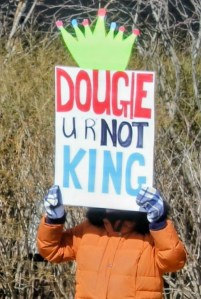
Niagara resident holds up this sign at a large rally in St. Catharines late this March. Photo by Emily Spanton
The Ford government introduced legislation this April 2nd that will, when it is passed (and given Ford’s majority at Queen’s Park, it will pass), put a complete end to our elected Regional Councillors choosing our own Regional Chair and will reduced the number of Regional Council seats from 32 to Niagara’s 12 local mayors and a Chair that will be appointed by the Ontario premier.
Further to that, the Regional Chair will be granted “super chair powers,” similar to super mayor powers that have already been bestowed on many mayors across the province, giving them the the clout to override or veto many of the decisions made by however many Regional Councillors are left to vote on anything.
And the votes of the 12 remaining mayors sitting on the Regional Council will be weighted to give those representing municipalities with the largest populations – in Niagara’s case, St. Catharines, Niagara Falls and Welland- the most say.
That pretty well means that the mayors for municipalities like Pelham, Thorold, Lincoln, Niagara-on-the-Lake, Port Colborne, Grimsby, Fort Erie, West Lincoln and Wainfleet will have little or no real say on Regional Council at all.
For all those right wingers out there who have been yelling for years that Niagara has too many municipal politicians, all of this may be just dandy. But for those of us value democracy at the local level, it is a disaster.
Indeed, what Ford is planning to do is so bad that one might wonder what is the use of having a Regional Council at all.
Worse yet, who is Ford going to pick to follow up his appointment of Bob Gale – the man with the Hitler book- to serve as Niagara’s next Regional Chair. Could it be a former Niagara Conservative MPP and Niagara Regional Councillor like Bart Maves? Or how about bringing back former Niagara Regional Chair Al Caslin?
God help us! Doug Draper
Now here is the news release from Ontario’s Doug Ford government with a heading that shamefully claims – just like Trump would – that its legislation with “strengthen Regional Government –
Ontario Introducing Legislation to Strengthen Regional Governance
Proposed changes would help local leaders speed up decision-making, reduce costs and expedite housing and infrastructure
April 02, 2026

Ontario Premier Doug Ford. He’s smiling at us and hoping that we buy more of his Trump-like bunk.
TORONTO — Today, the Ontario government introduced the Better Regional Governance Act, 2026 that would, if passed, make a number of changes to the way regional governments function in some of Ontario’s fastest growing regions.
These changes would support lower costs for municipal taxpayers and better alignment between regional decision-making and shared provincial-regional priorities. The proposed changes include giving the Minister of Municipal Affairs and Housing the power to appoint upper-tier council chairs in eight fast-growing regions and granting these council chairs “strong chair” powers to help them deliver on government priorities, such as housing and infrastructure.
The proposed legislation would also reduce the cost of government and support efficient decision-making in Niagara Region and Simcoe County by reducing the size of Simcoe County Council and Niagara Regional Council.
“We will always support our municipal partners, both lower- and upper-tier, in delivering locally led solutions that offer better value for taxpayers and speed up decision-making,” said Rob Flack, Minister of Municipal Affairs and Housing.
“These changes provide the necessary tools for local leadership to advance our shared priorities and better serve our communities, including by expediting housing and infrastructure development.”
The proposed Better Regional Governance Act, 2026 and related regulatory changes would enable the following:
Allow the Minister to appoint regional chairs in Durham, Halton, Muskoka, Niagara, Peel, Waterloo and York, as well as the warden of Simcoe County. Under previous legislation, the Minister had the authority to appoint chairs in Niagara, Peel and York regions for the 2022-2026 council term only.
Regional chairs in the eight municipalities listed above would receive “strong chair” powers which mirror “strong mayor” powers, providing more efficient, streamlined local decision-making, enabling them to deliver faster results for residents and support efforts to advance shared provincial-municipal priorities.
The number of municipal elected officials in Simcoe (population 351,927) and Niagara (population 477,941) is significantly higher than many other comparable municipalities in the province. For instance, Niagara region has 126 local elected officials across its upper and lower-tier councils.
By comparison, Toronto City Council has 26 members for a population of over three million and Queen’s Park has 124 MPPs representing over 16 million people across the province. This increases the cost of government for local taxpayers and creates dysfunction at council. To address these concerns, the government is proposing the following changes:
In response to a request from the county warden, Simcoe County Council would be reduced from 32 members to 17. The new council would be made up of mayors of the 16 lower-tier municipalities, plus the warden.
Niagara Regional Council would be reduced from 32 members to 13 members. The new council would include the mayors of each of Niagara’s 12 lower-tier municipalities plus the regional chair.
To facilitate the transition to the new council structure and ensure appropriate and effective representation, the government would also work with local municipal leadership to develop a weighted voting framework, which is already in force in Simcoe County and would be applied in Niagara Region.
All regions must review their council composition following the 2026 municipal election. Niagara Region would be exempt in 2026 and would return to regular reviews after the 2034 municipal election. The government will continue working with municipalities to identify ways to strengthen local governance in Niagara, Simcoe and beyond. Working together to advance shared provincial-municipal priorities helps advance housing and economic development, preparing both individual municipalities and the province as a whole for growth.
Quick Facts
- Currently, the heads of council of upper-tier municipalities have been selected using different methods – in Durham, Halton and Waterloo they were elected by the voters; in Peel, Muskoka and Simcoe County, they were appointed by the upper-tier council; and in Niagara and York they were appointed by the Minister.
- When Simcoe County tried to reduce its own council size, it received support from both county council and lower tier municipalities representing a majority of Simcoe County’s eligible voters. However, it lost on a tie – eight lower-tier municipalities supported reducing the size of county council, while eight lower-tiers were opposed.
- Weighted voting is a system where each member of council may be assigned a different number of votes. The number can be determined by many factors, including population or the number of electors in the ward represented. Since different individual members of council may have a different number of votes, in a weighted vote, a simple “majority of members” may be different from the “majority of weighted votes.”
- The proposed amendments would also provide the Minister of Municipal Affairs and Housing with regulation-making authority to set out weighted voting rules for upper-tier municipal councils starting with the term following the 2026 regular election.
- The government is announcing these changes in advance of the May 1, 2026, nomination deadline to give municipalities and candidates time to prepare for the fall municipal election.
Quotes
“The population of Niagara is projected to increase to over 700,000 residents by 2051, a significant transformation which will require new and innovative approaches to municipal governance and long-term planning. In a growing region like ours, it’s important to plan for the well-being and success of future generations who will call Niagara home. With the changes proposed for our region through the Better Regional Governance Act, Niagara will be ready to lead the province as a preferred place to live, work and visit.” – Sam Oosterhoff (Ford government, Conservative) MPP for Niagara West
“Change is long overdue in Niagara and the status quo is not an option. Taxes are too high because of duplication and inefficiencies and we need to streamline. No elected official will vote him or herself out of a job. We need this bold move from the Ontario government.” – Jim Diodati, Mayor, City of Niagara Falls
“I would like to personally thank the Ford government for making governance changes in Niagara. I believe this will lead to a more effective and efficient system that will benefit communities, residents and businesses within the Niagara Region.” – Frank Campion, Mayor, City of Welland
“Regional governance reform is a critical step toward ensuring fair, efficient, and accountable decision making across our communities. We look forward to working with the province to find the right balance of weighted voting representation that reflects both population and local voice.” – Sandra Easton, Mayor, Town of Lincoln
“Streamlining decision-making across Niagara is essential to delivering the Destination Niagara Strategy and supporting the region’s long-term growth. Premier Ford’s recent $300 million investment underscores the importance of this work, and Niagara Parks, as a self-funded agency that receives no tax dollars, looks forward to continuing to work with our partners to enhance the visitor experience and keep Niagara among the best places in the world to visit.”– Graham Coveney. (Ford government appointed) Chair, Niagara Parks Commission
“Regional governance reform is a vital opportunity to strengthen collaboration and strategic decision making that supports the entire visitor economy. As a current Board Member, the Tourism Partnership of Niagara looks forward to working with all partners to move Destination Niagara forward and ensure our region remains one of the most inspiring and sought after places to visit in the world.” – Mory Di Maurizio, Board Member, Tourism Partnership of Niagara
“The Niagara Home Builders’ Association supports regional governance reform as an important step toward building a more efficient and responsive system that helps get homes and infrastructure built faster. We look forward to working collaboratively with the province and local municipalities to create the conditions needed to meet Niagara’s growing housing and community needs.” – Kelly Anderson, Chair of the Niagara Home Builders Association
A Footnote from Doug Draper at Niagara At Large – We will definitely have more on this issue later. Stay Tuned and please share your views and this post with others.
NIAGARA AT LARGE Encourages You To Join The Conversation By Sharing Your Views On This Post In The Space Following The Bernie Sanders Quote Below and by sharing the Niagara At Large site at www.niagaraatlarge.com with all of your friends and associates.
“A Politician Thinks Of The Next Election. A Leader Thinks Of The Next Generation.” – Bernie Sanders
 Niagara At Large