
A Brief Foreword by Niagara At Large reporter/publisher Doug Draper followed by a News Release from Ontario’s Ford Government
Posted March 11th, 2026 on Niagara At Large
By Doug Draper
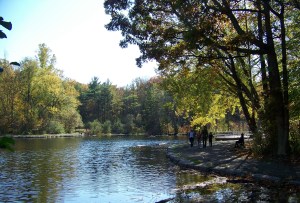
St. John’s Pond in Effingham, one of 41 conservation areas the Niagara Peninsula Conservation Authority cares for in and around the Niagara region. file photo by Doug Draper
Even while residents across Niagara are still reeling over plans being pushed by the Ford Government’s recently appointed Niagara Regional Chair Bob Gale to amalgamate Niagara municipalities and reduce the number of elected municipal representatives in our region, the Ford government issued a news release this March 11th announcing that it is moving ahead with amalgamating conservation authorities.
If and went this amalgamation occurs, which will likely be very soon, the more than 65-year-old Niagara Peninsula Conservation Authority (NPCA) and 35 other Conservation Authorities (CAs) across the province will be amalgamated into nine mega CAs, operating under the umbrella of one body to be called the Ontario Proincial Conservation Agency to be made of up individuals who are appointed by – you may have guessed it – the Ford government.
In summary, it means more provincial control of bodies that, in the case of the NPCA, addresses conservation and environmental issues in our region and is a steward of 41 highly valued Conservation Areas, among them Ball’s Falls, Woodend, Jordan Harbour, Two Mile Creek, Humberstone Marsh, St. Johns Pond and and the Wainfleet Bog.
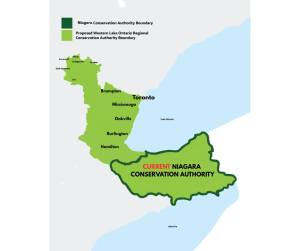
A map showing the boundary of the current NPCA and showing all of the green area that will fall under the jurisdiction of a larger CA the Ford government plans to absorb it into.
Under the Ford government, the NPCA would be absorbed into a Western Lake Ontario Regional Conservation Authority that, according to one of its reports, “extends along the western Lake Ontario shoreline from Niagara through Halton and Peel, encompassing urban and rural watersheds that support the Greater Toronto–Hamilton corridor. primarily based on the western portion of the Northern Lake Ontario and Niagara River Secondary Watershed.”
To many critics of this amalgamation plan, it means less local access and less say for the public when it comes to protecting and preserving what are left of our region’s precious natural heritage, and a greater danger that the Ford government will make even more natural areas available to developers.
In a statement Niagara Falls NDP MPP Wayne Gates put out on this plan this past December , he said; “Doug Ford is now forcing through the amalgamation of our local NPCA, the conservation authority that protects so much of what we hold dear in Niagara.
“Ford is silencing local voices and ending local control. And his government’s new province-wide agency can charge new fees back to conservation authorities, meaning local taxpayers will take on even more costs.
“Let’s be clear,” Gates concluded, “amalgamation like this means Niagara loses control of its own decisions, it means increased taxes, and it means fewer services.
But here we are and now the question is , will enough people stand up against the amalgamation of Conservation Authorities before it is too late, if it is not too late already.
Now here is the March 10th, 2026 News Releases from the Ford Government
Ontario’s Ford Government Taking Next Steps to Improve Conservation Authorities
Province consolidating 36 CAs into nine to deliver more consistent services, strengthen watershed management and better protect communities
March 10, 2026
TORONTO — The Ontario government is taking the next step to improve the province’s conservation authority system with our plan to create nine regional conservation authorities.
This follows extensive consultation on how conservation authorities can help get shovels in the ground faster on homes and other local infrastructure projects, while strengthening their vital role in managing watersheds and protecting communities from floods and natural hazards.
 The consolidated regional conservation authorities would reduce administrative duplication, redirect resources to front-line conservation and modernize permitting to help the province deliver on its plan to protect Ontario by cutting red tape and building an economy that is more competitive, resilient and self-reliant, to help keep workers on the job in the face of tariffs and economic uncertainty.
“Ontario’s improved approach would feature watershed-based regional conservation authorities operating under consistent provincial standards, modern tools and strengthened capacity – delivering stronger watershed management, flood resilience and better support for housing and infrastructure growth,” said Todd McCarthy, Minister of the Environment, Conservation and Parks.
“We listened and used feedback from last fall’s consultations to refine and strengthen our plan, including optimizing regional boundaries to better reflect local needs, knowledge and relationships.”
Ontario’s current system includes 36 independent conservation authorities with varying policies, processes and capacity, which has created a fragmented system with inconsistent standards and timelines. This has created uncertainty and delays for builders, landowners and farmers, and has made it more challenging for conservation authorities to carry out their role in protecting communities from floods and natural hazards.
To address this, the province created the new Ontario Provincial Conservation Agency (OPCA) last fall and began consulting with conservation authorities, municipalities and other partners on proposed boundaries for consolidating the province’s conservation authorities.
Based on the extensive feedback received, the government amended its proposed conservation authority boundaries and intends to introduce amendments to the Conservation Authorities Act in the coming weeks that, if passed, will set out a path to consolidate Ontario’s 36 conservation authorities to create nine new regional conservation authorities.
Under this plan, the OPCA would coordinate a clear and successful transition targeting early 2027 for consolidation, and to deliver on its goal of improving customer service, enabling more consistent decision-making and strengthening watershed management across the province.
With centralized leadership and independent oversight of conservation authorities by the OPCA, Ontario’s plan for a regional conservation authority system will reduce administrative duplication across the system and allow conservation authorities to redirect resources to front-line services, operate with greater consistency and transparency and deliver strengthened services to municipalities and permit applicants.
This would better position conservation authorities to support the building of new homes and infrastructure while continuing to protect communities from flooding and other natural hazards. Programs and services delivered by conservation authorities would remain the same, including watershed management, natural hazard management and source water protection.
To ensure local knowledge and input continue to guide watershed management, the province would require regional conservation authorities to create one or more local watershed councils that help identify local priorities for watershed-based conservation programs and services.
Regional conservation authorities would remain municipally governed, with regional municipalities, counties and cities appointing members to conservation authorities. Lower-tier municipalities in counties, such as towns and townships, will no longer be participating municipalities of a conservation authority under this approach.
“Today marks a milestone for conservation in Ontario. By building a modern, more unified system, we’re protecting local expertise while supporting front-line programs that communities rely on,” said Hassaan Basit, Ontario’s Chief Conservation Executive.
“The Ontario Provincial Conservation Agency would lead a smooth, well‑supported transition, ensuring conservation authorities have the tools and resources they need every step of the way to deliver effective watershed management programs, meeting the needs of today and the future.”
To support regional conservation authorities throughout the transition process, the province is providing annual funding to the OPCA in the amount of $3 million, beginning in 2026. This funding would be used by the agency to support conservation authorities as needed during the transition period. Following transition, this annual funding would go toward helping regional conservation authorities achieve program improvements.
These changes are part of the government’s plan to protect Ontario by improving the province’s fragmented and inconsistent conservation authority system to deliver more consistent services and more efficient resource and information sharing, ensuring conservation authorities are more responsive to the needs of the communities they serve.
Quick Facts
- The Ontario Provincial Conservation Agency would coordinate the transition to ensure conservation authorities can continue to manage flooding and other natural hazards, drinking water source protection, permitting and the management of their lands and recreational trails.
- Conservation authorities issue permits for development activities such as housing and the installation of supporting infrastructure in areas affected by risks of natural hazards such as floodplains, shorelines and wetlands.
- In November 2025, the government amended the Conservation Authorities Act to establish the Ontario Provincial Conservation Agency to provide efficient governance, strategic direction and independent oversight of Ontario’s conservation authorities.
- From November 7 to December 22, 2025, the province led a 45-day consultation on the proposed boundaries for the regional consolidation, with conservation authorities, municipalities, general stakeholders, and Indigenous communities, which included six regional workshops that engaged directly with conservation authority and municipal leadership. All input received was considered and helped to inform the government’s plans.
For more information on this amalgamation plan, click on the Ontario Government Environmental Registry – Proposed boundaries for the regional consolidation of Ontario’s conservation authorities | Environmental Registry of Ontario
To read a statement released late last year by the NPCA, click on –https://npca.ca/newsroom/article/changes-to-conservation-authorities-statement
NIAGARA AT LARGE Encourages You To Join The Conversation By Sharing Your Views On This Post In The Space Below and by sharing the Niagara At Large site at www.niagaraatlarge.com with all of your friends and associates.
Visit us every day on www.niagaraat.arge.com and on Doug Draper’s Facebook page at https://www.facebook.com/doug.draper.180 and encourage everyone else you know to do the same. Let’s build media outlets for local news and commentary!
 Niagara At Large