
A Statement from Mark Carney, Prime Minister of Canada, and Other Leaders coming out of this week’s G7 Summit in Alberta, Canada
Posted June 18th, 2025 on Niagara At Large
 A Brief Foreword from Niagara At Large reporter/publisher Doug Draper – The statement that follows is okay as far as it goes but what is both disappointing and astonishing is that it does not make one direct reference to carbon emissions or climate change.
This after scientists around the world have been warning for decades that the continued burning of fossil fuels and resulting build up of carbon in the earth’s atmosphere is a recipe for severe heat, drought and windstorms that fuel wildfires that are now causing more destruction to communities and to woodlands that are home to a host of living creatures that share this earth with us every year..
 It is hard not to conclude that crass backdoor politics and lobbying by special interests in the oil and gas industry are responsible for this omission.
Whatever the reason, here we are in the third decade of the 21st Century, with a climate emergency that is now worsening by the year, and we still don’t have enough politicians paying much more than lip-service to what counctless experts around the world are calling an “existential threat” to our very survival.
Now here is the Statement from the Leaders –
A Statement from the G7 Leaders, plus the Leaders of Australia, India, Mexico, the Republic of Korea, and South Africa –
Kananaskis, Alberta – We, the Leaders of the G7, are deeply concerned that the world has experienced record-breaking wildfires across every forested continent over the past decade, often overwhelming available national resources and requiring governments to request assistance from other countries.
These increasingly extreme wildfires are endangering lives, affecting human health, destroying homes and ecosystems, and costing governments and taxpayers billions of dollars each year.
 We resolve to boost global cooperation to prevent, fight and recover from wildfires by taking integrated action to reduce the incidence and negative impacts of wildfires and ensure our readiness to help each other, and partners, when needed.
We will take steps to prevent and mitigate the occurrence of wildfires by:
- Adopting a whole of society approach, including different levels of government, Indigenous Peoples, local communities, international and non-governmental organizations, academia, and the private sector, to share knowledge and drive research on reducing risks.
- Implementing mitigation and adaptation actions, grounded in scientific research and local knowledge, that reduce the risk of extreme wildfires, such as sustainable forest management, nature-based solutions, Indigenous land management practices including cultural or controlled burning, and adopting fire risk reduction measures around communities, buildings, and infrastructure.
- Raising awareness of the different causes of wildfires and measures to prevent them, including to reduce the number of wildfires started accidentally or maliciously.
We will strengthen global capacity to prepare for and respond to wildfires when they happen by:
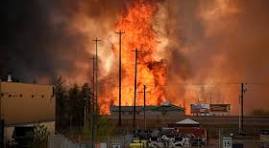 Leveraging research, tools and technology that forecast, identify, and monitor wildfires, such as fire danger rating systems, geospatial technologies, and systems to provide early warnings when wildfire moves towards inhabited areas or infrastructure.
- Collaborating on data collection and information sharing to better understand and respond to wildfires and their impacts, including on different population groups.
- Building our shared capacity to mitigate and respond to the impacts of wildfire exposure on human health and well-being.
- Enhancing interoperability, through sharing best practices and where relevant, developing common protocols, capabilities, and procedures related to wildfire response, including on training.
- Exploring ways to improve timely access to basic firefighting equipment and capabilities that help meet country-specific needs.
We will rebuild for resilience to recover from wildfires by:
- Identifying areas for active restoration efforts versus those where natural regeneration works best, taking actions that support biological diversity and restore nature and deploying nature-based solutions to strengthen resilience and reduce risks.
- Rebuilding with wildfire-resilient infrastructure, including strengthening the wildland-urban interface through resilient urban design, landscape, and infrastructure planning.
- Encouraging research to better understand local conditions to support and scale-up ecological restoration, finding best methods for sustainable forest management to help prevent and mitigate wildfires, including in rapidly shifting conditions, and using community-based, whole of society approaches that incorporate local and, where opportunities exist, Indigenous practices, and increased participation by women.
We will seek synergies with work underway at the G20. Interested signatories will also work through forums like the United Nations Global Fire Management Hub. We will align with commitments to halt and reverse deforestation and forest and land degradation by 2030 globally.
Together, we will achieve a stronger and more coordinated global approach to wildfire resilience.
We welcome the endorsement of the Kananaskis Wildfire Charter by the Leaders of Australia, India, Mexico, the Republic of Korea, and South Africa.
NIAGARA AT LARGE Encourages You To Join The Conversation By Sharing Your Views O This Post In The Space Following The Bernie Sanders Quote Below.
“A Politician Thinks Of The Next Election. A Leader Thinks Of The Next Generation.” – Bernie Sanders
 Niagara At Large