
‘Trump’s use of trade war tactics forcing concessions from Mexico and Canada is especially concerning since U.S. Defense Secretary Pete Hegseth has publicly shared that military force is still an option against Mexico.’ – Martin Danahay, English Language and Literature at Brock University
News from Brock University in St. Catharines, Niagara
Posted February 5th, 2025 on Niagara At Large

Trump trades salutes with the troops
Niagara, Ontario – In the wake of U.S. President Donald Trump imposing a 10 per cent levy against China and pressing a 30-day pause on proposed tariffs to Canada and Mexico, Martin Danahay is reflecting on the dangerous historical outcomes of past trade wars.
The Professor of English Language and Literature at Brock University specifically notes that the First Opium War, fought between China and the British Empire from 1839-1842, began as a trade imbalance.
“When China blocked the British opium trade, British traders successfully lobbied their government to attack China, ultimately forcing the removal of the trade blockade through military action,” he says.
Danahay notes that while the current situation between the U.S. and Mexico/Canada is a reversal of that situation — imposing levies on imported goods to force action on the flow of illegal fentanyl into the U.S. from its two neighbouring countries — the use of tariffs and “belligerent” rhetoric can easily transition into military conflict.
Another notable example, Danahay says, are the British trade restrictions imposed on American ships during the Napoleonic Wars in the early 1800s.
“Along with forced conscription of American sailors into the British Navy, the trade restrictions led to the War of 1812 between Britain and the United States,” he says.
Trump’s use of trade war tactics forcing concessions from Mexico and Canada is especially concerning, Danahay says, since U.S. Defense Secretary Pete Hegseth has publicly shared that military force is still an option against Mexico.
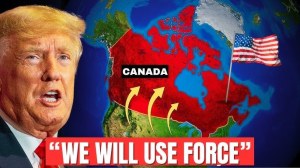
Over the past two months, Trump has repeatedly threatened Canada with annexation
While he says it is unlikely the U.S. will invade Mexico (or Canada), it is certainly possible that an invasion of a smaller country could result from a propensity to use trade wars and violent rhetoric as the basis for foreign relations.
Danahay says that Panama, in particular, seems vulnerable as various U.S. officials (including President Trump) have claimed that China is operating the Panama Canal, a key route in global trade.
“President Trump has also imposed tariffs on China ostensibly because of the production of the precursor chemicals for fentanyl, which is shipped to Mexico, processed and then smuggled into the U.S., where there is a widespread crisis of addiction to the synthetic opioid,” he says.
“President Trump has openly expressed a desire to take over the Panama Canal and Greenland, showing an imperialist mindset that is reminiscent of the British Empire. While many are of the opinion that Trump is unlikely to use military force, history shows that a combination of a trade war and military rhetoric can easily become the basis for war.”
NIAGARA AT LARGE Encourages You To Join The Conversation By Sharing Your Views On This Post In The Space Following The Bernie Sanders Quote Below.
“A Politician Thinks Of The Next Election. A Leader Thinks Of The Next Generation.” – Bernie Sanders
 Niagara At Large