
 “All of the internationally produced global temperature datasets show that 2024 was the hottest year since records began in 1850. Humanity is in charge of its own destiny. … The future is in our hands – swift and decisive action can still alter the trajectory of our future climate.” – Director of the Copernicus Climate Change Service, Carlo Buontempo
News from the European Weather Forecast Centre
Posted January 10th, 2025 on Niagara At Large
The year 2024 was the warmest on record globally and the first calendar year that was more than 1.5°C above the pre-industrial level, according to the Global Climate Highlights Report 2024 from the EU’s Copernicus Climate Change Service (C3S) implemented by ECMWF.
The Paris Agreement of 2016 has a goal to keep the rise in global surface temperature to well below 2°C above pre-industrial levels, and preferably to 1.5°C. This refers to an average over at least 20 years, so that one calendar year does not mean the goal has been missed.
Human-induced climate change remains the primary driver of rising air and sea-surface temperatures, while other factors, such as the El Niño–Southern Oscillation (ENSO), also contributed to the unusual temperatures observed during the year.
ECMWF Director-General Florence Rabier said: “The Global Climate Highlights is a vital tool for supporting international climate adaptation efforts. We are grateful for the European Commission’s continued trust towards ECMWF as an intergovernmental scientific organisation and for the dedication of our staff and collaborators, whose work makes this service possible.”
Record global temperatures
The year 2024 was the warmest year in global temperature records going back to 1850. According to ECMWF’s ERA5 reanalysis, the global average surface air temperature of 15.10°C was 0.72°C above the 1991–2020 average and 0.12°C above 2023, the previous warmest year on record.
This is equivalent to 1.60°C above an estimate of the 1850–1900 temperature, which is designated as the pre-industrial level.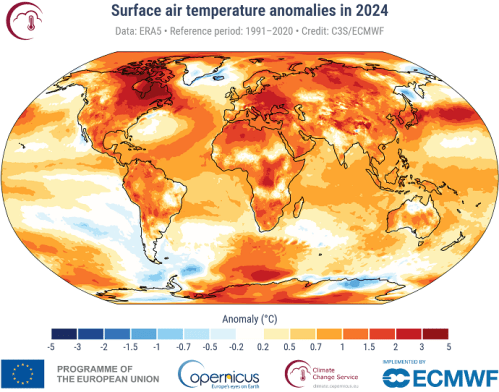
Surface air temperature anomalies for 2024 relative to the average for the 1991–2020 reference period. Data: ERA5. Credit: C3S / ECMWF.
2024 is the first calendar year that has reached more than 1.5°C above the pre-industrial level.
Global surface air temperature increases above the 1850–1900 pre-industrial reference period, based on several global temperature datasets shown as annual averages since 1967 (left) and as 5-year averages since 1850 (right). Credit: C3S / ECMWF.
Each month from January to June 2024 was warmer than the corresponding month in any previous year on record.
Sea-surface temperature
In 2024, the annual average sea-surface temperature (SST) over the extra-polar ocean reached a record high of 20.87°C, 0.51°C above the 1991–2020 average.
The year saw the end of the El Niño event that started in 2023 and the transition towards more neutral or La Niña conditions.
An El Niño event is a prolonged period of unusually high SST in the tropical Pacific Ocean. It goes hand in hand with changes in atmospheric conditions and can have strong repercussions on global weather patterns.
In La Niña conditions, SST in the tropical Pacific Ocean is unusually low. The El Niño–Southern Oscillation (ENSO) is the climate phenomenon made up of El Niño, La Niña, and neutral conditions.
European temperature
The year 2024 was also the warmest on record for Europe, with an average temperature of 10.69°C. This is 1.47°C above the average for the 1991–2020 reference period and 0.28° warmer than the previous record, set in 2020.
Spring and summer were the warmest on record for Europe. The average temperature for spring (March–May) was 1.50°C higher than the 1991–2020 seasonal average, and the average temperature for summer (June–August) was 1.54°C above the 1991–2020 seasonal average.
Other highlights
 In 2024, the area of the globe affected by at least ‘strong heat stress’ reached a new record annual maximum on 10 July, when around 44% of the globe was affected by ‘strong’ to ‘extreme heat stress’. This is 5% more of the globe compared to the average annual maximum.
- Around Antarctica, after reaching record-low values for the time of year during most of 2023, the sea-ice extent reached record or near-record low values again during several months of 2024. From June to October, the monthly extent ranked second lowest, behind 2023, and lowest in November. At its annual minimum in February, the monthly extent ranked third lowest in the satellite record.
-
In the Arctic, the sea ice extent was relatively close to its 1991–2020 average until June but fell well below average in the following months. At its annual minimum in September, the monthly extent ranked fifth lowest in the satellite record.

The Arctic ice is melting and there are few other livable place for these great animals to go
More information is available on the C3S website.
NIAGARA AT LARGE Encourages You To Join The Conversation By Sharing Your Views On This Post In The Space Following The Bernie Sanders Quote Below.
“A Politician Thinks Of The Next Election. A Leader Thinks Of The Next Generation.” – Bernie Sanders
 Niagara At Large
With the fires raging in California and 2024 being the warmest year ever recorded with the data there to prove it and this is the answer we get from some of our world leaders. https://www.bing.com/videos/riverview/relatedvideo?q=TRUMP+SAYS+IT+WILL+GET+COLD+VIDEO&mid=4C4A31F62BCE4B456DBE4C4A31F62BCE4B456DBE&FORM=VIRE It is sad to say that this looks like this is going to be our new normal.
LikeLike