
New Study – Rise of SUVs, Trucks has Cancelled Out 80 Per Cent of Fuel Economy Improvements in Canada

Many Canadians want their vehicles big – never mind the impact those vehicles have on the environment
“This study proves that US-Canada vehicle emissions standards have loopholes so big you can drive a gigantic truck through it. When automakers can get out of emissions standards by gaming the system with bigger and heavier vehicles, families end up paying the price by filling the gas tank more often, breathing more air pollution, and living with more dangerous streets for pedestrians, cyclists and young children.” – Nate Wallace, Clean Transportation Program Manager at Environmental Defence
News from Environmental Defence and the David Suzuki Foundation
Posted November 14th, 2024 on Niagara At Large
(A Brief Foreword from Niagara At Large reporter/publisher Doug Doug Draper – In all due respect to the time-honoured environmental groups that produced this study, you can’t always place all the blame in the laps of governments and private corporations.
In the case of the high sales rate for SUVs and trucks, a good deal of the responsibility also has to go to the people who buy them. No one is putting a gun to anyone’s head to buy these vehicles. It is a choice and obviously thereare significant numbers of Canadians out there whose desire for these vehicles over-rides any concern they may have, if any, about the impact they have on climate change and the environment.)
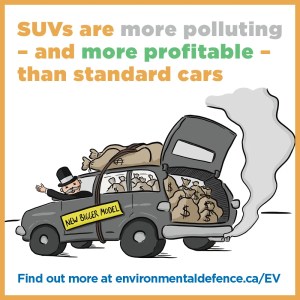 A new study commissioned by Environmental Defence, Équiterre and the David Suzuki Foundation has found that the shift in new vehicle sales towards more polluting SUVs and trucks has cancelled out more than 80 per cent of the reduction in average fuel consumption that has been achieved by more fuel-efficient engines over the period of 2010-2022 in Canada.
Canada adopts its vehicle fuel efficiency regulations from the American Environmental Protection Agency (EPA), and these rules currently allow automakers to get away with selling more polluting vehicles if they are larger in size or weigh more.
These loopholes have encouraged automakers to make bigger and heavier vehicles while shifting car sales to SUVs to ‘game’ the system.
This joint Canada-US regulatory policy highlights how the outcome of the US Presidential election will affect Canadian climate policy, road safety and cost of living. This is because SUVs and trucks consume, on average, 30 per cent more fuel than gasoline cars, larger and heavier vehicles are more dangerous on the road, and larger, gas-guzzling vehicles growing to dominate the vehicle market makes life more expensive for Canadian families.
 The study uses economic modelling to examine various methods of addressing these regulatory loopholes in President Biden’s final vehicle emissions standards rule, announced in March 2024, and how effective they might be in the context of new vehicle emissions rules applied in Canada, including the /Electric Vehicle Availability Standard/, which targets 100 per cent zero-emission vehicle (ZEV) sales by 2035
President Trump has promised to scrap Biden’s vehicle emissions standard rules, as he rolled back President Obama’s rules during his last administration.
Key takeaways from the study, conducted by the Sustainable Transportation Action Research Team (START) at Simon Fraser University include:
* Canada’s /Electric Vehicle Availability Standard/, which aims to increasezero-emission vehicle sales to 100 per cent of the new vehicle market by 2035, is the *most effective regulatory policy to reduce vehicle carbon emissions*. If Canada did not have this regulation, and only relied on President Biden’s EPA pollution standards for cars and trucks, carbon emissions would be cumulatively 84 million tonnes higher by 2035, equivalent to adding more than 21 coal-fired power plants to the grid or the emissions of 25 million cars in a year. Canada’s /Electric Vehicle Availability Standard/ is even more important in a world where President Trump rolls back the Biden rules and makes them even weaker.
*Design details of vehicle fuel efficiency regulations can have a significant effect on the market share of cars (sedans) versus light trucks (SUVs and pickup trucks) in Canada. The modelling indicates that regulatory policy changes such as re-classifying SUVs as cars rather than light trucks for emissions standards purposes would result in an 8 percentage point swing in the overall car vs. truck market share of new vehicles (the market share of cars sold increasing by 4% and the share of light trucks sold declining by 4%).
*The study modeled the introduction of an energy efficiency requirement for electric vehicles to encourage downsizing and to increase the supply of smaller, affordable electric vehicle models. It found that this would result in a 18 per cent swing in market share, with the market share of electric passenger cars increasing by 9 per cent and the market share of electric light trucks decreasing by 9 per cent.
To view the study, click on – EDC-EQT-DSF-Canadas-Future-VES-Vehicle-Size-and-Carbon-Emissions-1.pdf
 ABOUT ENVIRONMENTAL DEFENCE: Environmental Defence is a leading Canadian environmental advocacy organization that works with government, industry and individuals to defend clean water, a safe climate and healthy communities.
ABOUT DAVID SUZUKI FOUNDATION: The David Suzuki Foundation is a national, non-profit organization that uses evidence-based research, education and policy analysis to conserve and protect the natural environment, and help create a sustainable Canada.
NIAGARA AT LARGE Encourages You To Join The Conversation By Sharing Your Views On This Post In The Space Following The Bernie Sanders Quote Below.
“A Politician Thinks Of The Next Election. A Leader Thinks Of The Next Generation.” – Bernie Sanders
 Niagara At Large