
“Putting Wheels on the Bus” report outlines recommendations to federal policymakers to unlock public transit’s potential as a climate solution
News from Environmental Defence, a Canada-wide citizens organization advocating for a cleaner planet
Posted February 28th, 2024 on Niagara At Large
Ottawa, Ontario – A new report, titled “Putting Wheels on the Bus” from Environmental Defence and Équiterre, supported by modelling conducted by Dunsky Energy + Climate Advisors and Leading Mobility finds that Canada can double public transit ridership by 2035 if federal and provincial governments step up investments in expanding transit service hours and frequency, implement bus lanes and improve urban planning to encourage more housing density near transit.
Combined with electrification of bus fleets, the report finds that with these measures, Canada can reduce carbon emissions by sixty-five million tonnes by 2035, if investments begin now. Sixty-five million tonnes over the period 2024-2035 is equivalent to the annual carbon emissions produced by 20 million cars.
The policy interventions proposed in the report can be achieved by careful design of the planned federal Permanent Public Transit Fund and negotiated infrastructure funding agreements with provinces, territories, and cities, where the federal government would assume its traditional 40 per cent cost-share.
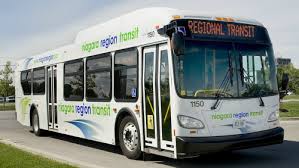
During recent budget discussions, Niagara Regional councillors struggled to find the money at the local level keep transit services growing in Niagara. .More funding from the federal government would obviously be helpful.
The report highlights that public transit systems across Canada are currently not allowed to use federal public transit funding to add service hours or increase service frequency, despite these measures being the most important drivers of ridership growth and emissions reductions.
Federal funding is also not allowed to be used towards making fares more affordable, despite Canada’s cost-of-living crisis.
Based on public transit fleet data obtained from the Canadian Urban Transit Association, the report finds that while municipalities have expanded their bus fleets with federal capital funding, they do not have the operating funding they need to actually put those bigger fleets into service. There are an estimated 1,700 buses gathering dust in garages across the country that could be in service if municipalities had the money to hire drivers and run them.
The modelling by Dunsky Energy + Climate Advisors and Leading Mobility found that increasing subsidies for public transit operations allows transit systems to increase service levels, and this is a particularly important way of reducing carbon emissions by incentivizing people to choose public transit over cars. The study found that the largest greenhouse gas reductions from public transit came from Land Use Effects.
 This refers to the ability of increased transit service to enable improved urban planning and land use, such as less city space needing to be devoted to parking. This allows people to make shorter, car-free trips to reach their destinations and live closer to jobs and amenities. The study highlighted the importance of pairing public transit investments with zoning policy changes that enable cities to build more housing near frequent transit service, because restrictive zoning policies can limit these benefits.
Public transit systems in Canada are at a turning point, with many still struggling financially because of reduced ridership due to the pandemic. This has led many to cut services and hike fares. Yet, these cuts drive an even greater reduction in ridership, which inevitably lead to even more service cuts and fare increases – a vicious cycle known as the ‘downward spiral’.
The report highlights that while Canada’s climate plan has targets to increase zero-emission vehicle adoption, it has no targets to increase public and active transportation use or to reduce the total number of kilometres traveled by car. The report authors recommend that beyond setting new goals, federal and provincial governments should also create long term, reliable operating funding streams for public transit systems. This would allow ridership to recover and grow while enabling Canada to meet its climate ambitions with abundant public transit.
Quotes
“Canada’s current public transit strategy is like a bus without wheels. Funding capital projects but not operations is not working to actually improve day-to-day service for millions of Canadians who rely on public transit. This policy choice is not working to shift people who are currently driving onto public transit. If the federal government intends on actually achieving meaningful emissions reductions with public transit, it must begin funding transit operations and encourage provinces to get on board too,” said Nate Wallace, Clean Transportation Program Manager at Environmental Defence.
“We cannot allow a ‘downward spiral’ to erode public transit in Canada, just when we need it the most as a clean and affordable climate solution. This report demonstrates that we have an alternative: we can choose to invest in public transit, grow ridership and adapt to new mobility patterns by providing more reliable, convenient and frequent service that works more equitably for everyone,” said Anne-Catherine Pilon, Mobility Analyst, Équiterre.
“Investing in public transit is a win-win for affordability and climate. The federal government has an opportunity to reduce household costs and greenhouse gas emissions by accelerating the Permanent Public Transit Fund and making it available for transit operating budgets. More frequent and affordable service will make public transit a viable choice for more people.” said Shelagh Pizey-Allen, Executive Director of TTC Riders, a Toronto-based public transit advocacy group.
To watch a video produced to accompany the release of this new transit report, click on the screen immediately below –
 ABOUT ENVIRONMENTAL DEFENCE: Environmental Defence is a leading Canadian environmental advocacy organization that works with government, industry and individuals to defend clean water, a safe climate and healthy communities.
ÉQUITERRE: Since 1993, Équiterre has been helping to find solutions, transform social norms and encourage ambitious public policies through research, support, education, mobilization and awareness building initiatives. This progress is helping to establish new principles for how we feed ourselves, how we get around and how we produce and consume, that are designed for our communities, respectful of our ecosystems, in line with social justice and of course, low in carbon.
NIAGARA AT LARGE Encourages You To Join The Conversation By Sharing Your Views On This Post In The Space Following The Bernie Sanders Quote Below.
“A Politician Thinks Of The Next Election. A Leader Thinks Of The Next Generation.” – Bernie Sanders
 Niagara At Large