
“It is also important to learn from past experiences. Many long-term academic studies have demonstrated that the projected benefits of past amalgamations often failed to materialize.” – Jim Bradley, Chair for the Regional Municipality of Niagara
A Statement from Niagara Regional Chair Jim Bradley to the Provincial Standing Committee on Heritage, Infrastructure and Cultural Policy
Posted January 10th, 2024 on Niagara At Large

Niagara Regional Chair Jim Bradley,
Regional Chair Bradley appeared before the Provincial Standing Committee on Heritage, Infrastructure and Cultural Policy during a one day hearing in St. Catharines this January 10th, 2024 to share his personal views on the housing crisis and what role municipal governance plays in addressing that challenge.
The following is a transcript of Chair Bradley’s opening statement.
“Good morning. I am Jim Bradley, Chair of the Regional Municipality of Niagara, accompanied by our Regional CAO Ron Tripp. I stand before you to share own personal perspectives on the future of municipal governance in Niagara and its pivotal role in tackling the housing crisis.
“A recent examination showed that even with an annual income of $85,000, homeownership remains elusive in Niagara. But as I have stated on numerous occasions, the Niagara Region is committed to partnering with your government to address the housing crisis.
“I also agree with Ontario Minister of Muncipal Affairs and Housing Paul Calandra: this governance discussion should be focused on how a manipulation of governance would result in more homes being built. My comments today will be focused on that goal.
“But it is also important to learn from past experiences. Many long-term academic studies have demonstrated that the projected benefits of past amalgamations often failed to materialize, leading to the same outcomes if no changes had been made. On the other side of the coin, recent studies in Peel Region regarding dissolution showed the potential for massive tax increases, and instability, if dissolution is considered.
“And while there are many governance models being proposed, none of them are predicated on how they will build more homes.
“There is not a single community in Ontario that does not struggle with the same challenges that we have in Niagara, and that includes those locations that were amalgamated in the late 1990s. The facts speak for themselves: amalgamation or dissolution is not a silver bullet solution to build more homes, tackle homelessness or even reduce administrative burdens.

At the hearing, Niagara West Conservative MPP presses Niagara Regional Chair Jim Bradley on the question of whether the region has too many municipal politicians.
“All that being said, no system is perfect, and there is always room for improvement. I would respectfully suggest that a series of incremental changes could strengthen our region, all while avoiding governance experiments that would be costly and distract from our ultimate goal.
“An overview of the Niagara Region
“With over $9 billion in assets, the Niagara Region provides a coordinated approach and economy of scale. We deliver costly and complex essential services such as police, EMS, public health, housing, transit, long-term care, Ontario Works and waste collection to name a few.
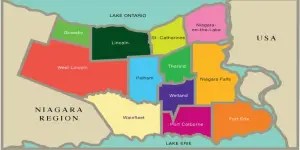
Local municipalities across are Niagara Region the way they are mapped out now, Is this the way it should stay, or should there be fewer municipalities or possibly just one City of Niagara? These were questions being explored at the standing committee hearing
“The Region also creates the opportunity to pool resources across Niagara to build the costly capital infrastructure that is needed to ensure all of our communities are growing equitably. While I believe in the autonomy and importance of our local communities, I also believe that the Regional model allows our communities the opportunity to grow in ways that would be impossible otherwise.
“A recent independent study by KPMG found that the Region’s property taxes as a percentage of household income are the lowest as compared to the other five upper-tier municipalities. Even with that distinction, we are at or above provincial standards across all of our lines of business. The same study found that 92% of our budget is dedicated to essential or provincially mandated programs.
“This term of council has made the expansion of shared services across Niagara a top priority.
“I am pleased to share that we have recently invested in a specialized staff team that is solely focused on identifying opportunities for shared services that are most likely to save taxpayer money and optimize service delivery.
“This team is making progress in many areas, including the unification of the Chief Building Official Services across Niagara. This move will ensure we are maximizing resources, interpreting the building code equitably across the region and, most importantly, expediting the construction of more homes.
“How the province can assist us in building more homes
“As you know, Minister Calandra’s request to this committee was to determine if current municipal structures are standing in the way of more homes being built.
“In response to that request, allow me to share some facts: we have 39,283 housing units already approved for development across Niagara. This equates to a 10 – 11 year of supply of housing units. If the development community were to start work tomorrow, we would surpass our provincial housing targets by 43 per cent.
“With over $85 million in grants and incentives provided in the last five years, the Region financially supported the development industry more than any other place in Ontario. Before Bill 23 minimized our role, we met or exceeded provincial commenting timelines 92% of the time. Since becoming chair, I cannot recall a single instance that the Niagara Region demonstrated NIMBYism and blocked development in a specific community.
“Niagara is also a financially competitive place to build homes. Development charges for a single- family dwelling in the Niagara region is $20,000 to $30,000 less than our neighbouring communities of Hamilton and Halton Region.
“I think the numbers speak for themselves: I believe that Niagara is a development friendly community. And while there are challenges to ensure more homes are built, I can confidently say those hurdles are not a result of our governance structure.
“To that end, there are many things we can do to build more homes:
“Senior levels of government must develop a “new deal” to close the infrastructure funding gap. For instance, we continue to seek funding partners for a new wastewater treatment plant, that once completed, will allow thousands of new homes to be built.
“As delays can also happen at the Provincial level, we ask that your government create an approvals facilitator, or provincial chief planner, to resolve conflicts among all parties to expedite approvalsWe suggest that the Ontario Land Tribunal appeal process be streamlined so the appellant is required to demonstrate that an appeal has merit before proceeding.
“We ask for the introduction of more Provincial incentive programs to encourage the private sector to build more purpose-built and affordable rentalsAnd finally, we applaud Minister Calandra’s stance on “use it or lose it” for MZOs. We ask that municipalities be given tools to help ensure that development happens in a timely fashion.
“In closing –
“The administration of local government programs and infrastructure in Niagara is exceedingly complex. Pulling at the threads of the municipal tapestry without fully comprehending the entire system can have dire consequences, not only on the delivery of municipal service, but also on a community’s ability to build more homes.
“Once we start pulling at these threads, the entire system may start to unravel.
“I trust that the government is undertaking this committee process to ensure they are looking beyond the anecdotal, and the emotional, to start a conversation about how best to end this housing crisis. I would respectfully suggest that cautious consideration be taken before significant decisions are made which could cost taxpayers billions, destabilize the Region and derail efforts to ensure everyone has a place to call home.
“Thank you.”-Niagara Regional Chair Jim Bradley

At the standing committee hearing, City of Niagara Falls Mayor Jim Diodati was among the strongest voices for fewer municipalities and fewer politicians in Niagara. NAL will report and comment on more of that later.
(Niagara At Large spent the day following this hearing and will have much more to say about the issues raised by those who made presentations, including municipal mayors and others) in the days and weeks ahead.
NAL urges all residents in Niagara to get engaged in the discussions and debates over what we should do to address the housing shortage and where do we go with municipal governance in this region. These issues are very important ones to address for the future of our region and all of us who live here. – Doug Draper, NAL)
NIAGARA AT LARGE Encourages You To Join The Conversation By Sharing Your Views On This Post In The Space Following The Bernie Sanders Quote Below.
“A Politician Thinks Of The Next Election. A Leader Thinks Of The Next Generation.” – Bernie Sanders
 Niagara At Large