
Selection of Lands Removed from Ontario’s Greenbelt Was Biased and Dismissive of Effective Land-Use Planning
Preferential Treatment Given to Certain Land Developer Requests – Ontario Auditor General
A News Release from the Office of Ontario Auditor General Bonnie Lysyk
Posted August 9th, 2023 on Niagara At Large

Ontario Auditor General Bonnie Lysyk lets Ford government have it on possible gutting of Ontario’s Greenbeit lands
Toronto, Ontario – “Provincial government actions in 2022 to open parts of the Greenbelt for development failed to consider environmental, agricultural and financial risks and impacts, proceeded with little input from experts or affected parties, and favoured certain developers/landowners,” – Auditor General Bonnie Lysyk said in a special report tabled this August 8th, 2023 with the Legislature.
Lysyk also noted that the owners of the 15 land sites removed from the Greenbelt could ultimately see more than an $8.3 billion increase to the value of their properties.
“The exercise to change the Greenbelt boundaries in Fall 2022 cannot be described as a standard or defensible process,” Lysyk stated.
“The truncated and highly restricted land selection exercise excluded substantive input from land-use planning experts in provincial ministries, municipalities, conservation authorities, First Nations leaders, and the public, while giving preferential treatment to certain developers with direct access to the Chief of Staff to the Minister of Municipal Affairs and Housing.”
The audit found that: • The government’s target to increase housing did not require removing land from the Greenbelt. According to the government’s Housing Affordability Task Force and the Chief Planners of the three affected regions (Durham, Hamilton and York), the removal of Greenbelt land sites was not needed to meet the government’s housing goals.
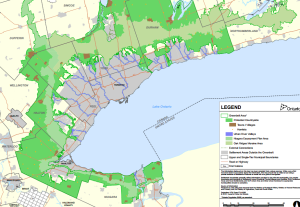
The green areas on this map, including those in Niagara, mark the Greenbelt. It is unclear if there is enough political will among our municipal and regional elected representatives to fight for its protection.
In fact, in late October 2022, the Ministry of Municipal Affairs and Housing (Housing Ministry) had already allocated housing targets to regions to build 1.5 million homes, before land sites were approved for removal from the Greenbelt.
• Political staff had substantial control over the entire Greenbelt amendment exercise. The Housing Minister’s Chief of Staff provided a small team of non-political public service staff in the Housing Ministry the criteria to be used in the selection process, directed the team to alter the criteria to facilitate the selection of many sites provided by the Chief of Staff, and imposed a three-week timeline and confidentiality provisions, limiting the team’s time and ability to assess the land sites and provide alternatives.
• Even though hundreds of site removal requests had been submitted to the Housing Ministry since the Greenbelt was established in 2005, only 22 land sites were considered in the 2022 selection exercise. Of those, only one was proposed by the Housing Ministry’s non-political public service staff, while 21 were provided directly by the Housing Minister’s Chief of Staff. Of the 15 land sites ultimately approved for removal in December 2022, 14 were brought into the exercise by the Housing Minister’s Chief of Staff and one was identified by the Housing Ministry’s non-political public service staff.
• About 67% (4,900) of the approximately 7,400 acres ultimately removed from the Greenbelt are on two land sites for which information was given by two developers to the Chief of Staff in September 2022 at an industry function they all attended. One of these developers subsequently provided information on the removal on three additional land sites, one of which related to a third developer.
Overall, 92% (6,800) of the approximately 7,400 acres ultimately removed from the Greenbelt related to five land sites involving three developers.
• Greenbelt removals were approved without full consideration of environmental and agricultural risks, and were inconsistent with the vision, goals and processes of the Greenbelt Plan to provide important natural features and agricultural land with permanent protection, as well as previous amendments to the Greenbelt boundary. The 2022 boundary changes removed almost 1,000 acres of wetlands and woodlands from the Greenbelt. As well, the Ministry of Agriculture, Food and Rural Affairs indicated that about 83% of the area removed is classified as prime agricultural land, having the highest quality and capability for agriculture.
• Restrictions on the Housing Ministry’s non-political staff team precluded an assessment of the cost to add needed infrastructure to each of the land sites proposed for removal, how the costs would be apportioned between the public and private sectors, or whether the affected municipalities would even allow those lands to be developed if the removals proceeded.
• While additions were made to the Greenbelt to offset lands removed, 2,400 of the added acres are areas typically already protected and largely undevelopable, and do not contribute agricultural land protection—a core objective of the Greenbelt Plan.
Further, although 7,000 acres of the Paris Galt Moraine were added as offsets, the Housing Ministry had recommended a larger portion be added to encompass important natural features and agricultural land.
Additions to the Greenbelt were necessary to offset removals because the Greenbelt Act, 2005, prohibits a reduction in the Greenbelt Area.
“While the people of Ontario deserve prompt action to solve societal problems like those generated by a need for housing, this does not mean that government and non-elected political staff should sideline or abandon protocols and processes that are important to guide objective and transparent decision-making based on sufficient and accurate information,” Lysyk added.
(Stay Tuned to Niagara At Large for much more on this Ontario Ford Government assault on our foodlands and on precious natural resources we should have a vital interest in protecting for ours and future generations. – Doug Draper)
NIAGARA AT LARGE Encourages You To Join The Conversation By Sharing Your Views On This Post In The Space Following The Bernie Sanders Quote Below.
“A Politician Thinks Of The Next Election. A Leader Thinks Of The Next Generation.” – Bernie Sanders
 Niagara At Large