
“Brock and Niagara are great schools, so why can’t we get there in decent time?”
By Niagara College student and Hamilton, Ontario resident Katie Gray
Posted February 24th, 2016 on Niagara At Large
Niagara, Ontario – Transit Riders of Niagara and Hamilton: Have you noticed all the ads for Brock University and Niagara College on bus stops throughout
our city? Have you ever wondered how long it actually takes to get to either by transit? If you attend a school in the Niagara region, and have to take public transit, you know exactly what I’m talking about.
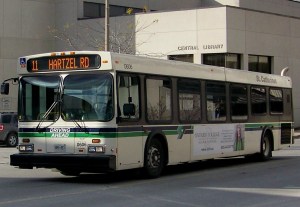
File photo by Doug Draper
Currently, I’m gearing up for my second semester of travelling from East Hamilton to Niagara College’s Niagara-on-the-Lake Campus.
The total ride takes two HSR buses, the GO Bus (which drops me off at Fairview Mall in St. Catharines), a bus to downtown St. Catharines, and then finally the shuttle that takes me to my school. That is five buses, and totals usually two hours and 18 minutes, if all the connections line up properly.
Going home, well, that takes even longer, as my classes end on the half-hour. And the GO Bus leaves Fairview Mall at quarter to, so I’m always waiting 1 hour and 15 minutes before I can even get on the GO bus, for 45 minutes. Please note: The first hour of my trip home is travelling between two highway exits, and yes, the GO Bus drives right past Niagara College before stopping at Fairview Mall.
Brock Riders, and Niagara College students from the Welland Campus have the same issues, when travelling from Hamilton, or within the Niagara Region. We all have to travel to downtown St. Catharines before we can get to our schools. The evenings and winter are particularly horrifying when you are in a town you do not know, by yourself, stuck at the bus terminal, waiting for your next bus.
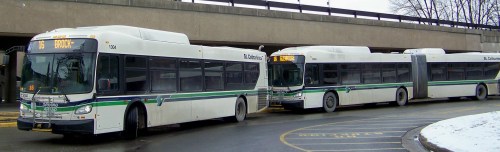
File photo by Doug Draper
Although the first GO Bus of the day gets into St. Catharines at 8:20 a.m. the earliest students can get to Niagara College NOTL is 8:48 a.m., if all the connections line up. If those connections do not line up, you aren’t just 18 minutes late for your 8:30 a.m. class, you are now 48 minutes late. So, what I’m saying is it is impossible to make it to either Niagara Campus, or Brock for the earliest classes, by taking transit from Burlington, Hamilton, or Grimsby. Impossible.
With winter weather (now here), the pressure is on to really try and make a difference quickly, concerning this issue. Commuters who typically drive to the Niagara Region, from Hamilton and beyond, could benefit with a decent public transit option when the roads are bad, and they do not want to deal with the stress of driving.

Niagara College student Katie Gray waiting for a bus
Unfortunately, when I discuss this issue with peers, family, and friends the overwhelming response is: “Why don’t you get a car?” I cannot begin to express how frustrating a statement like that is when you are a student, with limited access to funds.
Also, if you could believe it, commuting for five hours a day cuts into your ability to find a job beyond going to school, much less energy for volunteering.
In Canada, we have a right to accessible education. Why on earth is it so difficult to get to Niagara College and Brock, from our region?
The students who travel to Niagara from Hamilton and the GTA choose to go there because some programs are simply not offered closer. Brock and Niagara are great schools, so why can’t we get there in decent time?
Please, if you are in a similar situation, travelling to school or work in Niagara, sign the petition below (prepared and launched this January by the Niagara College Student Administrative Council) attached to this link: https://www.change.org/p/niagara-regional-and-municipal-government-get-niagadata:text/mce-internal,content,moving%20ra-moving
Thanks. Katie Gray
NOW IT IS YOUR TURN. Niagara At Large encourages you to share your views on this post. A reminder that we only post comments by individuals who share their first and last name with them.
Visit Niagara At Large at www.niagaraatlarge.com for more news and commentary for and from the greater bi-national Niagara region.
 Niagara At Large
I feel sorry for Ms. Gray but what she describes is an impact of the poorly founded decision to locate Ontario’s Community Colleges and Universities such as Brock, Trent and Carleton in suburban locations primarily only accessible by automobile.
Certainly it is possible to walk to these institutions from some of the low density residential communities that have grown up around them but mixing student housing in these single family areas presents other negative impacts.
Sadly bureaucracies such as school boards and hospitals continue to locate facilities where it is almost impossible to get to them by walking, cycling or public transit. In most of these examples it’s today’s youth that are experiencing the consequences. to parapharase Peter, Paul and Mary, “When will they ever learn”.
LikeLike
Katie,
I think you are fighting a good fight here. It is always great to see students stepping up as leaders on real student issues.
As a past student leader at an Ontario College and sustainability professional in the public education sector, I have spent a large amount of my young career advocating for and designing solutions to increase access to post-secondary institutions through local and regional transportation system enhancements. I have made the choice to adopt a “multi-modal” approach to my own transportation needs. I drive, own a car, and use transit on a regular basis. I am a firm beliver that we are all traffic, not that we are all just stuck in traffic.
I wanted to take the time to tell you that what you’re asking for isn’t impossible, it will require a focuses and strategic approach. Keep your head up!
I hope to see your name on the ballot for any upcoming student elections. This will give you a really good chance of making real change in Niagara.
It would be great to connect, by your post doesn’t share your contact information.
Cheers’
AG
LikeLike
They need to reduce automobile dependency and the only way I can see that is by designing communities better, rewarding employers if they locate on a bus line,
improving transit throughout Niagara and quite importantly, at the same time, make it more expensive to drive. Thirty percent of residents in Niagara Region don’t drive. While many live with spouses or others that do drive, many households do not have access to a vehicle (11%). Unlike driver’s licenses, public transit in its many formats is universal and available to all.
Transit systems need to be designed so that people aren’t taking two to three hours to get to a destination one can drive to in twenty minutes. We must begin to value EVERYBODY’s time. Unfortunately, the only people whose time is valued are those that can drive and have daily and unfettered access to their own vehicle.
This is about political will. Kitchener-Waterloo has a similar mix and population that we have and they have managed to develop their own seamless transit service and as they develop it, they get more and more money from senior levels of government to help pay for it. Locally, there is a lack of political commitment and to be frank, a lack of common sense among the upper tier municipal chambers in Niagara.
LikeLike