
By Ellen Perschbacher, University of Waterloo, Former intern at International Joint Commission’s Great Lakes Regional Office, Windsor, Ontario
Posted February 18th, 2016 on Niagara At Large
Microbeads are one way to clean your face, body and teeth and pollute the Great Lakes at the same time. Thankfully, there are alternatives.
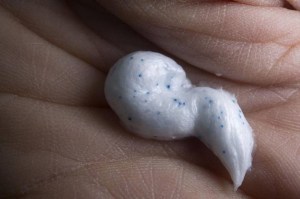
microbeads in toothpastes end up causing serious health and environmental problems in Great Lakes
Microbeads are tiny, spherical plastic particles ranging in size from an invisible 1 micrometer to 5 millimeters and are a subcategory of microplastics pollution. The tiny plastic beads are manufactured and added to hundreds of personal care products including cosmetics, face washes, toothpastes, deodorants, hair coloring, shaving creams and sunscreens. Manufacturers include them for their “ball-bearing” effect to create a silky texture to their products.
Once applied to the body, most personal care products are rinsed off and go down the drain to wastewater treatment plants. Because the vast majority of these facilities are not equipped to remove such tiny particles, they are discharged directly into surface waters. In the Great Lakes, a 2014 New York State Attorney General’s Office report found that 25 of 34 wastewater treatments plants discharged microbeads in their effluents.
Another common microbead pathway is through sewage sludge that is often applied as fertilizer on agricultural lands. Sewage sludge containing microbeads is spread as fertilizer and then mobilized and carried through the soil to groundwater sources or surface waters when it rains.
Microbeads also can make their way into the lakes during combined sewer overflow events, which generally occur during periods of heavy rainfall or snowmelt and allow untreated or partially treated sewage to enter local waterways.
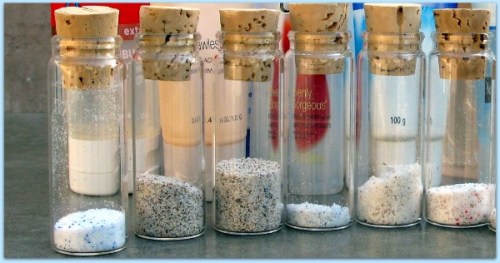
Microbeads appear in products including toothpastes. Photo Credit: Randall Benton
The continued increase in the amount of plastic waste in aquatic systems, combined with the lethargic degradation rate of these particles, means it’s no surprise that global waterways – including the Great Lakes – are accumulating incredible levels of plastic waste.
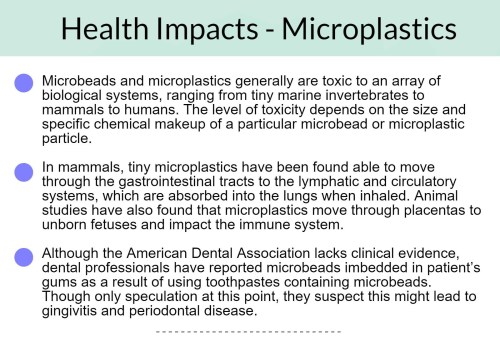
Once microbeads reach surface waters such as the Great Lakes, aquatic organisms and wildlife can mistake microbeads as food. The particles may contain toxic substances such as phthalates and bisphenol-A (BPA), and the petroleum present in the plastics serves as a magnet for other toxins such as the insecticide DDT. Reproductive and developmental health impacts from these toxic substances are well-documented, particularly as the toxins bioaccumulate in organisms higher in the food chain – including humans
The hazards of microbead exposure and consumption, which includes microplastics, are being studied at a worldwide scale. When species throughout the food chain are exposed to or consume microplastics, early findings from Environment Canada’s 2015 Microbeads Science Summary Report point to numerous health impacts.
There is still much to learn about the environmental and human health impacts of microplastics pollution. While global research efforts continue, preventing microplastics from entering the environment remains a key mitigation strategy (See beatthemicrobead.org/en/science for a summary of the latest international research).
For the Great Lakes in particular, where colder temperatures allow plastics to survive for centuries, preventing the tiny invasive particles from reaching the ecosystem is the best approach to stop their impacts on species throughout the food chain.
While state, provincial and national bans have been introduced or passed in Canada and the United States products containing microbeads are likely to stay in the market for some time. Consumers can purchase products with natural alternatives to microbeads – such as ground almonds, cocoa beans, apricot pits and sea salt – and download an app called Beat the Microbead that scans barcodes to determine if a product contains microbeads.
While eliminating microbeads from products – and eventually from the Great Lakes – will require much more research, legislation and action to deal with the broader category of microplastics, individual efforts can make a big difference to reduce inputs of microbeads from personal care products.
See more on this issue at: http://www.ijc.org/en_/blog/2016/02/16/tiny_plastics_inflict_huge_environmental_human_health_impact_story1/#sthash.fyVx1mSF.dpuf
The International Joint Commission (IJC) is an international organization created by the Boundary Waters Treaty, signed by Canada and the United States in 1909.
The International Joint Commission prevents and resolves disputes between the United States of America and Canada under the 1909 Boundary Waters Treaty and pursues the common good of both countries as an independent and objective advisor to the two governments.
In particular, the Commission rules upon applications for approval of projects affecting boundary or transboundary waters and may regulate the operation of these projects; it assists the two countries in the protection of the transboundary environment, including the implementation of the Great Lakes Water Quality Agreement and the improvement of transboundary air quality; and it alerts the governments to emerging issues along the boundary that may give rise to bilateral disputes.
Learn more about the International Joint Commission at www.ijc.org
NOW IT IS YOUR TURN. Niagara At Large encourages you to share your views on this post. A reminder that we only post comments by individuals who share their first and last name with them.
Visit Niagara At Large at www.niagaraatlarge.com for more news and commentary for and from the greater bi-national Niagara region.
 Niagara At Large