
We Are Hewers Of Wood, Rocks, Coal, Asbestos And Tar Sands Goo – And Now We Have A Dollar Soon To Be Worth Little More Than Two American Quarters
“I think the selling of these resources is a sign of the weakness of the whole (Canadian) set-up. … Instead of developing what you’ve got, you seem content to sell it in its raw state.” – the late British journalist Malcolm Muggeridge
A Commentary by Doug Draper
Posted January 12th, 2015 on Niagara At Large
As Canada’s ‘petro-lonnie’ sinks below 70 cents U.S. a the cost of vegetables, fruit and other imported products get harder for growing numbers of Canadians to afford, we’ve got a Bank of Canada chief who sits back and says he is not planning to do anything to pump up the dollar and the rest of us are just going to have to deal with the pain.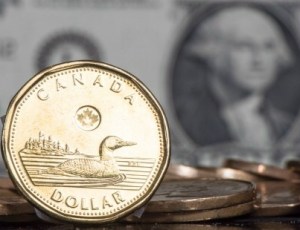
This same Bank of Canada governor – one Stephen Harper appointed hack named Stephen Poloz who a year ago this past November advised young people coming out of college or university with a huge debt and who can’t find a paying job to work for free – keeps reminding us, as other economists do, that the loonie, or whatever you want to call the metal slug that passes for a dollar in this country, tanks when the price for raw resources – particularly the undistilled goo from the tar sands – Canada sells on the world market tanks too.
Indeed, many economists have warned that Canada’s long history of selling off our raw resources rather than developing them into finished products ourselves makes the country’s economy particularly vulnerable when markets and prices for those resources take a significant fall.
Many experts have also stressed that the strength of Canada’s currency and other economic vital signs have been made even more vulnerable to a crash by the last government of Stephen Harper putting so many of the country’s financial eggs in the tar sands basket.
In his recently published book ‘The Carbon Bubble – What Happens To Us When It Bursts’, Jeff Rubin, the former chief economist at the Canadian Imperial Bank of Commerce, shared the following observations in the book’s introduction; “As Canada was busy putting all of its economic eggs in one oily basket – ramping up oil sands production to unprecedented levels – the warning signs were already plain to see (and had been for some time) for anyone who cared to look. … Given the oil sands’ oversized imprint on the country, there will be important repercussions for the Canadian economy, the Toronto Stock Exchange (one of the most oil-intensive bourses in the world) and your portfolio.”
Well, obviously the Harper/Ambrose party for old stock Canadians didn’t care to
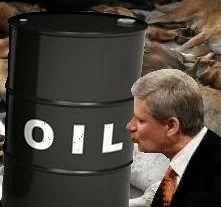
Harper and his party of old stock Canadians put most of their stock in the tar sands and the country’s economiy is suffering another meltdown because of it.
look, whether out of stupidity or out of being so much in bed with the elites in the tar sands industry that they could care less to look at the consequences for the country’s overall economy or the health of the planet.
And this was the party that told Canadians right up to election day last October that only they could be trusted to look after the economy. Even now, Rona Ambrose and the remnants of the Harper regime she’s interim leader of are behaving as if they won the election and new government in Ottawa should carry on with their agenda.
Canada should still build those pipelines for carrying the goo from the tar sands to port where it will be refined into gasoline and oil in another country and sold back to us at a premium, Ambrose and company insisted earlier this January when the loonie slide below 70 cents U.S. for the first time in going on 15 years.
Remember that this was the same Harper/Ambrose party that, while in government, tried to convince U.S. government to approve the Keystone XL pipeline from the Alberta tar sands to the America gulf coast on the grounds that 40,000 jobs would be created in the U.S. refining the stuff there.
Even if we wanted to go on destroying more boreal forest to mine this goo (and for the sake of the planet and my young daughter’s future, I certainly don’t), why wouldn’t we grow the refining capacity and jobs here in Canada?
That was never part of the agenda for the economic wizards in the Harper/Ambrose party and as fair as I can be to them, it has never been all that much a part of Canada’s history going back to colonial days when we traded in beaver pelts.
All of this has me recalling an interview I did with the late British journalist and intellectual Malcolm Muggeridge when he was a guest teacher in the journalism program I was enrolled in at the University of Western Ontario in 1979.

The legendary British journalist Malcolm Muggeridge could see the folly in Canada selling off its raw resources years ago.
In a story I did for late great St. Catharines Standard based on that interview, Muggeridge made an observation about the state of Canada that is as relevant today as it was then (except that you may want to change his reference to Japan then to China today) and that observation, published in a June 11th, 1979 edition of The Standard under my byline, went like this –
“I think the position of Canada today is very anomalous and rather hazardous,” Muggeridge said. “I can see, from talking to Canadians, that something is unsatisfactory.”
“You don’t want to be Americans, which is completely understandable, so you find yourselves, so you find yourselves ery thin on the ground on a huge continent, which you haven’t, in fact, developed,” he continued. “You sold it. You sold its wood and its coal and its oil but you haven’t developed it. It’s an undeveloped country, really.”
“The current economic problems of Canada are particularly surprising because its such a rich country agriculturally and from the standpoint of raw materials.”
“I think the selling of these resources is a sign of the weakness of the whole set-up,” Muggeridge concluded. “Instead of developing what you’ve got, you seem content to sell it in its raw state. In Vancouver, you can see all the unrefined coal and unrefined steel going off to Japan to feed the flames of that country’s prosperity.”
There were a couple of elections in Canada this past year that leave a glimmer of hope that we might finally get around to using these raw resources to make more things of our own in this country – that we may be able to go into a store and more easily find a ‘Made in Canada’ tag on a product.
An election in Alberta put NDP leader Rachel Notley in the Premier’s chair and a national election saw the country a new Prime Minister in the name of Justin Trudeau. Both are talking with more vigour than I believe I’ve ever heard from a Prime Minister or Premier in Canada about the need to “diversify” so that the country isn’t investing all of its economic eggs in a handful of raw material baskets.
For the sake of a sunnier future for all of us, let’s hope that diversification means using Canada’s resources to advance a manufacturing sector that feeds the flames of this country’s prosperity.
NOW IT IS YOUR TURN. Niagara At Large encourages you to share your views on this post. A reminder that we only post comments by individuals who share their first and last name with them.
Visit Niagara At Large at www.niagaraatlarge.com for more news and commentary for and from the greater bi-national Niagara region.
 Niagara At Large
The Canadian Government must take back control of our raw materials. For example, “By owning 70 per cent of their own oil production and taxing oil revenues at close to 80 per cent, Norway is now saving about $1 billion per week” compared to Canada being in a deficit position. The difference between our Loonie being on par with the US dollar and the current $0.69 is the multi national corporations are able to make higher salaries and bonuses for CEO’s and larger profits which they send out of Canada ASAP (perhaps offshore banks). In the meantime, Canadian jobs are downsized and workers who are retained are doing the work of two or more workers without any increase in compensation – perhaps a lower salary. Instead of lowering the interest rate – causing our Loonie to go down further in value, the Bank of Canada should attract investment. KEEP CANADIANS EMPLOYED!
LikeLike
The Canadian government must bring back the Bank of Canada as well. A conversation with constitutional lawyer Rocco Galati https://www.youtube.com/watch?v=Zw4aZ_V5594&feature=youtu.be
LikeLike
We need new thinking on our economy and its diversification. That’s why we changed the government completely. Canada needs to invest in our very smart people with intelligent science. Bring in wind and solar farms among other clean energy sources. Make effective education affordable. Build on our great history without deifenbaker’s fear of the future. Think of the avro arrow. I’ll never forgive that mistake and lack of courage. Stop handing Canada to the highest bidder for quick money that goes into the pockets of the one percent. Build new systems and technologies. Invest in the infrastructure, our population and our new immigrants. Build ou science programs and use all our resources for the enrichment of Canada. If we had geothermal /wind/solar farms we could produce good food all year round. Is that enough? I can go on and on.
Look to Iceland and Denmark and many other progressive countries in Europe to name a few. Look to Europe for advice and ideas so we develop products and services we can sell to the americas. we should be more independent in our thinking and ways forward.
Protect our land with satellites and drones and missiles and stay out of manufactured wars over oil which is a dead issue anyway. Invest in ways to cconvert the cars on the road to hybreds. Use more geothermal energy.
don’t sign the TPP until it fully benefits Canada. We have lots of trading pacts now.
LikeLike