
-
“There are numerous areas where improvements are needed to enhance the quality and cost-effectiveness of government.” – Report
News from the Office of Ontario’s Auditor General
Toronto, Ontario – This December 2nd, Auditor General Bonnie Lysyk’s 2015 Annual Report was tabled in the Ontario Legislature.
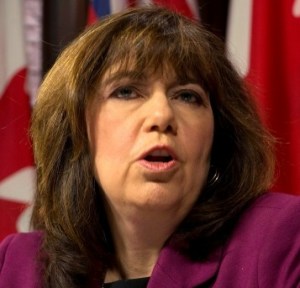
Ontario Auditor General Bonnie Lysyk releases critical annual report on cost and effectiveness of government services.
It covered results from a wide range of value-for-money audits, including energy planning, health-care services, long-term-care homes, child welfare, infrastructure planning, and electricity transmission and distribution.
“This year’s report shows there are numerous areas where improvements are needed to enhance the quality and cost-effectiveness of government and broader-public-sector services,” Lysyk said.
There are 14 value-for-money audits contained in the Report, as well as a chapter on annual reports of government agencies and a section on government debt.
Findings in this year’s Report include:
- A new computer system used in the administration of social assistance—SAMS—was launched prematurely with serious defects at a cost of over $200 million, which was about $40 million overbudget, with additional costs to fix the defects that are expected to bring the total cost to about $290 million.
- The government had a process in the Electricity Act and its regulations for drafting and approving a long-term technical energy plan, but didn’t follow it.
- The Ministry of Health and Long-term Care fell behind on its critical-incident and complaint inspections at the province’s 630 long-term-care homes.
- The province has yet to correct many of the problems in the Home Care Program of Ontario’s 14 Community Care Access Centres that were identified in an audit our Office completed five years ago.
- Children’s Aid Societies are not always meeting provincial protection standards, may be closing cases too soon, and are taking too long to complete investigations of possible abuse.
- The Ministry of Children and Youth Services lacks sufficient information about the quality of care provided by Ontario’s 47 Children’s Aid Societies to oversee them effectively.
- Ontario’s 14 Local Health Integration Networks have a mandate to plan, fund and integrate local health systems, but the Ministry of Health and Long-term Care has not clearly outlined what the end result should look like and when it should be achieved.
- Ontario does not have co-ordinated plan or funding strategy in place for cleaning up contaminated sites.
- The Ministry of Northern Development and Mines has not been effectively encouraging timely mining development in the province, even though Ontario has a significantly lower tax rate on mining than the national average. There is also a need for a long-term plan for inspecting and rehabilitating abandoned mine sites.
- In recent years, Hydro One’s transmission and distribution systems have become less reliable, yet their costs are increasing.
- Given that Ontario plans to spend more than $120 billion on infrastructure over the coming decade, it needs to better identify and prioritize where the spending should be directed.
- Eighty per cent of the new funding the Ministry of Economic Development, Employment and Infrastructure approved in the last five years to support businesses went to select companies that were invited to apply for it.
- Although school buses are generally safe modes of transportation, government oversight should be strengthened to ensure that even more could be done to lower the risk to students.
- The Ministry of Research and Innovation does not track the total funding ministries and agencies invest in research and does not evaluate the impact of funded research. This results in difficulty determining whether value for money is being achieved.
- The annual reports of some of Ontario’s largest agencies are not being made public in a timely manner— or not at all in some cases. The Ontario Legislature is therefore not up to date on all agencies’ financial and other activities for the past year.
The Office of the Auditor General is an independent Office of the Legislative Assembly that conducts value-for-money and financial audits of the provincial government, its ministries and agencies. We also audit organizations in the broader public sector that receive provincial funding. Our vision is to deliver exceptional value and assurance to members of the Legislative Assembly, the Standing Committee on Public Accounts, and all Ontarians through high-quality work that promotes accountability, value for money and effective governance in the Ontario public sector.
For more information and to view the full report, please visit www.auditor.on.ca .
Visit Niagara At Large at www.niagaraatlarge.com for more news and commentary for and from the greater bi-national Niagara region.
(NOW IT IS YOUR TURN. Niagara At Large encourages you to share your views on this post. A reminder that we only post comments by individuals who share their first and last name with them.)
 Niagara At Large