
News from the Canada/U.S. Chamber of Marine Commerce
Ottawa, Ontario, September 30th, 2015 — As the debate continues both at home and abroad on carbon offsetting measures, the Chamber of Marine Commerce is urging stakeholders and governments to carefully consider the environmental advantages and the competitive challenges faced by the bi-national Great Lakes-St. Lawrence shipping industry.
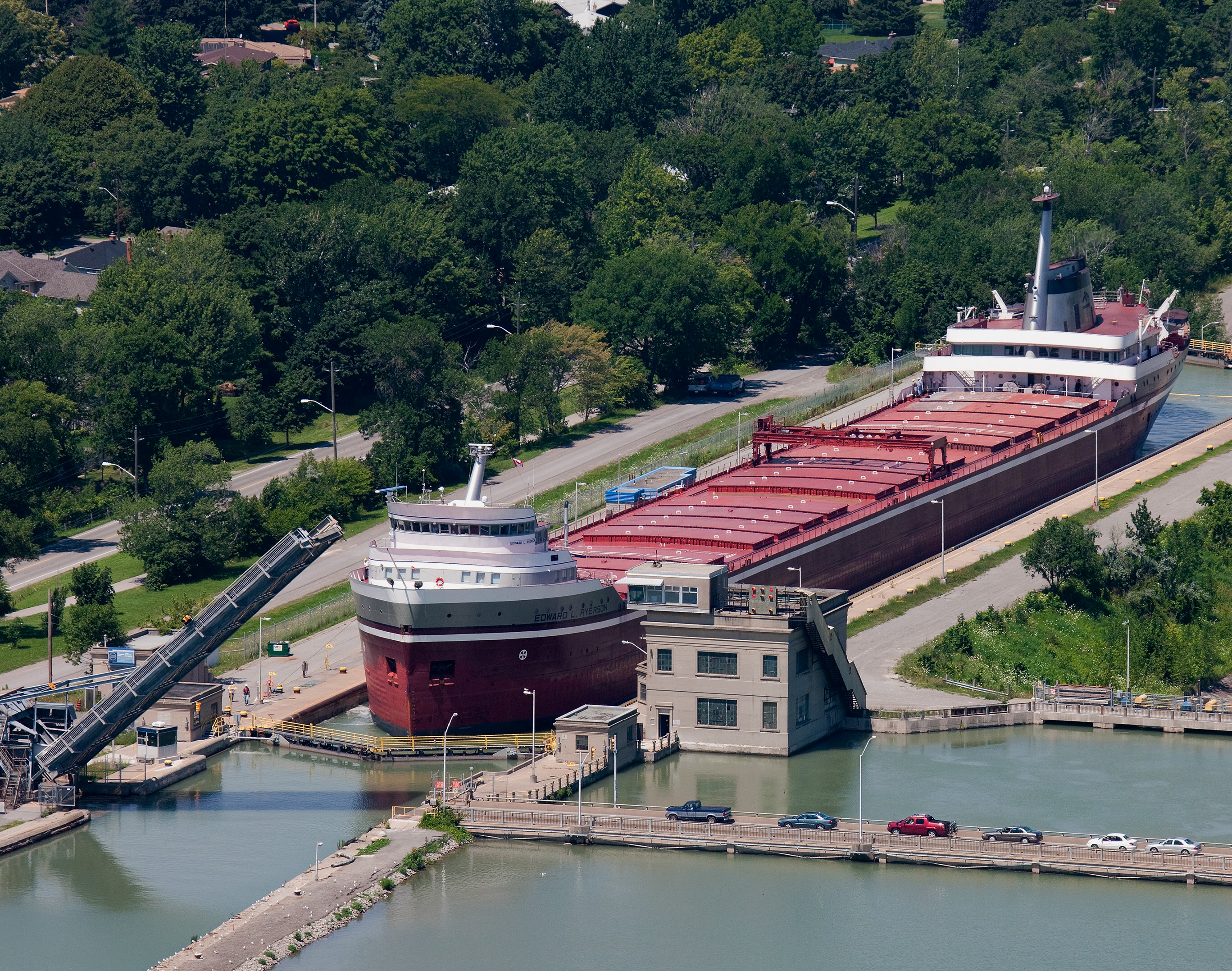
Another ship moves through the Welland Canal system in Niagara, Ontario
The call comes as the Ontario government develops details of a new cap-and-trade system to reduce greenhouse gas emissions and federal government negotiators head to Paris in December for the United Nations Framework Convention on Climate Change (UNFCCC) meeting.
Stephen Brooks, President of the Chamber of Marine Commerce, said that some past Canadian and U.S. regulations arising from international environmental commitments didn’t properly differentiate between domestic and global shipping.
He explained: “Unlike the global shipping fleet, most domestic shipping competes directly with road and rail. The more we unnecessarily burden this short-sea shipping with extra costs, the greater likelihood this freight moves to less environmentally-friendly modes. We also need to think about the negative impact of thousands, even millions of more heavy trucks on our overburdened highways and in neighborhoods where our families live, work and play.”
Ships have the lowest carbon footprint per tonne-kilometre. A recent study done by Research and Traffic Group showed that rail and truck would respectively emit 19 per cent and 533 per cent more greenhouse gas emissions per cargo tonne-kilometre if these modes carried the same cargo the same distance as the Great Lakes-Seaway fleet.
Allister Paterson, President of Canada Steamship Lines, added: “Canadian ship owners are investing over $2 billion in new Great Lakes ships and technologies that significantly further reduce fuel consumption, greenhouse gases and air emissions.”
Great Lakes-Seaway shipping supports 227,000 jobs and $35 billion in business revenues in Canada and the U.S., and contributes to the competitiveness of North American manufacturing, mining, energy and agricultural sectors.
About the Chamber of Marine Commerce
The Chamber of Marine Commerce is a bi-national association that represents more than 150 marine industry stakeholders including major Canadian and American shippers, ports, terminals and marine service providers, as well as domestic and international ship owners. The Chamber represents the interests of its members by addressing government issues affecting marine transportation. Advocacy extends to federal, state/provincial and municipal levels of government.
Visit Niagara At Large at www.niagaraatlarge.com for more news and commentary for and from the greater bi-national Niagara region.
(NOW IT IS YOUR TURN. Niagara At Large encourages you to share your views on this post. A reminder that we only post comments by individuals who share their first and last name with them.)
 Niagara At Large
The one good thing to come from the ‘religion’ of AGW/Climate Change is that we are cleaning our air, water and soil pollution. It’s funny how humans don’t seem to be able to do things for the right reasons.
It appears that the December Paris conference will lead us further into the corruption of Carbon Trading and transfer of jobs to India, China & Brasil. Instead we should use our scarce funds to strengthen Canada’s infrastructure against the fire, flood & famine that always happen somewhere as climate changes (remember the Biblical story of Joseph who advised Pharaoh to prepare for 7 years of drought that would follow 7 years of plenty?)
Too bad no political party has had the courage in this federal election to tell Canadians that IF the AGW scare is true, according to Kyoto, we need to stop driving cars & flying anywhere.
Since None of us are going to do that AND None of the AGW predictions have occurred (in fact, there are scientific papers that the 18 year pause is actually the beginning of a 50 year cooling phase), let’s do come serious research on what causes climate to change. Earth’s climate is obviously far more complex than our scientists have imagined and they’ll need several more decades to ‘settle the science’.
LikeLike