
A Commentary by Doug Draper
In Canada’s Harperland, there is no recession, just a “contraction” – a word Stephen Harper and his trained seals have been using in response to everything from the economic bloodbath in once carbon-rich Alberta and chronically high, double-digit unemployment rates for Canada’s young people to a loonie that has devolved to dodo status against the American greenback.
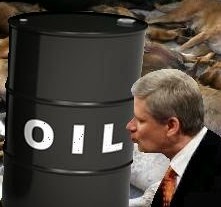
Canada’s Prime Minister Stephen Harper has made the country especially vulnerable to recession or worse by putting so many eggs in the tar sands basket.
Yes, in Harperland the economic data released by Statistics Canada this September 1st, showing two consecutive quarters of negative growth – a long enough slump to, by any measure used in the developed world, constitute a recession – is nothing more than “a couple of weak months,” added Harper in response to the figures and is “almost exclusively” due to air rushing out of the balloon in one sector.
That might sound like a relief if the sector being battered wasn’t one Harper has focused almost exclusively on developing over the past 10 years to the neglect of most everything else. That sector is an energy sector dominated by the costly and dirty extraction of raw, unrefined bitumen from the tar sands (what Harper and his wordsmiths long ago sucked the mainstream media into calling the “oil sands” or “oil patch,” as if they are harvesting something as benign as strawberries or blueberries there) in the northern reaches of an Alberta he and a critical mass of core members of his Tory clan hail from.
How very interesting that Harper’s Conservative government is now attempting to link the economic mess it will hardly acknowledge or take responsibility for to a sector it has otherwise sold to us as a key driver of Canada’s economic growth.
“The oil sands are a very important resource for our country,” said Harper during a top in Niagara, Ontario four years ago. “It’s a source of economic growth and jobs across the country, not just in the west, but in Ontario and Quebec too.”
Thus the hell-bent effort to demonize environment groups and lull the rest of us into rolling over and playing dead while Harper and company gutted environmental rules and muzzled Environment Canada scientists so they could expand the dirty operations and construct pipes for shipping the tarry stuff out of the country where other nations see a growth in jobs refining it.
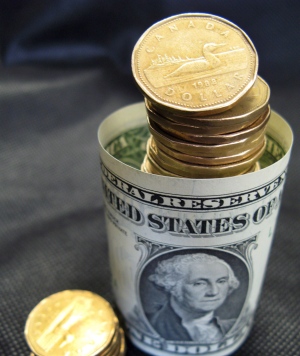
Diving loonie means higher prices for food and other consumer products imported to Canada. The loonie has dived in almost direct relationship to the falling fortunes of Harper’s tar sands fantasies
In a recently published book called ‘The Carbon Bubble – What Happens To Us When It Bursts’, a former chief economist at CIBC World Markets, Jeff Rubin writes; “No oil industry in the world is more vulnerable to plunging (oil) prices than the oil sands, home to one of the planet’s most costly and emissions-intensive oils. …”
“As Canada was busy putting all of its eggs in one oily basket – ramping up oil sands production to unprecedented levels, – the warning signs were already plain to see (and had been for some time) for anyone who cared to look,” Rubin adds. Given the oil sands’ oversized imprint on the country, there will be important repercussions for the Canadian economy, the Toronto Stock Exchange (one of the most oil-intensive bourses in the world) and your portfolio.”
In ‘Audacity of Hope’, a book Barack Obama wrote before he won the U.S. presidency seven years ago, he wrote; “Our dependence on oil doesn’t just affect our economy. It undermines our national security.” Since then, (and even while it continues to engage in fracking and other worrisome gas and oil extraction activities) significant steps have been taken in the U.S. to develop greener forms of energy. Right across the Niagara River in Buffalo, New York, what will be one of the largest manufacturers of solar energy on the continent is now under construction.
Even Saudi Arabia, still one of the world’s largest sources of oil, is thinking ahead and is now building huge solar facilities to provide energy to its people.
And here in Canada, we have Harper wanting to stay the course with his one trick pony leaving us more vulnerable to recession than other countries that have had the presence of mind to build more diversified economies outside the carbon bubble.
Where does Harper get off trying to cast himself as a great economic leader?
At a campaign stop in Gananoque, Ontario this past August 31st, Harper did the old rolling up of the sleeves to help staff at a local Tim Horton restaurant serve coffee and doughnuts.
“Tell me what to do,” he was reported saying to the staff. “Just don’t let me handle the cash.”
When we Canadians go to our polling stations this coming October, we ought to make sure Harper and his clan never get their hands on the national till again.
Visit Niagara At Large at www.niagaraatlarge.com for more news and commentary for and from our greater binational Niagara region.
(NOW IT IS YOUR TURN. Niagara At Large encourages you to share your views on this post. A reminder that we only post comments by individuals who share their first and last name with them.)
 Niagara At Large
Harper claims to have an economics degree. It seems that the only thing he learned about economics was that when there is an economic problem do as an ostrich – bury your head in the sand and repeat “There is no problem”. While he is in the ostrich position he reminds his caucus to repeat “There is no problem” or better still hide from the public.
LikeLike
Yes, we are in a “technical” recession. That’s jargon for a real recession. But whether we are or aren’t Harper and most political leaders and business interests with real power have missed the key failure in our approach to economics in any event. We live on a finite planet. We are unlikely to be moving to other planets on a large scale at any time in the near future. So this planet, at least for now, is all we have. The idea of continuous growth in the economy as the measure of a nation’s success is in need of a radical rethinking.
Consider the human body. Each of us has one, and only one. It is finite. Continuous growth of the human body is commonly known as cancer. It kills the body. Homeostasis does not! If we keep using growth as the measure of success economically, we will keep killing our planet as the cancer we humans have become. Our thinking is in need of a serious surgical intervention. Perhaps it might start, in at least one small way, by getting rid of the currently leadership and finding more creative economic thinkers who understand the cancerous nature of sustained growth of the economy.
I don’t see that happening of course, in no small part because we can’t even get people out to vote! Now, growth in voter turnout, ironically is the real answer to making change. Sitting on our butts on election day is laziness, apathy, and frankly disgusting in a nation whose people claim to care about democracy!!
LikeLike