
By John Bacher
On May 13, 2015 the Niagara Region submitted its briefing paper to the panel headed by former Toronto Mayor, David Crombie on the Co-ordinated Provincial Plan Review.
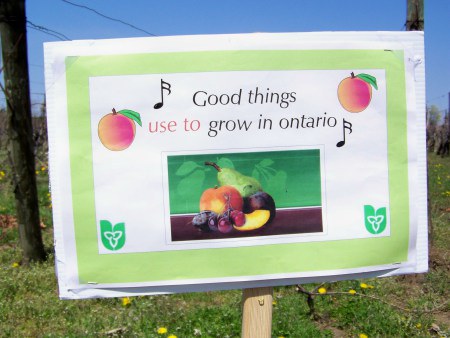
Due to a loss of canning companies around bad trade deals or just pressing in on our farmlands in ways that governments do not give them the support they deserve, we lose these precious growing lands in our region and country. File photo by Doug Draper
The contents of this audacious but revealing document can be summed up well with a parody of one of the plans being reviewed- the Growth Plan, more commonly called “Places to Grow.” What the Niagara Region’s government is calling for, quite simply, is “Places to Sprawl.”
In horrible details, Niagara Region’s government, with the backing of its 12 local municipalities, comes up with a revolting litany of ways to bulldoze down planning regulations that guard against a blight of low density sprawl further into this region’s green lands. Cleverly, it suggests a way which, if implemented, would simply dissolve the Greenbelt as a planning tool. The Niagara Region’s brief suggests that in place of the Greenbelt’s 10 year freeze on urban boundary expansions, that they be allowed to take place “at more regular intervals”. This is justified on the basis that the “Niagara Region is at a critical time of change.”
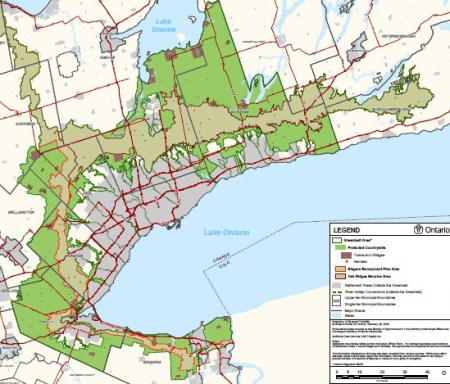
The Greenbelt in Ontario, Canada’s Golden Horseshoe and Niagara, has received international praise. But Niagara’s regional government and local municipalities wish to breach its boundaries in deference to urban developers.
The Niagara Region’s efforts to dissolve the Greenbelt are supported through a number of planning studies, none of which have had any advertised public meetings. We are told about “an Urban Visioning Strategy to redefine where and how we grow.” There are “Master Plans” for servicing, to be topped off by a study of “Mobility Hubs.”
The future studies that the Niagara Region is trotting out to justify the dissolution of the Greenbelt are contradicted by a completed report, conducted by the Dilon planning firm. Unlike the secretive meetings cited by the Niagara Region, this did go through extensive public consultation. It concluded that no urban boundary expansions are justified, in part because they pose a threat to the scenic beauty that is the basis for our tourist industry.
The Region also makes many suggestions for withdrawals from now agriculturally zoned land from the Greenbelt. These protected landscapes are placed into “Settlement Areas within the Growth Plan.”
The first priority is all, and what is sadly left of the remaining tender fruit land in Grimsby north of the Niagara Escarpment. The second are “lands south of Beamsville, extending slightly into the Escarpment and lands on the eastern part of Jordan.”
The third priority for Greenbelt shrinkage is an array of lands good for grapes and tender fruit in Niagara-on-the-Lake. On top of this are “lands to the west of Old Town and lands to the west of St. David’s in the Town of Niagara on the Lake.”
The Niagara Region also seeks removal of; “Lands in the vicinity of the Virgil urban boundary and the general southeast corner of this boundary.”
Cut backs from the Greenbelt are advocated in the Town of Pelham. These are the hamlet of Ridgeville, “that also recognize the lands designated as Fonthill Kame by Dr. Menzies.”
Extensive removals from the Greenbelt are also sought for Niagara Falls. Here the cutback is defined as lands, “in the northern part of the City of Niagara Falls extending from the urban area boundary to the municipal boundary.”
In addition to advocating Greenbelt cuts, the Niagara Region urges the designation of some lands now within what is termed “the protected countryside” of the Greenbelt to become “Special Policy Areas.” More lands await the detailed mapping which is being developed by the Niagara Region. The brief cites a preliminary list its shopping list of greenbelt loopholes.
It provides “Examples of areas that would benefit from this type of policy.” One “example” is “Lands along Highway 55 in the Town of Niagara on the Lake between Virgil and Old Town.” Another are “Lands along Victoria Avenue in the Town of Lincoln between the urban boundary of Vineland and the QEW Service Road.” together with adjacent lands “along the north side of Culp Road.”
In addition to cutbacks and the creation of special policy areas, the Niagara Region calls for an end to the Greenbelt’s protection of forests. Its brief deplores how, “Woodlots which are functioning components of farms” are now “classified as key natural heritage features.”
The only environmentally positive aspect of the Niagara Region’s brief is its call for two expansions of the Greenbelt. One is a new suggestion to include Grimsby’s rural lands south of the Niagara Escarpment. The region also finally endorses Thorold’s decade old call for the expansion of the Greenbelt in Lake Gibson around a water supply reservoir. This measure however, has yet to be followed by a formal endorsement of this expansion by the Niagara Regional Council as is required for such Greenbelt expansions by the province.
What makes the Niagara Region’s war on the Greenbelt so absurd is the major asset of our community, the fact that we are as the brief acknowledges “a world renowned tourism destination, drawing millions a year to Niagara’s natural and created attractions.” The Region should acknowledge what its planning consultant and the public who bothered to come out to its three public meetings and respond to surveys found- that this asset is degraded by sprawl.
John Bacher is working on the Greenbelt Review for the Sierra Club of Canada and the Niagara-based citizens group, the Preservation of Agriculture Lands Society. This is the first in a series on articles on the review. Later articles on the review will deal with wildlife, forests, fruitland , water pollution, the Niagara Escarpment and forests.
(Niagara At Large invites you to join in the conversation by sharing your views on the content of this post below. For reasons of transparency and promoting civil dialogue, NAL only posts comments from individuals who share their first and last name with their views.)
 Niagara At Large
John – thank goodness for your comprehensive understanding of what is going on. I don’t get it–promoting the Niagara region is often keyed by
this landscape — tourism, most biz and even educational institutions all riff the same jingle about our ‘prettiness’ to get attention. They can’t have it both ways. Low density is passe and bad for health. Sprawl is brainless in this era of environmental urgencies . We need more public consultation.
LikeLike
Hear, hear, John; well explained.
Niagara won’t realize what we’ve lost until some unexpected world event happens and we want to grow Food on our excellent … subdivisions?
What unexpected world event might happen?
– Someone said 50+% of North American food is grown in California by importing Water from North-western USA states. When will their long term drought dry up our food supply? (Almonds have Doubled in price in the past year!)
– Carbon Pricing by Ontario should raise the cost of Transporting food by Truck in North America & by Ship from across the oceans.
– War, embargoes & trade disputes elsewhere on earth, can disrupt food supply & price .
– Ditto for diseases of plants (eg. potato blight) and animals (eg. Mad Cow, Bird Flu).
– Ditto for plagues like Ebola.
Niagara won’t realize what we’ve lost until some unexpected world event happens and we want to grow Food on our excellent … subdivisions? Europeans have had centuries to understand this, and it explains why they subsidize their farmers to keep them growing food. We complain about the modest extra cost of healthy food from ‘supply management’ Marketing Boards which cost the taxpayer nothing, while the rest of the world hide their agri-grants in taxes.
PLEASE Regional Councillors, think beyond the short re-election cycle!
LikeLike
John this is the sole determination of the developers for they in many cases finance the election of most if not all the Regional Councilors and they in turn literally “OWN” the council… WE see evidence of this every time there is an attempt to raise the Development Charge…What can stop this????? God Only knows because it is a “CREED of GREED” and a feeling of selfish ENTITLEMENT that makes them feel they are the masters of the realm????…..this and the dollar bill seems to be their “GOD”
LikeLike
Good one John just like the Garden City. Turning Niagara into trtirement capital of Ontario new shopping mall proves it
LikeLike
Wonderful comments above, and good report, John.
I received an online survey about this more than a month ago; I could see the way the questions were trying to force one to support development at all cost. I don’t know who was behind it, but do have my suspicions about the cabal that runs the Region. My experience with the city of St. C. Planning dept (Infil, infil, infil) makes me weary. Greens spaces and community gardens are not going to win the day with these corporate planners.
LikeLike