
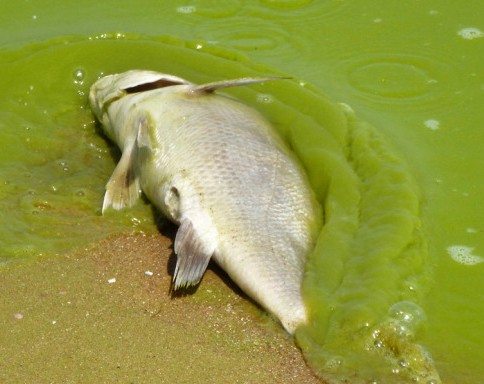
Another of countless dead fish washed up along the Ontario shores of Lake Erie in a slime of killer algae the province’s Conservation Authority administrators and board members has failed to effectively address.
News from the Alliance for the Great Lakes • Environmental Defense Canada • Environmental Defense Fund Freshwater Future • Michigan League of Conservation Voters • National Wildlife Federation Ohio Environmental Council
Quebec City, Quebec, Canada – This June 12th, , the Governors of Ohio and Michigan and the Premier of Ontario announced a significant commitment to restore Lake Erie by putting an end to harmful algal blooms like the one last summer that left nearly 500,000 Toledo-area resident without safe drinking water.
We applaud their commitment to reduce the amount of nutrient pollution, specifically phosphorous, flowing into western Lake Erie by 40 percent – and we look forward to working with U.S. and Canadian public officials to take action to meet that goal.
The commitment is an important step forward in keeping Lake Erie free of harmful algal blooms and, in turn, protecting our region’s economy, drinking water and way of life. The science is clear: dissolved phosphorus from agricultural runoff is driving the resurgence of harmful algal blooms.
Today’s commitment is another positive step toward restoring Lake Erie. We look forward to hearing additional details and working with the states and provinces to implement the agreement.
An Afterword from NAL publisher Doug Draper – An agreement like this is good news.
The health of Lake Erie as a source of drinking water for millions of Canadians and Americans, including residents in the Niagara, Ontario/Western New York region, is under serious threat given the algae growth in the lake, much of it a result of nutrient contamination running off from agricultural lands and aggravating climate conditions.
States like Michigan and Ohio are taking significant steps to deal with this farmland runoff, but there is little evidence that Ontario is taking anything other than token steps on this front.
One of the reasons for this is that Conservation Authorities responsible for protecting watersheds in Ontario, including the Niagara Peninsula Conservation Authority, are dominated by administrators and board members, appointed by political friends at the municipal level, who are more supportive of the interests of land developers and the most backward-thinking members of the agricultural community (farm representatives who too often do not embrace the greener practices of many good farmers).
Until the Niagara Peninsula Conservation Authority and its counterparts across the province are disbanded – meaning that their administrators and board members are given their walking papers, and the good front-line staff from these authorities are kept and brought under the wing of the Ontario Ministries of Natural Resources and Environment, it is increasingly impossible to believe that environmental protection initiatives such as the one defined in this recently signed Lake Erie agreement will be taken as seriously as it should on the Ontario side of the lake.)
(Niagara At Large invites you to share your comments on this issue below. NAL only posts comments by individuals who also share their real first and last name.)
 Niagara At Large