
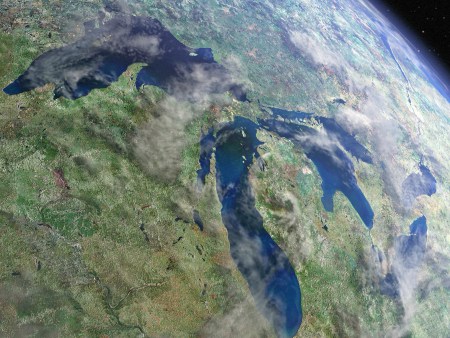
The Great Lakes from space. The largest single basin for fresh water in the world. Do we still care enough to save them?
News from the Alliance for the Great Lakes • Freshwater Future • Michigan League of Conservation Voters Ohio Environmental Council • National Wildlife Federation
(A Brief footnote from Niagara At Large – Nutrient pollution from both sides of the U.S.?Canada borders of the Great Lakes could suffocate theses greatest of frehwaters to a point where there is no live living n them for fish or the rest of us. Note here that no Canadian group is involved in the important post below. Not Polluton Probe, the Council of Canadians or anwyone else. Apparently they have all given in to Harperland and an attitude in Canada that there is no more hope for anything around protecting the life-sustaining resources of our planet.)
Chicago, U.S.A. – May 2015 – Solving the nutrient crisis facing the Great Lakes requires an all hands on deck approach. The report released today by Ceres – Feeding Ourselves Thirsty: How the Food Sector is Managing Water Risks – is a clear call to action for increased private sector engagement to improve water quality not only at their facilities but also throughout their supply chains from farm to factory.
At the beginning of many food sector supply chains are farming operations throughout the Great Lakes region, from soybean farms in the Lake Erie watershed to dairy farms in the Green Bay watershed.
The science is clear that agricultural production is a significant source of nutrient pollution in the Great Lakes. Nutrient pollution is the cause of harmful algal blooms, which are experienced most acutely in western Lake Erie but are well-entrenched in other areas including Green Bay and Saginaw Bay.
Actions highlighted in the report, if implemented by the 37 major U.S. food sector companies profiled, would significantly improve the health of the lakes and make strong progress toward solving the region’s nutrient crisis. The report identifies actions such as partnering directly with suppliers to increase technical expertise or providing funding for efforts that will prevent nutrient pollution from entering waterways; addressing pollution impacts at the watershed scale rather than field by field; and, encouraging investors in food sector companies to integrate results from water risk analysis and into buy/sell decisions.
However, private sector engagement is only one part of a permanent solution to the nutrient crisis. Leadership by the Great Lakes Governors and Premiers is vital to clearly mark the goalposts for addressing the harmful algal blooms plaguing Lake Erie. At the upcoming meeting in early June of the Council of Great Lakes Governors, the region’s leaders should commit to at least a 40 percent reduction in phosphorus inputs into the Western Lake Erie basin, with an emphasis on reducing agricultural sources. This reduction commitment must be accompanied by a clear timetable with a firm deadline, set milestones, and a monitoring plan to measure progress and help agencies adjust programs, if needed, to ensure deadlines are met.
For more information contact:
Alliance for the Great Lakes – Jennifer Caddick: jcaddick@greatlakes.org, (312)445-9760; or Molly Flanagan: mflanagan@greatlakes.org, (312) 445-9741
Freshwater Future – Jill Ryan: jill@freshwaterfuture.org, (231) 348-8200
Michigan League of Conservation Voters – Jack Schmitt: jack@michiganlcv.org, (734) 222-9650
Ohio Environmental Council – Adam Rissien: arissien@theoec.org, (614) 487-5832
National Wildlife Federation – Jordan Lubetkin: lubetkin@nwf.org, (734) 887-7109
(Now Niagara At Large invites all who care to share their real first and last name to use the space below to share your comments on this important issue.)
 Niagara At Large
Expand the Green belt to include the whole Province . Turn the Ontario Drainage Act into the ground water retention act and vegetative buffer from land use operations and our watersheds act …
LikeLike