
News from the Hamilton, Ontario based watchdog group Citizens At City Hall, better known as CATCH in the Hamilton area.
(A Brief Foreword note from Niagara At Large publisher Doug Draper – This very same extreme weather report, courtesy of man-assisted climate change, could apply to our greater Niagara region. We could certainly use a watchdog group like CATCH here in Niagara to push our municipal politicians – many of them still living in the last century – along.)
May 1st, 2015 – In the wake of the hottest March in global records, there are growing provincial and municipal efforts to address the impacts of climate change, including a major McMaster symposium next week on how to respond to weather extremes in Ontario. And in contrast to Hamilton’s refusal to fund additional climate staff, Halton is trumpeting its financial commitment in the opposite direction.
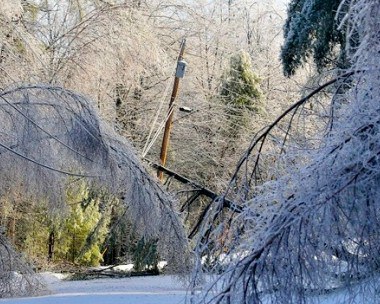
A recent look at weather conditions that snapped trees, downed electrical wires and caused millions of dollars of other damage in southern Ontario. Too bad we have too many loud voices on regional council in Niagara who call climate change a joke. This photo is here via NAL and was not part of the original CATCH piece.
The regional government that includes Burlington, Oakville and Milton highlighted climate change spending in its recently approved 2015 budget. That includes close to $6 million to strengthen response to “emergencies and urgent incidents including severe weather events” and to provide equipment for emergency warming centres.
“Weather patterns have changed over the past few decades with more localized storm events of greater intensity occurring with greater frequency, such as the December 2013 ice storm and the August 2014 flood,” notes the region’s media release on the budget. There’s also $5 million set aside to prevent the kind of basement flooding that hit over 3000 Burlington homes in last summer’s record-breaking storm.
The majority of Hamilton council in their budget deliberations rejected a senior staff recommendation to support the current half-time climate coordinator with two staff to prepare adaptation strategies for extreme weather at a cost of $192,000.
The May 11 all-day McMaster symposium is titled “Ready, Steady, Adapt” and is organized by the Ontario Climate Consortium (OCC). It is hosted by the university’s Centre for Climate Change and features a keynote address by Glenn Murray, the Ontario Minister of the Environment and Climate Change.
The Wynne government has now announced carbon pricing after completing a province-wide consultation on climate change policy. Last week Ontario and Quebec issued a joint statement that Canada is “particularly vulnerable and disproportionately affected by the impacts of climate change” and must take “ambitious mitigation measures” as well as focus on adaptation.
“Climate change is already hurting our environment, causing extreme weather like floods and droughts, and hurting our ability to grow food in some regions,” the premiers of Canada’s two largest provinces declared, “Over the near term, it will increase the cost of food and insurance, harm wildlife and nature, and eventually make the world inhospitable for our children and grandchildren.”
The joint statement came on the heels of a meeting of eleven premiers that challenged federal inaction on climate and responded directly to comments by Prime Minister Harper. The common front at the summit in Quebec City included all provinces but Alberta.
After a record hot 2014, the National Oceanic and Atmospheric Administration in the US reports that “the first quarter of 2015 was the warmest such period on record across the world’s land and ocean surfaces” and that “seven of the past eleven months (May, June, August, September, October, and December 2014, along with March 2015) have tied or set new record high monthly temperatures.”
Major impacts linked to climate change include a record 85% decline in the volume of ice in the Arctic Ocean and the extreme drought affecting California where officials say the fire season has become permanent and last week announced one of the world’s most ambitious targets to cut greenhouse gas emissions. The state supplies nearly a third of American food and much of the fruit and vegetables sold in Hamilton supermarkets which are now being replaced by Mexican produce.
The OCC made a submission to the province arguing that “reducing emissions and enhancing resiliency in the Greater Golden Horseshoe region requires a renewed effort to counteract the trend towards de-densification that has locked many Ontarians into an auto-dependent, high-carbon lifestyle.” Its McMaster symposium has several business speakers as well as an exploration of the role of art in climate activism.
Symposium co-sponsors include Environment Hamilton and the Hamilton 350 Committee. The latter is also helping organize a climate change film showing and discussion at 7pm on Saturday, May 9 in Stoney Creek United Church.
CATCH (Citizens at City Hall) updates use transcripts and/or public documents to highlight information about Hamilton civic affairs that is not generally available in the mass media. Detailed reports of City Hall meetings can be reviewed at hamiltoncatch.org. You can receive all CATCH free updates by sending an email to http://hamiltoncatch.org/newsletter/?p=subscribe . Sharing links are available on the hamiltoncatch.org.
(Niagara At Large invites you to share your comment on this post below. This stite is moderated and only psts comments from individuals who also share their real first and last name.)
 Niagara At Large