
A Message to Readers from Niagara At Large publisher Doug Draper
When we launched Niagara At Large five years ago, we made a point of encouraging people across our greater region in Niagara, Ontario, the Buffalo, New York area, and beyond to join the debate on issues we post here.
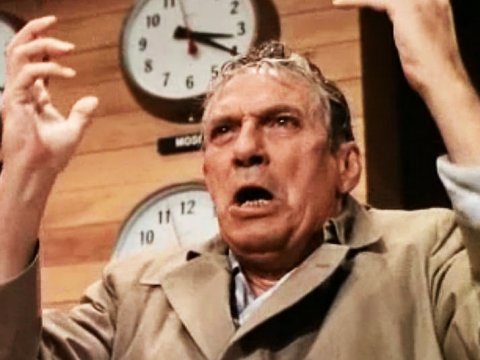
At least Howard Beale stood behind his name and had rants that were interesting. We ask for something of the same here.
We also made it clear from the start that, unlike most online sites hosted by mainstream media outlets and others, we would stay true to traditional, and what we continue to believe to be well-thought-out, first principles of journalism that require each and every person who posts a comment here (what is the equivalent to a Letter To The Editor in a newspaper that is still actually printed on paper) to share their real name with their views.
We continue to embrace these principles for reasons of transparency and the same kind of public accountability that applies to this publisher, to public servants and to anyone else who posts or is part of a story or commentary here with their name hanging in the balance.
Our view is that if others are willing to put their name on the line in a story or commentary, then those who respond should show the courtesy and courage to put their names on the line too. Those who don’t or who choose to use false names and email addresses are nothing more than cyberspace snipers – cowards who shoot at others from behind the bushes.
In our view, the anonymity of other mainstream media blogs, including those sponsored by Sun Media, grants these cowards license to attack people in uncivil ways that would never be tolerated in an open, civil forum.
So we are proud to continue with our policy of only posting comments by people who share their real first and last names, and we could hardly care less of that means posting fewer comments than those sites willing to post comments by those who prefer to identify themselves as ‘disgruntled’ or ‘rage master’ or flamethrower’. In our view, comments from these cowards are mostly laden with poison and add nothing of any value to the discussion or debate.
So rest assure around this. We remain most welcome to post your comments if they are civil and you have the courage to share your name with them. Other than that, please do us a favour go to online sites at the St. Catharines Standard, Niagara Falls Review and so on where almost any kind of anonymous sewage seems to go.
Finally, a journalistic hero of mine, Margaret Sullivan, now the public editor at The New York Times and a former managing editor at The Buffalo News, wrote the following column when she was still the Buffalo paper’s editor and was one of the first from a mainstream paper who had the guts to say no to anonymous online comments.
Her column from The Buffalo News, reprised here below, does as good a job as any of saying why Niagara At Large will not entertain comments from anonymous cowards. Here is Margaret Sullivan’s take on this issue.
Seeking a return to civility in online comments
By Margaret Sullivan
Some editors were sitting in a news meeting one morning not long ago, bemoaning the often outrageous, intolerant and hateful online “comments” attached to stories on The News Web site, when News Business Editor Grove Potter uttered a simple but eloquent truth:
“Let’s face it,” he said. “We’ve created a class of anonymous flamethrowers.”
He’s right. We have. And shortly, we’re about to change that dramatically.
Online commenting began, a year or so ago, as a way to engage our Web readers and give them a chance to air their points of view and get some discussion going on the topics of the day.
Quickly, though, the practice degenerated into something significantly less lofty. Particularly on stories about inner-city crime — but not only on those stories — reader comments can be racist and ugly. In fact, we’ve been shocked at how seemingly routine stories can elicit comments that veer off into offensive territory.
One local reader, Bob Gallivan, wrote to me about it recently.
“What is intended to be an open forum for individuals’ thoughts and opinions is all too often the outlet for small-minded, omniphobic hatemongers, racists and just plain mean-spirited people,” he said.
Media organizations all over the country, particularly newspapers with active Web sites, are struggling with this subject. There’s no easy answer. The tension is between wanting to take advantage of the freewheeling expression of the Internet and wanting to keep standards of reasonable tolerance and decency on a public site.
After quite a bit of internal discussion, The News — in the next few weeks — will make a significant change. We will require commenters to give their real names and the names of their towns, which will appear with their comments, just as they do in printed “letters to the editor,” which have appeared daily for many years on the newspaper’s op-ed page.
It will mean that Web site readers must fill out an online form and include a phone number that we will use to help verify that they are who they say they are. It won’t be foolproof, and it will be somewhat labor-intensive for us, but we think it will raise the level of the discussion.
“We hope to raise the level of discourse by providing a measure of accountability,” said News Online Editor Brian Connolly.
The change arises, in part, after other methods have failed. The commenting was set up with certain restraints built in. One was self-policing — if a number of readers flagged a comment as unacceptable, it would be taken down. Another was monitoring by editors here, though the high volume of comments on dozens of stories a day made that impractical.
In some recent cases — for example, the celebrated Batavia arrest for adulterous sex on a picnic table — we’ve taken the more extreme measure of not offering commenting at all on stories that seemed most likely to descend into the gutter.
But, despite these precautions, trouble crept in anyway, like Peter Rabbit squeezing under the farmer’s fence. We have felt for some time that The News’ reputation for fairness and good taste was being damaged.
Clearly, it’s time to do something about it.
The changeover to the use of real names and locations will happen around Aug. 1. Before that, we’ll give our Web readers plenty of notice about how to comply with the new procedures.
The aim of publishing reader comments, all along, has been to have a free-flowing discussion of stimulating and worthwhile ideas — something of a virtual village square.
Now that people’s names will be attached to their ideas, we’re hoping that aim, finally, will be achieved.
Now share your views below if you dare to share your real name. Doug Draper, Niagara At Large.
 Niagara At Large
SNNNNAP! This is a superb piece of writing! Kudos to you Mr. Draper for taking the moral highground and staying there. There is enough cyberbullying, trolling and skulking permitted and encouraged by some ‘publications’ to satisfy those who thrive on this sort of trash.
LikeLike
Like drivers who rant at other cars when sitting in their vehicle so too does anonymity on the web create a similar environment. I applaud Niagara At Large with this stand.
LikeLike
One of the reasons I appreciate N-A-L is the insistence on real names for comments. I often disagree (sometimes strongly) with the opinions expressed by Doug or other commenters. But by having real names used, there is a greater degree of responsibility in the comments.
LikeLike
Thank you for maintaining integrity.
LikeLike
Real names for commentary or anonymity for tips still though, right?
Sometimes there are people and organizations that should not be named without a proxy. The proxy that can protect the weak from litigation and real threats of violence. That was why the anti-Scientology Anonymous meme exists.
There is a lot more respect here than in the Disqus comments section of local news sites.
LikeLike
Too many people post hatred to anonymous news sites, especially during the Faces of Poverty series being run by our local papers. I do believe if the policy of using real names was in effect there, there would be less of the cyber bullying and hateful comments people tend to post.
LikeLike