
A Foreword by Niagara At Large publisher Doug Draper
A drinking water crisis at the western end of Lake Erie in Toledo, Ohio offers the most dramatic warning yet that a lake serving as a source of tap water for millions of Americans and Canadians, including most of us living in Western New York and Niagara, Ontario, is facing serious environmental troubles.

U.S. President Richard Nixon and Candian Prme Minister Pierre Trudeau sign ground-breaking 1972 agreement for addressing Great Lakes pollution. Lake Erie algae pollution at the time was a major driver for this agreement.
You may have heard by now (because it has made top-of-the-hour, national news on both sides of the Canada/U.S. border since the first days of this August) that close to half a million residents in City of Toledo, located along the southwestern shores of Lake Erie, have been told not to drink or use any water from their tap for food preparation because it is contaminated by a toxin from the lake that could destroy their liver.
The toxin that rendered Toledo’s tap water for some five days up up this August 4th, even when boiled, highly dangerous to drink is festering in the slimy, green algae that has been blooming in ever more greater quantities in Lake Erie for more than a decade now. And it is so eerily reminiscent of a time in the late 1960s and 70s –years leading up to my time as an environment reporter at a newspaper in Niagara – when there was so much algae smothering the waters of Lake Erie that scientists declared the whole water body to be on the verge of being “dead.”
The plague on Toledo’s water supply should also serve as a message to all of us about what two or three decades of placing environmental protection lower on the list of our national priorities can do to a resource as vital and massive as the Great Lakes.
In 1972, Canada’s then Prime Minister Pierre Trudeau and U.S. President Richard Nixon signed a ground breaking Great Lakes Water Quality Agreement that unleashed billions of dollars in both countries for modernizing municipal wastewater/sewage treatment plants and reducing the runoff of phosphorus related contaminants from farmlands that contributed to the growth of lake-smothering algae back then.
For a couple of decades, it contributed to a telling success story and recovery as Lake Erie (the shallowest of the Great Lakes and, therefore, more prone that the other lakes to algae blooms) made a significant comeback.
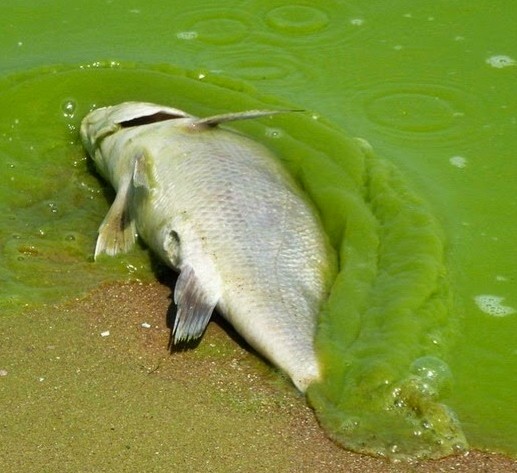
Dead fish float ashore in the algae slime. Algae growth robs the lake waters of oxygen necessary for fish to survive.
Then we entered the 1990s, when the first Earth Day and birth of a popular environmental movement in 1970 seemed a distance away, and populations on both sides of the border allowed more right-wing governments to convince them that environmental protection was standing in the way of jobs and business. The former Ontario government of Mike Harris used this period to take a meat axe to the budgets of the province’s Ministries of Environment and Natural Resources, and gut may environmental programs and regulations put in place during the 70s and 80s to avoid crises like the one we are now seeing unfold in the western end of Lake Erie.
So far, the eastern end of the lake, which is deeper and which is the source of much of our tap water in Niagara, Ontario and Western New York, is reportedly still safe. But who knows for how long if the algae bloom in the lake continues to expand.
And how will we really know what risks we may face if, on the Ontario side of the border at least, when we have federal and provincial governments that have underfunded recourses for addressing the problem. Just as disturbingly, we have regional Conservation Authorities, like the one in Niagara, that have been told not to get in the way of anything urban developers or the agricultural industry want to do, even if it means flows of agents that promote algae growth in our rivers and lakes.
That leaves it up to members of the public to demand that governments get back to dedicating the resources need to protect us from environmental threats like the one unfolding in Lake Erie.
Now here is a recent post from the citizen groups, Ohio Environmental Council and Alliance for the Great Lakes on this growing disaster in Lake Erie waters.
Saturday, August. 2, 2014 – Ohio Environmental Council and Alliance for the Great Lakes Issue Joint Statement on Toledo Drinking Water Crisis Our thoughts are with all of the Toledo area residents who woke up to the horrible news this morning that they cannot use their tap water because it is toxic.
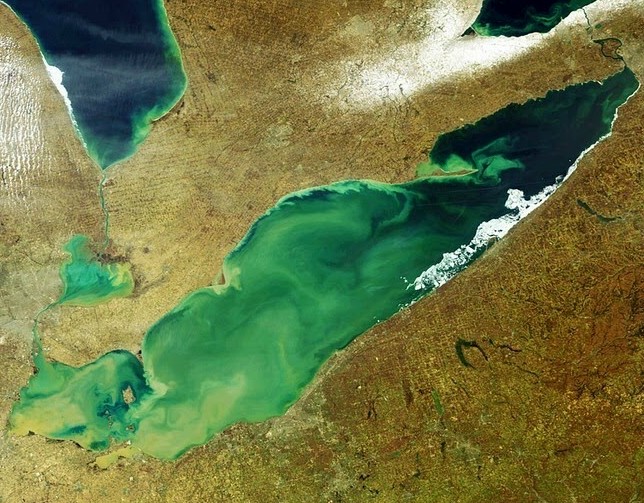
A Satellite photo from about 10 years ago on already growing algae swamp (in green) in Lake Erie.
Today’s drinking water crisis is a loud wake-up call, not just for the city but also for the nation. High levels of a dangerous toxin – microcystin – caused by algal blooms in Lake Erie, have compromised the city of Toledo’s drinking water. More than just a nuisance, the toxic algal blooms plaguing Lake Erie and fueled by excess nutrient pollution threaten approximately 11 million people who draw their drinking water from the lake.
While nutrient pollution comes from many sources, only a few – farm fields and sewage treatment plants – contribute the lion’s share of the problem. These blooms rival the blooms in Lake Erie from the 1970s that sparked the Great Lakes Water Quality Agreement and the Clean Water Act, which regulate wastewater treatment plants and industries, and banned phosphorus in laundry detergents.
As a result, Lake Erie recovered. It is unacceptable that nutrient pollution has been allowed to contaminate Lake Erie so significantly that the drinking water for more than 500,000 northwestern Ohio residents has been compromised. In the wake of this crisis, federal and state agencies will have an opportunity to act to stem the flow of nutrients into Lake Erie.
We urge agencies to learn from this crisis and act swiftly. A great place to start is enacting the recommendations put forth by the International Joint Commission in their report released this spring, “A Balanced Diet for Lake Erie: Reducing Phosphorus Loadings and Harmful Algal Blooms.” Delaying action will only cause continued harm to the lake and more crises like the one Toledo is facing today. Link to this statement online: http://www.greatlakes.org/document.doc?id=1481 For more information contact: Adam Rissien, Ohio Environmental Council: (614) 706-9374, arissien@theoec.org Jennifer Caddick, Alliance for the Great Lakes: (315) 767-2802, jcaddick@greatlakes.org The International Joint Commission report can be found at: http://www.ijc.org/en_/leep#sthash.D5a3TKfJ.dpuf
(Share your views on this post below. Please know that we only post comments by people who are willing to go on the line and share their real name.)
 Niagara At Large
How many more “deaths” will the Great Lakes overcome? They overcame ‘phosphorus’ which made clothes whiter than white. Now we are replacing phosphorus with genetically modified crop material. This GMC material allows us to enjoy beautiful looking vegetables _ at what price?
Could the runoff of this material protect the algae and allow it to grow in the Great Lakes and other fresh water bodies? What is more important synthetic natural food or natural food that mother nature provides?
Perhaps we can hasten the death of the Great Lakes with the building of oil pipelines not properly maintained and not immediately address spills. Perhaps we can add “fracking” to the mixture.
Many money making companies have adopted the policy to “ask forgiveness after the disaster rather than ask permission to proceed with the project”.
LikeLike
The situation is really worse, than they are saying this past spring in Florida nearly 200 manatee died , when their water became plagued by the toxic blue/green algae blooms, they warn do not even breath the fumes off this stuff, it is that powerful, The biggest disaster to happen to the Niagara River happened when a Mayor of Fort Erie decided to break an OMB ruling concerning sewage line extensions to the new sewage system built in Stevensville/Douglastown, the ruling said that the system designed for 1600 people should not be expanded at all, and was the centre point of their ruling, despite the fact that this was legally binding by a Provincial Agency the Mayor in a registered vote over the objections of dozens of Stevensville residents gave permission to Parkdale Homes to build homes in a forbidden area of Town. the result new homes had raw sewage bubbling up into the basements the sewage system was overflowing , so the Town had to dump raw sewage into Black Creek at Stevensville and Douglastown. this has happened for the past 8 years, a serious violation of the Federal Great Lakes Clean Waters Act and the Ontario Clean Waters Act. The only reason that I can think of, is that lawyers derive a lot of income from real estate transactions,.and the Mayor is a lawyer.
LikeLike
Thanks Doug. One of the worst cuts to the Ministry of Natural Resources were for tree planting programs which are still way below the levels of 1992, when the cuts started. This has reduced incentives for farmers to plant streams around watercourses-a big reason for the flushing of nutrients into Lake Erie that has caused this crisis.
LikeLike
Today I drove along Lakeshore Road from Port Colborne to Rock Point and there wasn’t a single place I could get out & walk the shore. Every place STANK! The green slime went up the shore ten feet and at least an equal distance into the water. I came home VERY depressed. What a bloody shame.
LikeLike