
(A Brief Preface by Niagara At Large publisher Doug Draper – Thanks so much to John Bacher for bringing the sad passing of Pat Potter, who was finally living with her husband Chuck in Gillmore, Ontario, to our attention. She is a reminder of the once very active, local citizen-based environmental movement we once had – unfortunately, so much more than we do now in this greater Niagara region and the Ontario/New York border communities neighbouring us.
As an environment reporter with the then independently owned St. Catharines Standard, I felt honoured to get to know this person, along with others now gone like Margherita Howe, Laura Dodson, Peter Stokes, Doug Elliot, Janet Truckenbrodt, Gord Harry and Marilyn Gracey (mentioned in John’s post here), just to name a few, and their care and passion for making our communities better places for all of us to live in is sorely missed. Tragecially, and for whatever reason, we just don’t have that same critical mass of grassroots activism for environmental, conservation and heritage protection any more.
So, once again, thanks to John for sharing this memory of Pat Potter.)
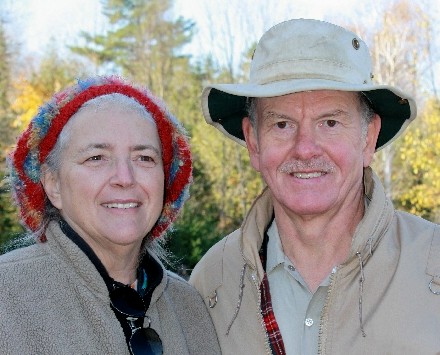
Pat and Chuck Potter at their self-sustaining ‘earth home’ in Gillmore, Ontario
By John Bacher
In Queenston, Ontario, there is a small Anglican Church named the Church of Our Saviour.
Although officially it is of Christian inspiration, legend tells us. It was of more secular origins, intended as a pun. “The Saviour”, has a dual implication. The legend is that the name honours the heroic commander of the troops of the Battle of Queenston Heights, who perished in combat, Sir Isaac Brock.
In the midst of the War of 1812, we commemorate the saviours of Upper Canada, such as Brock, Laura Secord and heroic Native commanders, including John Brant, Tecumseh and John Smoke Johnson. These should awaken us in Niagara to the saviours of our own time, who rescued Niagara from the toxic threats of the time. One of these giants recently died, Pat Potter. Pat Potter’s role as a saviour of Niagara is seen by her involvement in two proposals to have a toxic waste incinerator and refuse dump located in our region, sponsored by the now defunct, Ontario Waste Management Corporation. (OWMC) The first involved a scheme to have the facility in an area of South Cayuga, located within the flood plain of the Grand River. She passed on her experience here to another champion of the penultimate demise of the second effort Marilyn Gracey.
Potter explained to Gracey how, “You’ve got to fight for yourselves…Demand a moratorium on landfill. Landfill is only an excuse for doing nothing. If you read something you don’t agree with or you don’t understand call the OWMC …Suffering in silence won’t do any good. Make them explain it. I call the head office in Toronto and I don’t hang up until I know what it says. I don’t care if they have to explain it six times.”
How much Potter became a saviour of Niagara is shown by the difficulties experienced by the Swan Hill, Alberta toxic waste incinerator that the OWMC proposal was modelled upon. In 1997, a few years after the OWMC proposal was scrapped, the Alberta health ministry issued warnings to people to limit consumption of fish and wild game caught within 30 kilometres of the Swan Hills incinerator. Pregnant women, nursing mothers and young children were banned from eating anything within this entire radius. Such an impact in Niagara would have been horribly destructive to the agricultural sector.
Potter’s environmental activism started in her twenties while she was still known to other activists in the community as Pat Hayes, before meeting her future husband Chuck in Hinton Alberta. In the 1970s, her activism involved raising concerns about air pollution from a pulp and paper factory, which was resolved by a legal challenge and an eventual order on the factory to retool its operations to reduce the pollution.
Potter eventually moved back to her home town of Dunnville where she took on polluters earlier exposed in a controversial television documentary, “The Air of Death.” As a result of her protests, nuclear waste which had been dangerously stored in an outdoor lagoon was put into secure containers in an above ground ware house. She also had the pesticide Chlordane banned in Dunnville, which had previously been used against Japanese Beetles.
The Potters’ exposed leaks in a clay liner which was supposed to protect water from contamination by PCBs stored in Smithville. The Potters used a sampling device in the form of an old popcorn can with a pull-back cord to collect contaminated sludge from a lagoon at the storage site. Tests on the gooey sludge by Ian Brindle, a Brock University chemist, and by the province’s Ministry of Environment revealed that Smithville’s drinking water, then obtained from an underground community well, was on the road to contamination and a piped supply was brought in.
In the late 1980s, the Potters worked closely with the Environmental Delegate for the Six Nations Iroquois (Haudenosaunee) Confederacy Norm Jacobs. They worked together successfully to stop toxic discharges from factories in the Grand River watershed and exposed a scheme to dump Toronto’s wastes in the nearby Six Nations reservation.
One of Pat Potter’s most important achievements was to work with James Bradley during his first term as Minister of Environment in the 1980s on the issue of Acid Rain. While a student at Brock University, she wrote a joint paper with one of her instructors, Dr. Michael Dickman, on lake acidification caused by sulphur pollution. It was given to Bradley shortly before his critical announcement that Ontario would impose unilateral cuts to sulphur pollution. This proved effective in shaming the Canadian and American governments into signing a treaty on acid raid.
Pat Potter gave important meaning to the term, NIMBY, which had been associated with, Not In My Backyard. For several years she had a boat by that name and gave educational tours of the Grand River and Lake Erie. Those who took part were told that the boat’s name meant, “Now I Must Become Involved.”
John Bacher is a veteran conservationist in Niagara, Ontario and long-time member of the citizen group, Preservation of Agricultural Lands Society. A past contributor of posts to Niagara At Large, his most recent book is called ‘Two Billion Trees and Counting – The Legacy of Edmund Zavitz’,
(NAL invites you to share your views in the comment boxes below. Remember that we need your full name on this site to post your comment. No pseudonyms allowed.)
 Niagara At Large
Thank You Pat for your hard work in editing my two books ‘Who Will Speak’ and ‘A Pun My Word” and for your belief in my writing ability.
LikeLike
So sorry to hear of the passing of Pat Potter, a double Leo with all the warmth of the sun in her soul. She was a true pioneer and took on big business in a way few would dare to do. She involved me in some of her escapades where I learned how much power we can have by daring to stand up for your rights and the rights of many. others.
She transformed the lives of many young people, showing them how to regain their power. She taught me to become more political and a much stronger person. Also i took their tire house building workshop and found that even with disabilities I could do this as well.
Surely this is a woman who lived well and left the world a much better place.
Oodles of gratitude for your light and generosity, Pat.
LikeLike
To John – I knew Pat in the l990’s. I am now working for The Narwahl – an environmental online newspaper. If you have any isssues you want covered, please let me know. leemoore1939@gmail.com
Pat and I spent a lot of time together, including locking the gates of Uniroyal in the 90’s, I just read that it was closed down in 1971.
She was an amazing woman.
LikeLike