
An Important Messsage To All Niagara Citziens from the Niagara Poverty Reduction Network
(A brief foreword to this post from Niagara At Large publisher Doug Draper – This spring, Niagara’s regional government and 12 local municipalities are making a concerted effort to press Ontario’s provincial government to expand Go Transit services in Niagara, and that is a good thing.
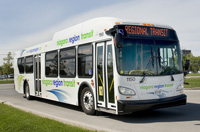
One of a handful of regional buses now on the road for an inter-municipal transit project.
There are a couple of very important points to keep in mind, however.
The provincial agency Metrolinx and Go Transit have repeatedly made it clear that if they going to apprve and provided an expanded service here, Niagara needs to get its act together and provide a more comprehensive regional transit service. Ater all, you can’t simply drop Go passengers off somewhere in Niagara if they can’t then find easily find local transit connections to get from one location to another across the region.
Yet even at that, Niagara is in the last year of a three year, inter-municipal transit pilot project and support among regional and local municipal councillors for expanding that system seems somewhat shaky. Indeed, there are some councillors who have repeatedly expressed interest in pulling the plug on it altogether, leaving most of the responsibility for transit services to St. Catharines, Welland and Niagara Falls, which operate most of the transit buses here.
Most other regions in this province have consolidated there local transit services into one transit system available within walking distance of most, if not all their citizens. In return, they have experienced the kind of funding support and expansion of Go Transit services that Niagara is now asking for from the province.
In other words, if Niagara hopes to get more of a commitment from the province, it has to play its part by making more of a commitment to a regional transit system here.
That is why the following post from the Niagara Poverty Reduction Network is important, along with the transit survey the NPRN is asking you to click on and fill out below. Those of us who support building a full-fledged regional transit system in this region should also make it our business to find out what their regional and local representatives’ position is on transit and vote accordingly in this coming fall’s municipal elections.)
NIAGARA, ON, April, 2014 – This spring Niagara Regional Council will be deciding on whether or not to proceed with a Regional Transit System. While it has the support of many communities, it will take a triple majority vote at Council if the pilot program is to live beyond August, 2014. Niagara residents now have an opportunity to share their opinion on its future by completing a public survey either online or in person.
Members of the Niagara Poverty Reduction Network (NPRN) believe that an Integrated Regional Transit system is critical to the health and well-being of Niagara residents and the Region’s future economic growth and prosperity. According to Rick Merritt, Convener of the NPRN, “an integrated Regional Transit system will benefit everyone, not just those using transit.”
Research has shown that it’s an important factor in attracting and retaining a diversified labour pool, especially youth. A qualitative study conducted by J. Sinclair and Associates revealed that Regional Transit has improved the quality of life of its riders by creating access to transportation and employment opportunities across municipal jurisdictions.
Many Niagara residents have demonstrated their support for the GO Train service to Niagara in a recent grass roots petition. However, Merritt states, “people need to understand that the future of GO Transit depends on Niagara first having an integrated Regional Transit system in place.”
Metrolinx, an agency of the Government of Ontario created to improve the coordination and integration of all modes of transportation, asserts that Niagara needs accessible feeder buses linking people to other communities if the GO is to come to town.
Even if you are not a user of Regional Transit, the Niagara Poverty Reduction Network encourages Niagara residents to support it for the greater public good. The system, as it currently operates, is costing the average taxpayer $9.75 per year. “That’s a small price to pay for the multiple benefits it offers, not only to riders of transit, but the community as a whole,” claims Rhonda Barron, member of the NPRN Transportation Working Group.
A recent issue paper from the Canadian Urban Transit Association lists a number of economic benefits tied to public transit. Nationally it contributes 10 billion to Canada’s economy. Transit employs 45,300 Canadians directly and 24,300 indirectly. It reduces vehicle operating costs by approximately 5 billion and traffic collisions by 2.5 billion. Transit also reduces greenhouse gas emission by 2.4 million tones every year valued at $110 million.
“And let’s not forget that these numbers don’t tell us the whole story. How do we place a dollar value on individual health and happiness or prosperous and sustainable communities?” asks Barron.
The online survey is available at www.niagararegion.ca/survey until April 30.
The Niagara Poverty Reduction Network consists of 30+ organizations – human and social service agencies, boards of education, faith-based organizations, public health, community health centres, the business community, regional government, and individuals who live in poverty – working collectively to reduce poverty in Niagara through information sharing, changing attitudes, and compelling Niagara citizens to get involved and take action. For more information on the NPRN, or to get involved, visit their website at www.wipeoutpoverty.ca
(NOW IT IS YOUR TURN. Niagara At Large encourages you to share your views on this post. A reminder that we only post comments by individuals who share their first and last name with them.)
 Niagara At Large