
By Mark Taliano
In March of 2007, Gildan Activewear Inc., a Montreal-based textile manufacturer, decided to leave Canada for sunnier climes.
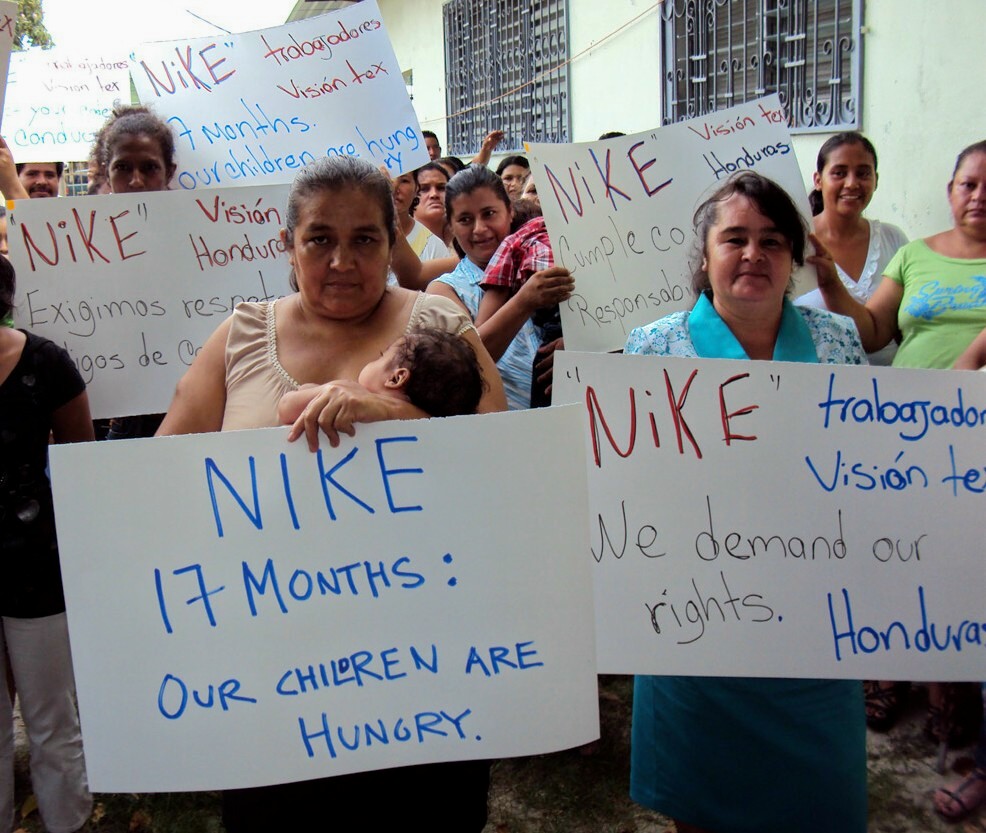
Workers that make goods for us rally for waged that might keep their families out of the starvation zone – all so that we can get a a t-shirt for less than five bucks. Who is being suckered more = them or us?
The company laid off hundreds of Canadian workers, and resettled where business was good: Honduras. “Free Trade” legislation facilitated the exodus from Canada, and powerful psychological operations (psy ops) strategies reassured people at home and abroad. Corporations and their government subsidiaries repeated messaging about “competitiveness and efficiencies” in Canada while Hondurans were promised economic revitalisation and jobs. The end result? Canada lost jobs, and Honduras’ asymmetrical, toxic economy, was further entrenched.
Honduran sweatshop workers are basically slaves, and their status will likely remain unchanged, or get worse. Since the 2009 military coup — which removed the democratically-elected President Manuel Zelaya, the illegal regime dismantled or corrupted institutions that might be of benefit to humans (including constitutional judges), and it created a heavily militarized and murderous environment. “Since 2010”, reports Raul Burbano, delegation leader of election observers from Common Frontiers, “there have been more than 200 politically motivated killings.”
In the meantime, Canada’s Gildan corporation profits from the misery. Gildan pays NO taxes in Honduras, and the workforce (primarily women) is easily exploited . Unions are not allowed, collective bargaining is not allowed, and human rights are not a concern.
Workers produce T-shirts from about 7:00 am to 7:00 pm four days a week, at jobs that are physically repetitive. Repetitive strain injuries are common, proper care is elusive, and injured workers are easily discarded. Since workers have few rights, someone younger and healthier can usually be found. In poverty-stricken environments like Honduras (and elsewhere), job scarcity means that a replacement worker will likely work for less money, and even fewer rights. At Gildan, inspectors aren’t allowed in to the plant, and workers are fired (or worse) if they try to organize unions.
One former worker, now “discarded”, explained that she would be given a cortisone shot to treat her calcified tendonitis, and then sent immediately back to work. Proper treatment in such a case would involve an injection followed by rest, but work quotas are more important to foreign share-holders than worker health.
It’s no surprise then, that by age 25, chronic work injuries, coupled with poor medical treatment, often prevent workers from performing their fast-paced tasks.
Worse still, once a worker leaves Gildan, she is likely to have irreversible health problems which preclude her from finding alternate employment. Some women need crutches to walk; others can’t hold their babies or do housework. Savage poverty imposes itself on their already precarious existences, and decimated social institutions perpetuate the misery.
Healthcare, schooling, and other social/public institutions are abysmal, and only those (few) with money get adequate service.
What are the drivers behind such misery?
Those who control the levers of power in Honduras are governed by self-serving interests that do not include the common good. Consequently, society and the economy have been spirally downward since the coup.
Prior to the 2009 military coup, freedom and democracy were making inroads into the malaise, but now the power structure looks something like this:
At the top of this asymmetrical and entirely dysfunctional political economy are transnational corporations, including banks. They are the free-marketeers/slavers that are seamlessly aligned with governments in Canada and the US. They tacitly, if not overtly, drive foreign policy decisions.
On the ground in Honduras looms the invisible hand of the occupying U.S military that fosters and enables destabilization, and is allied with the corrupt dictator Juan Orlando Hernandez. Compliant dictators make good proxies, and Hernandez has likely been a U.S puppet for some time now.
Locally, the nexus of powerful polities includes narco gangs, the police, the military, the para-police ( Tigres ), and rich oligarchs, (including about ten very wealthy families).
Corruption throughout society is so pervasive, that people trying to make a living often have to pay extortion money not only to gangs, but also to the police.
Now, with a growing number of US military bases of occupation, and the murderous dictatorship of Juan Orlando Hernandez solidified, profits are basically guaranteed for transnational sweatshops in what is essentially a state-sanctioned Slaver’s paradise.
As Canadians, we need to continue asking important questions. For example,
Why are these “Free Trade” Agreements, such as the Canada-Honduras Free Trade Agreement so secret? and Why have we chosen to profit from the misery of others?
Once we get some answers, we might choose to pay a couple dollars more for our next T-shirt.
Mark Taliano is a Niagara resident and regular contributor of commentary to Niagara At Large. He joined a delegation of Canadians and Americans this November, 2013 in observing elections in Honduras where there are concerns among Hondurans t that corporations profiting from a free trade agreement their country recently signed with Canada may corrupt the results.
(Niagara At Large invites you to share your views on this post. A reminder that we only post comments by individuals who share their first and last name with them
 Niagara At Large
I flatly refuse to shop in places like Walmart and Target because of their employee policies and crappy goods but, unfortunately that leaves some people out of work and is no guarantee as to where things are made. Even upper end stores patronize sweat shops.
I also refuse to buy any kind of foods processed in China, even for my dogs. I’ll pay the price for quality or locally produced goods. Such big box places also undercut mom and pop local businesses and close them down.
With the profits these clowns make as CEO’s of multinational companies, the could still keep their prices reasonable, pay their workers more and hire Canadians (or whatever nationals are appropriate) but heaven forbid they might not be able to but fur lined sinks and air conditioned dog houses.
LikeLike
While I disagree with most of what Mr Taliano publishes here, I do agree that supporting sweatshops in third-world countries is wrong.
But there is another point to be made: is someone holding a gun to your head and forcing you to buy these items?
LikeLike