
A Comment by NAL publisher Doug Draper
“December 1st, 1955, our freedom movement came alive. And because of Sister Rosa you know, we don’t have to ride in the back of the bus no more.” – from the Neville Brothers song Sister Rosa.
It was her one simple, yet so very brave and dignified act that sparked a movement that would also see the emergence of Martin Luther King as one of the greatest civil rights leaders of all time.
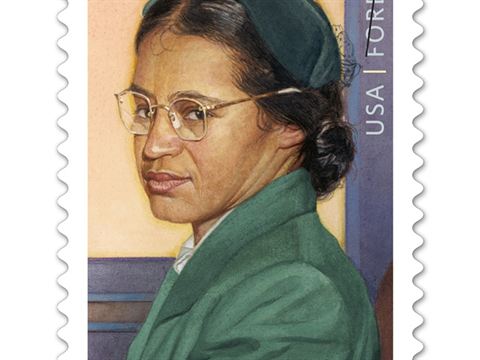
The new U.S. Rosa Parks postage stamp.
And it was that movement that opened a door to a new era of equality and freedom for people of colour in America – an opening that would eventually make it possible for an African American to move from not being allowed to use a “white washroom” to being elected president of the United States.
Her name was Rosa Parks and it was all so fitting in the mind of this writer, who grew up embracing her as one of my heroes, that this February 4 – on what would have been her 100th birthday and what is the start of a two-month stretch celebrating Black and Women’s History – that the U.S. government honoured her, once again, by issuing a postage stamp with her image on it.
Barack Obama was still six years away from being born when on the 1st of December, 1955, Rosa Parks, who worked as a seamstress in Montgomery, Alabama, refused to move from her place on the bus when the driver told her to give up the seat to one of the white people who boarded the now fully-loaded bus. It was enshrined in Montgomery, Alabama law at the time that black people could only sit at the back of the bus until such time as the bus was full and a white passenger needed one of their seats.
On this day, Parks, who had grown up with the specter of lynchings and white men covered in white sheets parading past her home, decided she’d had enough. When the bus driver told her to give up her seat, she said no.
“People always say that I didn’t give up my seat because I was tired, but that isn’t true, she wrote in a memoir published before her death in 2005. “I was not tired physically. The only tired I was, was tired of giving in.”
Rosa Parks’ refusal to give in resulted in her arrest and jailing on charges of public misconduct, and triggered a boycott of Montgomery buses by the city’s sizable population of blacks that continued on for more than a year, despite a good deal of hardship for many whose only alternative was to walk many miles to get to work or school. At the finish of what had by then become international news and an embarrassment to a country founded on a declaration of equality for all, the city was forced to put an end to making black people ride in the back of a bus.
The Montgomery Bus Boycott, as it forever became known, inspired civil rights activists across the country to do everything possible, through whatever acts of non-violent, civil disobedience were necessary, to break down every last barrier of discrimination against people of colour and all people who – for whatever reason – were pressed down by an upper class. And Rosa Parks, a tiny, soft-spoken but courageous woman, was among those at the vanguard of that great, progressive movement we must, unfortunately, still fight today, if we have her courage to do so.
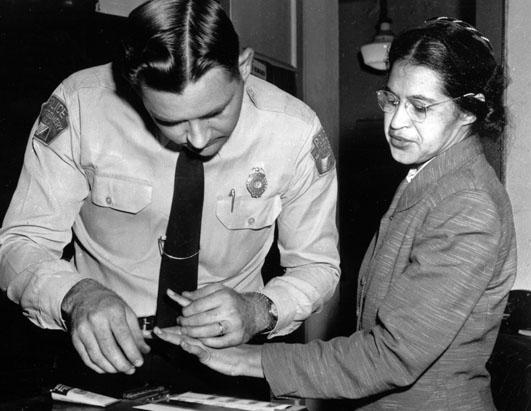
Rosa Parks, being arrested and booked, for refusing to give up her seat on a bus
Rosa Parks died in 2005 at age 92 in her last home in Detroit, Michigan, not that far away from us. Her casket was carried in a bus, quite like the one she refused to give up her seat on to the U.S. Capital building in Washington, D.C., where she was one of the few civilians to lie in state in that building’s rotunda and where members of the U.S. Congress saluted her as “the first lady of civil rights.”
The American civil rights movement of the 1950s and 60s remains a model for what it takes, through dynamic leadership and planning, to advance progressive change. The present day Occupy and Idle No More movements would do well to learn from it.
I will leave the last words to those wonderful Neville Brothers from Louisiana, a group I was privilieged to see live, from their most moving musical tribute to Sister Rosa before I cross the border to a post office in Niagara Falls or Buffal, New York to pick up my Rosa Parks stamps.
“Thank you Miss Rosa. You were the spark, that started our freedom movement. Thank you Sister Rosa Parks.”
(Niagara At Large invites you to share your comments below. PLEASE NOTE that you must include your first and last name with your comment. Views from anonymous parties are not posted on this site for reasons of accountability and of encouraging a more open and civil dialogue on issues of interest and concern to our lives and communities.)
 Niagara At Large
What a super and appropriate tribute, especially this month celebrating black history. There’s more coming: watch this space!
LikeLike