
By Doug Draper
If you are looking for a great night of theatre in a beautiful outdoor setting, you can’t do much better than ‘Shakespeare in Delaware Park’ in Buffalo, New York.
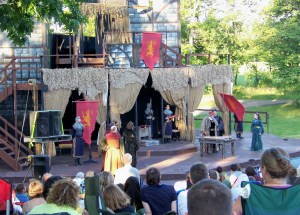
Shakespeare in Delaware Park on stage. File photo by Doug Draper .
The 37th season of this – one of the largest and longest running free Shakespeare summer theatre productions in North America – gets underway this Tuesday, June 21st and continues through to the August 19th, with a week’s break this mid-July between the two plays being featured this summer.
Those plays include ‘Richard the Third, starting June 21st5 and running every Tuesday through Sunday, beginning each evening at 7:30 p.m. until July 15th. The second play, A Midsummer Night’s Dream and a good one to enjoy in the park under moon and stars, runs from July 26th to August 19th, and also begins each evening at 7:30, Tuesdays through Sunday.
The natural amphitheater for these plays is on the grass and you may be well advised to bring a blanket and pillows, or lawn chairs. It is also advisable to show up a little early since theatre goers park their cars along some of the wonderful neighbourhood streets near the park where the classic old homes are also a sight to behold.
Finally, there is an intermission at each play where members of the cast walk through the audience on the slopping grasses above the stage hoping you might slip a donation of money for Shakespeare in Delaware Park into a little sack they are carrying to help keep productions going. This event has some generous corporate sponsors but government cuts to the arts have made keeping things like this going a little more challenging in recent years. So donate, if you can, and enjoy plays that are always carried out as professionally as any you might attend in a commercial theatre. You can find out more about Shakespeare in Delaware Park by visiting the troupe’s website at http://shakespeareindelawarepark.org/ .
Niagara At Large is posting the Shakespeare in Delaware Park companies of the story line for this year’s plays for your information.
Richard The Third
June 21st – July 15th< Directed by Saul Elkin.
After a long civil war between the Royal families of York and Lancaster, England enjoys a period of peace under King Edward IV. But Edward’s younger brother, Richard, resents Edward’s power and happiness. Angry, power hungry and bitter over his own physical deformity, Richard plots to kill all those who stand between him and the throne.
He manipulates a noblewoman, Lady Anne, into marrying him even though she knows he has murdered her first husband. He plots to have his own older brother, Clarence, executed. When his brother King Edward, who has been ill, dies, Richard becomes Lord Protector of England in charge of Edward’s two young sons who are heirs to the throne. He imprisons the boys in the tower of London and in his bloodiest act, Richard sends hired assassins to kill the boys. Then, with the help of his right hand man, Lord Buckingham, he has himself crowned King of England.
Richard’s reign of terror produces a challenger to the throne, the Earl of Richmond, who is gathering forces in France. Meantime Richard has his wife, Queen Anne, murdered so that he can marry his niece, Princess Elizabeth, daughter of his late Brother King Edward and Queen Elizabeth. Queen Elizabeth, who has promised her daughter to Richmond, manages to hold Richard off.
Richmond invades England. The night before the decisive battle Richard has a nightmare in which he is confronted by those he has murdered. Richmond is victorious, is crowned King Henry VII, and is betrothed to young Elizabeth. Peace returns to England.
A Midsummer Night’s Dream
July 26th – August 19th Directed by Kyle LoConti
Although in modern productions this play has often been set in many different times and places, Shakespeare set the play in Ancient Athens. Wherever it is set it is one of Shakespeare’s most delightful romantic comedies.
Theseus, Duke of Athens, is preparing to marry Hippolyta, Queen of the Amazons. The preparations for the festivities are interrupted by the arrival of an angry father, Egeus, who has come to ask the Duke to intervene because his daughter Hermia will not marry his choice Demetrius because she in love with Lysander. The Duke warns Hermia that she must either obey her father or be sentenced to death, or to a life as a nun.
Hermia and Lysander decide to elope and escape Hermia’s cruel fate. They tell Hermia’s friend Helena of their plan and they run into the forest. Helena, who loves Demetrius, tells him the lovers have fled and he follows them into the forest followed by Helena. They are all promptly lost in what we discover is an enchanted forest ruled by Oberon and Titania, the King and Queen of the fairies. Oberon and Titania are quarreling over an Indian boy she will not give him. Oberon overhears Helena declare her love for Demetrius, who tells her he cannot love her because he loves Hermia. Oberon has his mischievous servant Puck find a magic flower whose juice sprinkled on the eyelids of a sleeper will make the sleeper fall in love with the first creature he sees when he awakens. Puck mistakenly sprinkles the juice on Lysander’s eyelids who, when he is awakened by Helena, falls in love with her and rejects Hermia…beginning a series of hilarious errors that are only resolved at the end of the play.
Meanwhile, a group of Athenian laborers are rehearsing a play in the forest that they hope to present at the wedding of Theseus and Hippolyta. Puck overhears the rehearsal and plays a trick on them by giving Bottom, the star of the little play, an ass’s head which scares the others away. Bottom is lured to the sleeping Titania who Oberon has treated with the flower juice. She awakens and falls in love with the ass. Having had his little joke Oberon restores Titania’s sight and she and Oberon are reunited.
Puck removes the ass’s head and Bottom returns to Athens to rejoin his fellow actors who hear that their play, “The Tragic Love Story of Pyramus and Thisbe,” has been chosen to be performed at the wedding. Meanwhile Puck has sprinkled the “magic juice” on the eyes of the sleeping lovers who awake and all four are happily reunited.
The play ends with the laborers’ hilarious rendition of “Pyramus and Thisbe,” after which the four lovers agree to share the Duke’s wedding day and all exit happily together.
 Niagara At Large
Fantastic theatre and a truly beautiful setting for these truly fabulous works of art. Thank you Doug for bringing this wonderful opportunity to us.
LikeLike