
By John Bacher
When proponents of the Canadian Motor Speedway in Fort Erie, Ontario began their public relations campaign to sell their purported “NASCAR-like” complex, part of the sales pitch was that about a third of their 827-acre scheme was to be a campground. It was claimed that about a third of the acreage was to be a “family recreation area.”
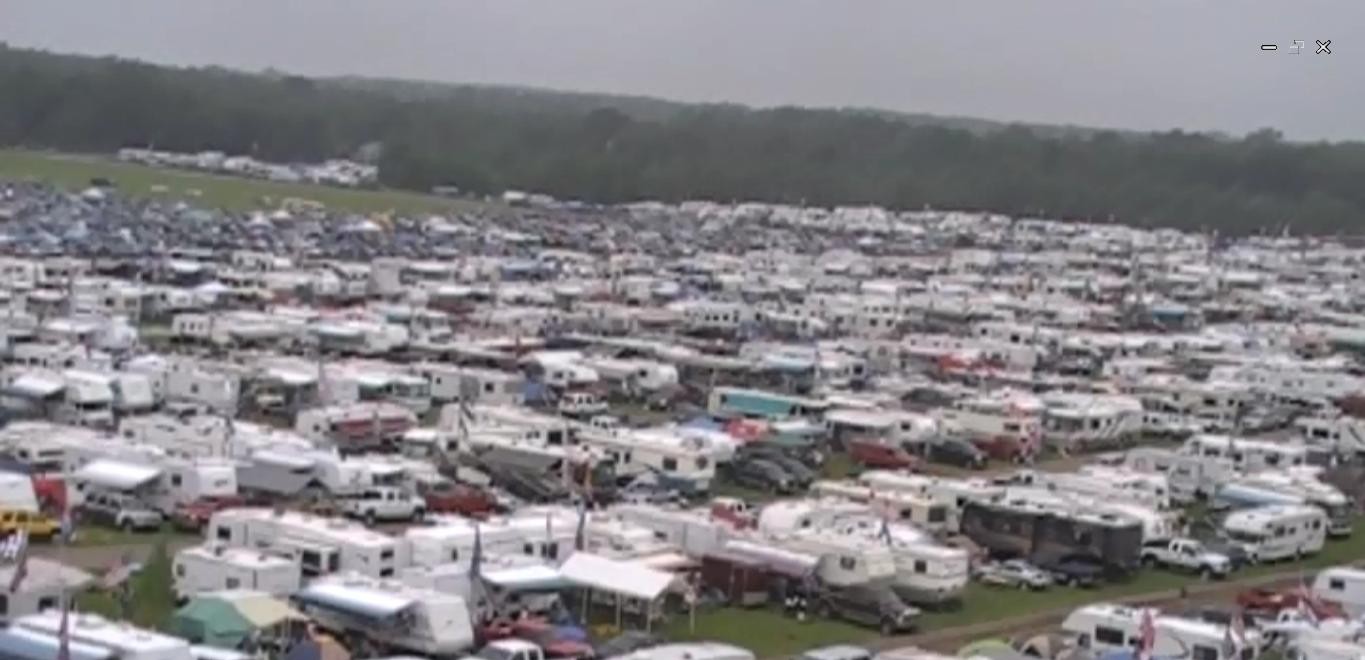
A 'parking camp' around a race track in Michigan. Is this what is in store around a NASCAR track proposal for rural lands, including wetlands and the headwaters of Miller Creek in Fort Erie, Ontario?
Images were made of a camp ground in a conservation area like setting, on former farmland, while protected wetland forests would be laced by hiking trails. This was seen as a charming feature which would lure prestigious industries to establish themselves in a park-like campus.
While termed a “family recreation area” in the “Speedway Concept Plan”, a more sinister definition appears in the current proposal which is scheduled to be debated before the Ontario Municipal Board on June 18th. What is on the map is termed a “parking camping” designation.
For those of us who have never attended a NASCAR event the term “parking camping” appears mysterious. This mystery was solved when a detective, motorway opponent Sandy Vant, went to Michigan to visit an actual NASCAR track. She found and photographed vast acreages of recreational vehicles massed together on top of died out grass. It is this experience which the speedway’s defenders seek to bring to Niagara.

The headwaters area of Miller Creek in Fort Erie where a 'parking camping' site for a NASCAR racing facility would go.
What is most odious about the “parking camping” wastelands planned for the speedway dead zone is that they are planned to be put in two very environmentally significant locations. These are the headwaters of Frenchman’s and Miller Creeks.
What makes the planned speedway so monstrous is that it will disrupt what is the last stand of the Carolinian ecosystem. While images of defending Canada’s wild vastness are appealing these areas of the north are not the most bio-diverse parts of our nation. What has the greatest wealth of bio-diversity are the Carolinian forests of Southern Ontario. Apart from Indian reservations, the greatest concentration of these habitats are found in Fort Erie.
Fort Erie’s relatively good forest cover, the best in southwestern Ontario, is the basis for its streams to have excellent fish habitat. Some of this habitat is found in both Miller and Frenchman’s Creek which are threatened by the motorway.
A massive parking camping area is planned just outside the protected flood plain of Frenchman’s Creek. A fish sampling study conducted by the Royal Ontario Museum found that a Species of Special Concern, the Grass Pickerel, is found in this threatened area of Frenchman’s Creek. Proposed storm water ponds to handle runoff from the parking camping could be inundated in a heavy storm event beyond the regulation limit and their toxins flushed into Frenchman’s Creek.
Miller Creek is also imperil from parking camping. Its headwaters west of Laur Road was recently photographed by Mike Dickman, a dedicated scientist who has worked for decades to protect the environment.
Where these clean waters gush forth from an underground spring, will if the Town of Fort Erie, the Niagara Regional Council and the Canadian Motor Speedway win at the OMB, become a poisoned wasteland full of leakage of brake fluids, oil and antifreeze.
John Bacher is a Niagara resident and long-time conservationist and member of the Niagara-based citizens group, the Preservation of Agricultural Lands Society.
(Niagara At Large invites you to share your views on this post in the comment boxes below. Remember that NAL only posts comments by individuals willing to share their real first and last names with their views.)
 Niagara At Large
I have been trying for over 30 years to get the Town of Fort Erie to comply with restrictions on the Sewage lagoon located inside the Niagara Falls border the corner of Netherby and QEW. Our group had the 1980 decision of the OMB on our side. the Town broke the aggreement by voting to extend the existing sewer lines a violation of the OMB, Paul Fell ,Rick Shuler and Redekop overuled Anne Marie Noyes and the OMB aggreement. unilaterally. every creek in Fort Erie has had raw sewage dumped into it, because they can, nothing shames these people not even an article about the Crescent Park dumping of sewage in the Globe and Mail, the creek you mentioned has had everything dumped in it already, the ooze from the former sludge pond and the Town dump.all ends in the Niagara River also the highest figures for cancer are those that live along the Niagara River, so for me that is not too much for anybody to give a darn, nobody gives a darn.
LikeLike
Parking for 10000 or more?
I’ve been wondering when the issue of parking would be mentioned. The ‘family recreation’ paved area certainly is cause for concern. The regular parking area for the track itself must also be considered. While the artistic photo concept I’ve seen of the track looks beautiful, but there seems to be no major parking area included. If this facility is to service really large crowds and do it well, some facility parking will be required. After all they expect to be able to seat 65000 people and maybe expand to 100000 in the future. Consider this: (325 sq ft = 1 car parking space) therefore 10,000 cars requires over 74 acres of parking lot, 5000 cars = 37 acres, even 1000 cars need approx. 7.5 acres of paved parking. Of course this does not take into account the Rvs, buses or commercial parking required. Certainly, a good portion of race goers will opt for the ‘family recreation area parking’. No matter the configuration, some significant paved parking will be required. There is also to be 250 acres dedicated to an ‘environmental element’. Also the Research & Dev is to take 66 acres (reduced from 80 acres?); the commercial area is to take up 74 acres. Which I believe leaves about 150 acres for the track, stands and the 2.6 mile road course. It’s not how much bio diversity are they saving its how much will be destroyed permanently to bring this project to fruition. The simple math: is 250 acres (or 170 acres depending on the source) of environmental element and at least 577 acres of no environmental element. No matter the total, the question is: how much natural space can we afford to loose for some temporary construction jobs, some permanent part-time jobs and very few fulltime positions? There is no argument our town needs jobs badly. But do we want to pay for them with the loss of a large amount of the natural environment?
LikeLike
I thanks the respondents for their thoughtful replies. Miller Creek is one of the most sewage free streams in Fort Erie right now because there is very little non-agricultural development in it. Most of the watershed is a designated provincially significant wetland within the Town’s urban boundaries. This situation outraged the Fort Erie council, which demanded and it appears received “compensation” in the form of what effectively is an urban boundary expansion onto agricultural land.
The relatively small amount of land needed for the actual racing course illustrates how this facility could be located within urban boundaries. The main obstacle is the assumption that rural people should have to put up with the noise.
LikeLike