
By Doug Draper
Should the number of municipalities in Niagara be reduced to possibly eight or six or three, or maybe even just one?
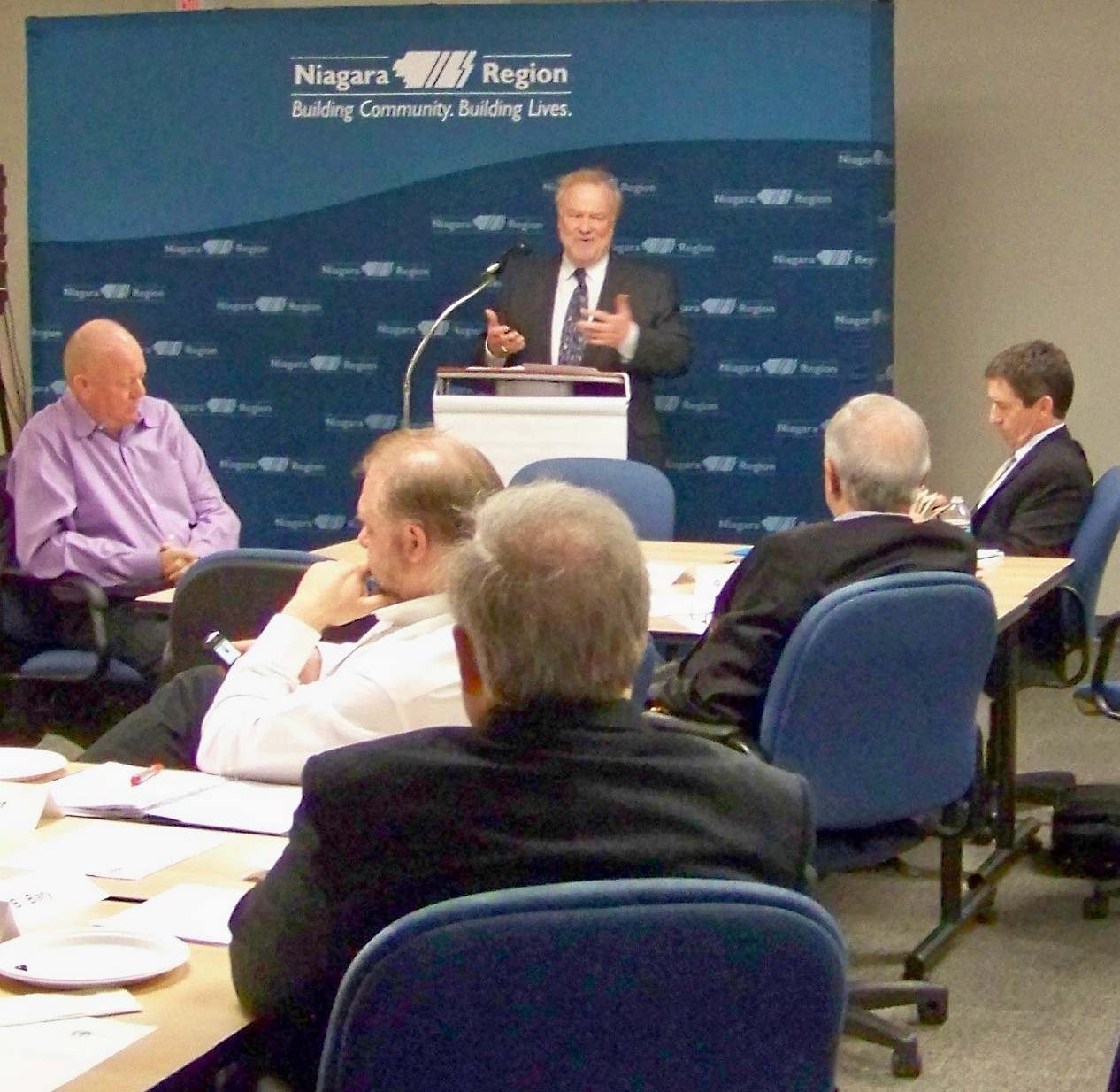
Municipal affairs expert David Siegel speaks to regional councillors and mayors at first session of governance review. Photo by Doug Draper
Do we need as many politicians as Niagara now has – a total of 125 or one for every 3,419 residents at the regional and local municipal levels – serving a region with a total population of 427,421?
Which level of municipal government, regional or local, should be responsible for delivering what services to Niagara’s residents? Or should our regional and municipal governments simply continue with the status quo?
These are but a few of the questions Niagara’s 31 mayors and directly elected regional councillors began exploring this February 16 at the first of what will be a series of committee of the whole meetings to be called for ways of improving the way we are governed in the future.
Niagara’s regional chair Gary Burroughs began the February 16 session with a reminder that all options for possible change are on the table and he repeated his hope that everyone on the regional council, including mayor of Niagara’s 12 municipalities, can work together in a spirit of cooperation to reach some decisions during this four-year term of council.
During the February 16 meeting at the regional headquarters in Thorold, the councillors and mayors took turns outlining areas they believed were most important to explore. On what is perhaps the thorniest issue – that of amalgamating municipalities – comments ranged from St. Catharines regional councillor Brian Heit expressing his longstanding desire for one ‘City of Niagara’ to Thorold Mayor Ted Luciani saying “no amalgamation – let’s not talk about it,” and a number of other expressing a willingness to look at reducing the number of municipal governments or at least reduce the number of politicians in the region. Some suggested the number of politicians could be reduced by making some of them do “double duty” on regional and local councils.
Many councillors and mayors also expressed a desire to eliminate in duplication in services and to take some services like water and wastewater and place them entirely under the jurisdiction of one municipal body.
David Siegel, a Brock University political science professor and longtime municipal affairs expert who spoke at the session, told the attendees that any bigger decisions, like reducing the number of municipalities or transferring key services like water or transit from one tier of government to another will require approval from a triple majority of regional councillors, and local councillors and municipalities, and possible approval from the province’s Ministry of Municipal Affairs. The province’s Municipal Affairs Minister will expect municipal leaders to make a strong case for any major changes and to show that they have gone through a consultation process with the public.
At the end of the session, Burroughs said he feels optimistic that the review got off to a good start and those councillors and mayors expressed a general willingness to look at a broad range of options.
Niagara At Large will be following this governance review closely as it unfolds and we invite our readers to express their views in the comment boxes below. Only the comments of those who attach their real names to them will be posted.
 Niagara At Large
Perhaps an independent review of Hamilton and Ottawa’s success at reducing the size of their governments would bode well for our future. I believe they eliminated their respective regional governments. It would be diificult for me if I were one of our 125 councillors, to look at myself and agree that it is time for me to push myself away from the trough!
LikeLike
Here we go again. Around the merry-go-round. How many studies have we had on this questions? The Region paid outside consultants whose costs ballooned, for which taxpayers were on the hook in the last 2 decades. I can think of at least two. Where did they go? Into the round file, it appears…..
is there music we can add to this carousel?
LikeLike
I think the biggest hurdle Niagara Region has is showing people that it has a proven track record of good governance at the regional level. The second would be proving that amalgamation would actually save taxpayers money.
Niagara’s hospitals were amalgamated to save money and provide better service. That didn’t work out very well, but who knows maybe if we repeat the exact same actions maybe we’ll get different results this time.
LikeLike
I think it’s time to move towards one Niagara, but in stages – not one fell swoop like in Toronto. Uploading more and more services, or through gradual reduction of municipalities …? Many ways to achieve this.
LikeLike
I’ve been lamenting the terrible idea of One Niagara in several NAL posts (perhaps wasting e-ink), so here’s a comment from someone else:
“Niagara government system responsive to residents’ needs”
By CHARLES SALMON/Life Matters, posted 2012-02-17
http://www.wellandtribune.ca/ArticleDisplay.aspx?e=3474462
If you liked what integrating the health services in Niagara brought to south Niagara, then you will love the idea of One Niagara.
Whenever the idea for One Niagara is raised, one of the first complaints is how “over governed” we are with so many municipal and regional councillors. We are told that we, the poor beleaguered taxpayers, can be relieved of a great burden if only we cut the number of elected representatives.
Well, elected representatives are the least expensive part of our system of government. What elected representatives are, are actual legitimate representatives who, when they choose to speak on an issue, cannot simply be written off as some erratic crank. They have legitimacy because they have been elected.
If someone wants to exert influence for any private reason, say to get some development project approved, then having fewer elected representatives around will make the approval process easier, more streamlined, more “efficient”. But it might not have the views of the community expressed in the rush to approval.
There is also a bit of Yertle the Turtle in this desire for One Niagara. You might remember the story: Yertle was ruling his pond, sitting on a rock. He decided he needed a higher throne to expand his domain, so he assembled his turtle minions to get under him so he could have a bigger realm. That this caused discomfort to those on whom he was sitting did not cause him any concern. That is the nature of those who would climb on others to enhance their status.
We know that amalgamating several smaller units does not result in any savings. Oh, a few lower level support workers will be fired as services are centralized and consolidated, but these savings will be more than offset by the new salaries for the new commissioners of whatever departments as they will have to be at parity with their peers in like-sized assemblies of government. Accessing the services will also be more difficult as they will have been moved away from the smaller centres.
Now, the aspirational endeavours of Yertle were able to be undone because a turtle named Mack burped, and the whole pile of turtles came tumbling down. But real life politics is not so simple. You see, if the council of Wainfleet is done away with, then the forces that wish for the Binnbrookification of Wainfleet will only have to apply to the council of One Niagara for the tracts of houses to start to appear.
What has not been explained is this: just what is it that the present arrangement of municipal entities and regional council is preventing?
The new business development model seems to be operating on the premise that there are a line of entities waiting to set up shop in Niagara if they just did not have to deal with the local municipality. This is a fallacy. No municipality would offer any resistance to any legitimate development opportunity.
A former colleague used to say that there were two types of people involved in economic development; there were those who talked about it and went to conferences and won awards, and there were those who actually did it. The ones who did it had businesses with real jobs that they could point to; the others had pictures on the walls of their offices.
The trouble is that there are not many legitimate entities wandering around looking for a place to set up shop.
The only true opportunity for local municipalities is in developing and facilitating the potential of the businesses and people who already have a natural affinity for the local place. That is, existing businesses, existing residents, and former residents who have a fond recollection of the place where they grew up. This type of development requires bringing people together. It does mean helping to bring capital and expertise together. It frequently results in just a few jobs at the start and is not really good as a photo opportunity. It takes effort, time and expertise.
An economic development strategy built on increasing population, supporting small enterprises and bringing people together to discover opportunities needs a place where an intellectual ferment of ideas can take place, and where people can discover other people with whom they might be able to do business. It is long-term, low-key development. It is in fact the process of creating a home-grown, indigenous, recession-resistant economy. And, when it is done properly, it results in true economic development that lasts.
-30-
LW> And that process is best done with easily-accessible Local Councillors who know their voters, not by highly-paid bureaucrats in far-flung offices.
LikeLike
Yes,Lorne but that does nothing to resolve the parochialism that sits around the table today the prevents anything from getting done and if the regional layer is eliminated, forget about getting any businesses relocated here or more funding from the provincial level as a town of 20,000 or so will not compete similarly for provincial bucks as a region with 450,000 to 500,000 people who can collectively benefit from better services. Even without the region, services are centralized anyways and there will only be less ways to access them, as without a region, there will be no regional transit, no regional governance, no guarantee of service for all people living within that service’s location. I agree the NHS needs a good lesson in planning, as they have been unfair to the southern tier. Instead of preaching further parochialism and separatism, we should be pushing for more equitable and geographically appropriate services that are delivered by a higher level of government.
LikeLike
OK Angela, let’s try this to improve governance in Niagara:
1. abolish the municipalities in favour of One Big Niagara … BUT …
2. keep the same total number of municipal Councillors still elected in local wards (abolish existing Regional Councillors & Mayors), so that we can all have easy access to our politicians, and average people can afford to run for office
3. pay the new Councillors the same amount ($10,000/yr?) so that we save $$$, and politicians don’t come to Need the honourarium – they should run to Serve, not as a source of income
4. continue to elect the Regional Chair from elected Councillors, so that we don’t end up with wealthy people who only need to run a campaign in St.Kitts/Thorold where most voters live (why would someone from St.Kitts waste money to run across Niagara, when they are well enough known at home to win, just by running there)
5. make 12 Local Committees to solve local issues that affect only the former municipalities; they can meet in the former City Council chambers
6. keep the same local buildings & civil servant teams, who know local conditions (you don’t want to hear the horror stories about Regional staff when they leave St.Kitts/Thorold to service the boonies…)
7. make Regional Committees have members from all 12 areas to ensure truly Regional decisions that serve us all
(eg. no more Regional Transit that only serves 3 of the 12 areas, but is paid by all 12 – there ARE other ways!)
-w-
I’ve used a few principles to come up with this:
A/ the small towns & rural areas have different issues from the cities & don’t want to be constantly outweighed by them
B/ rural preservation is an Asset to urban areas and important to our future, not just something to be subdivided and paved
(eg. Agriculture is Niagara’s 2nd largest industry [after government?!] )
C/ we don’t want to be over-regulated (by empire-building civil servants) and under-governed (with too few politicians, whom we can buttonhole on the street with ideas, and change at elections, if they don’t respond to us)
D/ politicians are elected to Question the bureaucracy and set Policy
E/ local municipal buildings serve important identity purposes which outweigh whatever apparent $$$ savings are proposed for closing them (the savings don’t materialise -witness TO, Hamilton, Ottawa- because the civil servant empire gets higher pay to manage more people)
(eg. Port Colborne proposed that it be the Regional HQ in 1970, and was laughed at by Niagara North
(eg. why does everything need to be centralised in the same place?
you’ve agreed that all of Niagara shouldn’t be sharing St. Kitts’ hospital – the congestion should be interesting when the full NHS plan is finished)
(eg. why can’t we move Regional departments around Niagara, as the Province has moved Ministries around Ontario?)
F/ local civil servant teams know their areas best and should Not be moved away
(eg. crime jumped after Regional Policing in 1970 because they moved our local officers -who knew local criminals- around the Region…)
(eg. Port Colborne had 70% re-cycling before garbage was Regionalised, and now the Region is lucky to have 50%, even though Port’s ‘garbage servants’ moved to the Region)
G/ Bigger is Not automatically Better
H/ in all proposed ‘Development’, we want existing residents to have easier access to the people who decide -politicians- than the developers
LikeLike
I wonder if everyone that supports One Niagara knows that Regional Niagara already spent $200,000.00 to study this matter. The professional consultants warned against the mega-city option and also warned that it would not result in major cost savings.
LikeLike
Again, I think Lorne White makes some great points. Andrew Sancton, an Ontario Academic, has written several books on the amalgamations and their results. One can look them up.
Let’s look at Chatham-Kent, or, the worst-case scenario, Toronto. In the latter, something like 26 different councils, and one borough (Leaside) were amalgamated under Mike Harris’ regime. That meant, every firefighter in the amalgamated Toronto, every unionized librarian, every paramedic, every garbage collection (outside services) or nurse, etc and so on, had to amalgamate their uneven-at-the-time collective agreements, that is, merge.
Who is naive enough to think that any of them would go for the bottom line? So the top-earners among these disparate fields all rose to the top, costing Toronto Huge Dollars….. this is a saving? Please! It has cost Toronto millions, if not billions. I speak as a former unionized employee, who made dirt-poor wages here in St. Catharines, compared to my colleagues elsewhere.
Do I have an answer? I do not. Read Andrew Sancton’s works, and weep.
LikeLike