
By Pamela Minns
Culture defined to its fullest is arts, culture and heritage.
Although they are connected, heritage is not always mentioned in the same breath as culture !
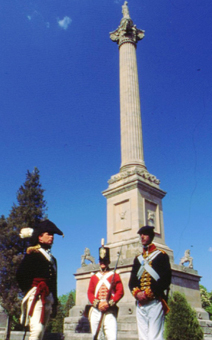
Brock Monument and the bicentennial of the War of 1812 had a lot to do with Niagara's 'Culture Capital' designation.
Since Niagara has recently been declared by our federal government the ‘Cultural Capital of Canada’ for 2012, with that title comes a huge responsibility for all of us; we need to not only think seriously about the future sustainability of the arts, culture and heritage in our Region, but we need to “walk the talk”.
I had the privilege of serving on the first term (2007–2010) of the Regional Culture Committee, when time was spent bringing the group together on discussion of cultural issues, the Asset Mapping of the Region, and work towards a formal Culture Plan for Niagara. This plan was approved by the Regional Council and implementation of it was declared the mandate of a new Culture Committee.Near the end of the committee’s first term it was announced that application was being made to declare The Region of Niagara, Cultural Capital of Canada and with that title came $2 million in funding. It was obviously felt that the Region had advanced to the point that culture was an issue and driving force throughout the 12 municipalities in our Region. This, I am sure, became apparent through the work which was done by the Culture Committee during their first term and the extent of the culture in Niagara which came to light during the process of Asset Mapping.
The Region of Niagara is comprised of its 12 municipalities, all of which have extensive heritage, cultural events and the arts. This strong picture of Niagara Culture, I am sure, contributed to the reason the Region of Niagara made application in the first place to be named the Cultural Capital of Canada and further, the reason they were awarded this title.
It has just been announced that the title “Cultural Capital of Canada” is being shared between Niagara and Calgary; that title comes with $1.6 million from the federal government, and the “Niagara Region plans to put this towards numerous cultural activities with a War of 1812 theme during next year’s bicentennial anniversary
We have a Legacy Council in place and many local committees which are working extremely hard and concentrating their efforts on events for the bicentennial for the War of 1812. This bicentennial celebration is a “main event” and emphasizes the historical nature of our Region. Long after this celebration is over, our regular arts, culture and heritage keep ”happening” in the Niagara Region.
The matter of “culture” happens every day in Niagara on a regular basis. There are struggles and problems which are inherent in the field of arts, culture and heritage. We need to think about the fact that arts, culture and heritage are normally not considered number one on the list of vital issues we face on a daily basis like health care, jobs, taxes, the environment, etc. Actually, in a survey done locally this past year by the TV Ontario program Agenda, it showed heritage second to the bottom of the list of issues vital to our citizens. So, we need to consider the responsibility we have with our new title. When we think about heritage in our Region, our minds often drift to Niagara-on-the-Lake where they have done such a wonderful job of retaining their built heritage for all of us to admire and enjoy. Now that Niagara is the Cultural Capital of Canada we are “on stage” and it is up to us to do the right things to live up to that immense title and the responsibility connected with it.
Having said that, we can take a lesson from the movie “Mr. Holland’s Opus”. Mr. Holland was a dedicated and respected music teacher at a high school, and when, as it often does, the budget for cultural activities was being cut, Mr. Holland pleaded with the Board saying that if culture is cut “pretty soon these kids won’t have anything to write about” The three R’s won’t do it ! …and how right he was !
The Smarter Niagara Summit held in May of 2007 named the four pillars of a complete community as:
Environment ))
Economic ))
Social ))
Culture (arts, culture, heritage) Equals Sustainability ))
It is vital that we keep the culture pillar of our society strong on a continuing basis. Implementation of the Culture Plan should help give us direction for this pillar of our Region. Again, with this new title for Niagara, the peoples of Canada will be watching; “The Cultural Capital of Canada” means a great responsibility and commitment from each of us – pride, support and respect for the culture of our communities, help in keeping our arts, culture and heritage strong, making wise decisions on the future of Niagara’s culture, as well as preserving and protecting the rich heritage which exists in every corner of our Region.
Pamela J.Minns is a Niagara,Ontario resident and long-time advocate for protecting and preserving the heritage of this region.
(Niagara At Large welcomes you to share your views on this post below.)
 Niagara At Large