
By Mark Taliano and Tori Crispo
Unions are suffering. Corporations are leaving to make profits elsewhere. The middle class is disappearing. Economic disparities between rich and poor are growing faster in Canada than in the United States, and banks are making a fortune. It might be described as “the best of times” (for banks) and “the worst of times” for the 99%.
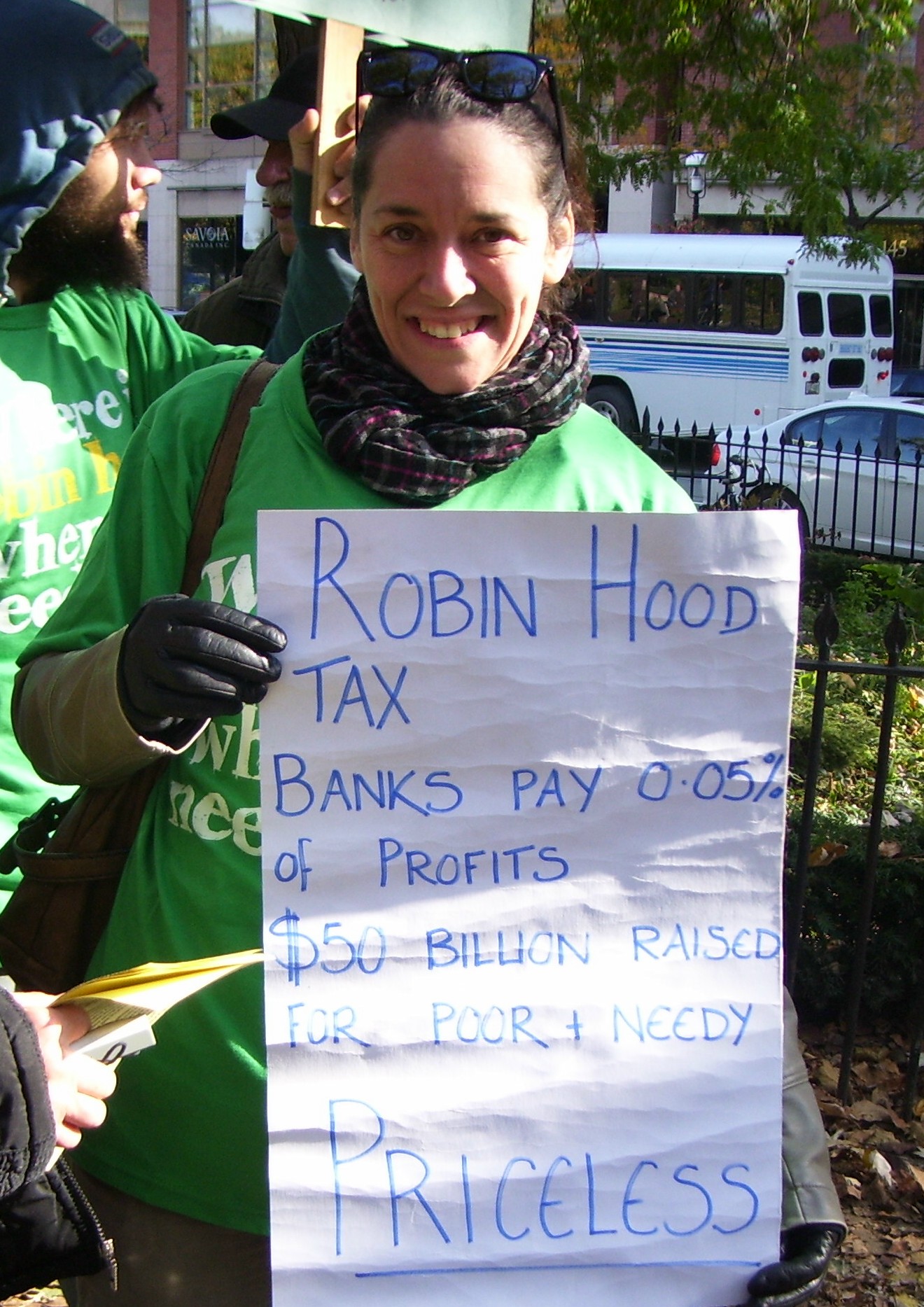
Photo courtesy of Mark Taliano
The October 30 Occupy Robin Hood March, leaving St. James Park in Toronto and traveling to the Financial District for a rally, featuring speakers such as CAW Economist and author James Stanford, came up with some assessments and answers.
A reasonable assessment is that the rules are not equal and fair, and many are waking up to some uncomfortable realities.
Yes, the banks were bailed out and they paid it back, but it’s still unfair that the public sector has been burdened with insuring their risky loans, and yes, we’re talking billions of dollars.
Current Investment Bank speculation practices are also unfair. Derivatives and hedge funds do not produce goods or services, but they do lead to market crashes, as they did in 2008. And they are legal. Some call it ‘casino trading”, and it doesn’t help the 99%. It is accurately referred to as “legalized, subsidized, protected gambling”. As Douglas Rushkoff observes in a CNN piece, “… (the) fiscal operating system on which we are attempting to run our economy is no longer appropriate to the task.”
So, what are the solutions?
A first step, approved by Germany, France, Holland, the Vatican, even Bill Gates, as well as legions of economists, would be the Robin Hood Tax (also know as the “Financial Transaction Tax”, and previously the “Tobin Tax” in Canada). It’s a “no-brainer” for progressive societies and progressive policy-makers, and this is what it looks like:
A tax of about .05% would be levied on certain Financial Sector transactions (especially the speculative varieties). Such a tax would raise billions, it would enhance the perception that the financial sector is paying its fair share, and it would curb destabilizing financial transactions.
Former French President Jacques Chirac noted that it would “shift the burden of crisis resolution from the general public to the financial sector … a sector that is still relatively exempt from paying their fair share of taxes.” Current French President Sarkozy, who also champions the Financial Transaction Tax, has put it on the G-20 Agenda.
The Financial Transaction Tax would be a start, but bank taxes such as Corporate Income taxes, Capital Gains taxes etc. are also on the table. Loans and mortgages do put money into the real economy, but such taxes would increase these amounts, to the benefit of the “99%”.
One “occupation” theme is the growing income disparity between the rich and poor, and the fact that this disparity is growing faster in Canada than in the U.S. These taxes would help to slow that growth in income disparity.
The consequences of these increasing disparities are profound for our society. Richard Wilkinson, in an episode of Ted Talks entitled “How Economic Inequality Harms Societies” notes a litany of ills associated with unequal societies, including more mental illness, more violence and homicides, more school dropouts, less social mobility, and so on. He wryly observes that “if you want to realize the American dream, you’d be better off moving to Denmark” (or Sweden or Japan for that matter.)
The choice is ours: more democracy and equality for the “best of times” or more of the same for what may well become the “worst of times”.
Mark Taliano and Tori Crispo are Niagara residents and contributors to Niagara At Large.
(Niagara At Large invites you to share your views below. Remember that we only post comments by people willing to share with their views their real first and last name.)
 Niagara At Large