
By Dawn Pierrynowski
You’ve heard of chimney sweeps but do you know about the Chimney Swift?
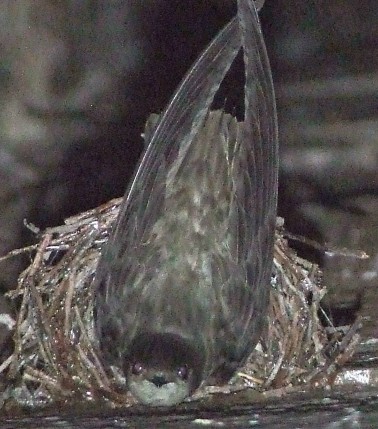
A Chimney Swift, nesting down a chimney shaft. A species struggling to survive.
These unique birds – known more technically as Chaetura Pelagica – are an urban-dwelling aerial insectivore that eats about 1,000 flying insects each day while flying continuously high over towns, fields, forests and wetlands. They are known as the “flying cigars” because of their cigar-shaped body (12-14 cm long), narrow pointed wings, short spiny tail, and quick jerky movements while in flight.
They are a vocal bird that makes a series of high-pitched chip notes while in flight, and can often be heard before they are seen. Their small feet are uniquely suited to landing on the sides of a structure and clinging to the rough surface with their toenails. They do not perch on branches or land on the ground like other bird species.
Chimney Swifts are migratory and arriving in late-April to early-May. Towards the end of the summer they congregate for their migration to the upper Amazon basin in South America. Quite the travelers!
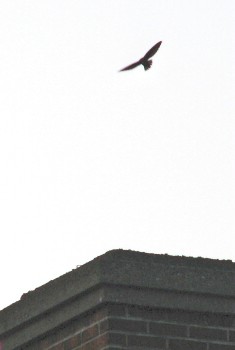
Still in full flight but for how long?
Historically, large hollow trees found in old growth forests were the nesting sites for Chimney Swifts but as this habitat has largely disappeared, they are primarily found nesting and roosting in large brick chimneys and other similar manmade structures including air vents, old open wells, outhouses, abandoned cisterns and lighthouses. Chimney Swifts face the added pressure of habitat loss resulting from the modernization of chimneys (capped, round, metal flues) that prohibits the swifts from entering potential nest sites.
Unfortunately, Chimney Swifts are one of several insect eating species in North America that is declining rapidly. The dramatic and rapid population decline (over 90%) has led to the recent listing of Chimney Swifts by the Committee on the Status of Endangered Wildlife in Canada (COSEWIC) as a federally threatened species. Scientists still do not know where this species is found, how many swifts there are and which urban areas are most important.
Without this information, we cannot make sure that swifts continue to be seen and heard in our cities. Bird Studies Canada’s (BSC) goals are to record swift numbers, behaviour and, movements throughout their Ontario range, resulting in comprehensive and comparable province-wide population trends. They have launched the Ontario SwiftWatch program which involves community groups and individuals who find and track nesting locations, count numbers of birds and act as urban stewards.
Members of the Niagara-based Bert Miller Nature Club have volunteered to monitor possible roosting and nesting sites the Fort Erie/Ridgeway area. You can help by looking for Chimney Swift activity a half hour before and after sunset. If there is activity, you will see them feeding high overhead and then they will amazingly dive tornado-like into a chimney or other suitable structure. If you have information regarding an active site, please contact Dawn at 905-384-2476, Lynda at 905-871-5856 or Janet at 905-871-0480.
How You Can Help Out!
· If you have a masonry or clay flue-tile chimney, keep the top open and the damper closed from March through October to provide a nest site.
· Metal chimneys should be permanently capped to prevent birds and other wildlife from being trapped.
· Have your chimney cleaned in early March before the Chimney Swifts return from their winter home in South America.
· As with all wildlife, do not disturb the birds or nesting sites. Observe from a distance.
· For more information on how you can help, visit: Bird Studies Canada at http://www.bsc-eoc.org; the Ministry of Natural Resources at www.mnr.gov.on.ca; www.chimneyswifts.org
· Spread the word
Dawn Pierrynowski is a Niagara resident and vice president of the Bert Miller Nature Club, an organization that has been dedicated for decades to protecting and preserving our natural resources.
(We invite you to share your views below and to encourage your friends and associates to visit Niagara At Large at www.niagaraatlarge.com for more news and commentary on matters of interest and concern to residents in our greater Niagara region and beyond.)
 Niagara At Large