
A Commentary by John Bacher
Within the corridors of power at Brock University, there is an intense debate over the future of a 52-acre meadow with some native tree regeneration, predominately Black Walnut, along that meadow’s edges.
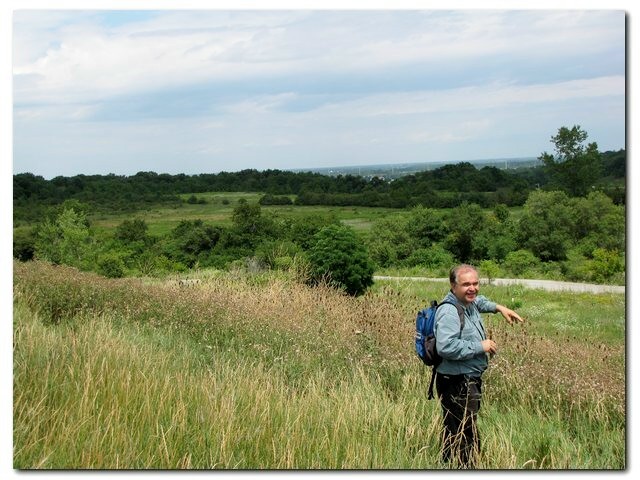
John Bacher at site where trees could grow.
This debate concerns lands owned by Brock University and situated in between the forested Niagara Escarpment and the Glenridge Landfill Rehabilitation Site – a rather clumsy name given to describe a park owned by the Niagara Region and managed by the Niagara Peninsula Conservation Authority.
This park, although its central feature is a hill that is a former landfill site, also contains ponds with healthy frog populations and a lake that is the best place in Niagara for visitors to view catfish.
Until about 20 years ago the Brock meadow was farmed. This ended when access to the site was cut off by the construction of the Glenridge Landfill (a site that became a dumping ground for municipal wastes from the St. Catharines and Thorold areas). In this time the Niagara Escarpment forest has slowly expanded onto the formerly cultivated land. Although Black Walnuts, spread by squirrels, are in the vanguard, behind them a new forest is filling in with Canada Plum, Pin Cherry, White Oak and White Ash. The site has abundant wildlife with sightings common of Wild Turkey, Woodcock, Coyotes and White Tailed Deer.
Although officious officials in the university’s landscaping department have cited deer browse as a reason not to reforest these lands, these trees have expanded into the meadow at a normal rate for a dry soil conditions on the edge of the Niagara Escarpment. Black Walnut has a bitter taste to deer. It is successfully regenerating, even in the core areas of the Short Hills Park, which have the worst problems of heavy deer browse in Niagara.
The lack of access to tractors while leading to the abandonment of cultivation, is not a barrier to development. An extension of Tremont Drive right across a thin ribbon of forest and the Bruce Trail could be the basis of a future subdivision.
One dedicated environmentalist who appreciates the Brock meadow is Frank Hardy one of the core of the volunteers of the Friend of Malcomson Park. He has found that the meadow is relatively free of invasive exotic plants and therefore provide excellent habitat of pollinators such as native bees. He has step up wooden boxes on poles in the meadow to help the bees reproduce.
For now the Brock-owned meadow is protected from development by a little-publicized good planning initiative of the provincial government termed the Built Boundary. The measure intended to prevent urban sprawl as part of the province’s Growth Management Plan for the booming Golden Horseshoe around Toronto restricts development on the outer fringes of urban boundaries. The meadow is outside this built boundary line, so no development applications can be made.
The Built Boundary however, is intended to be a temporary measure, to be lifted in 10 to 15 years after municipalities have made some progress in increasing their urban densities. In the long term land use is supposed to be guided by the newly developed St. Catharines “Garden City”, Official Plan.
The St. Catharines Planning Department is not very sympathetic to those who would like to maintain the wildflower meadow or reforest it. Although a number of comments were made by citizens requesting that the area be protected from development in the new Garden City plan their comments were not summarized in the department’s report to council after public input was received.
The “Garden City Plan” calls for the Brock meadow to be developed on the basis of a designation termed “medium density residential.” When I complained about this last spring to public meeting that an opportunity to reforest lands adjacent to the Niagara Escarpment was being missed by this designation, no interest was shown by the City Council. It later passed the plan with the proposed designation unchanged.
Rebuffed by City Council, environmentalists such as the Peninsula Field Naturalists and the St. Catharines Chapter of the National Council of Women appealed to the University President Jack Lightstone. They came up with an attractive name for the proposal to be called the “Founders Forests”, later changed the “The Founders and Builders Forest.” The concept is to honour the Founding Board of Brock University and those who subsequently worked to enhance build it up. Many of the notables of the Founding Board such as Mel Swart and Arthur Schmon were effective advocates of more forest cover in Ontario.
Last summer, Lightstone referred the reforestation proposal to the Brock University Sustainability Committee. This resulted in considerable faculty and student interest in the reforestation proposal. This arose out of its work in calculating both Brock’s direct (from its own buildings and vehicles) and indirect (from people travelling to the university and from faculty trips) carbon emissions.
It was discovered that one acre of reforested former farmland would annually absorb around 2.5 tons of carbon. On this basis reforesting the meadow would eliminate all of Brock’s direct emissions and about 10 per cent of its total emissions. Such a step would put Brock out in front in the race for universities around the world to be recognized as carbon free. This is being done so that they can play a major role in one of the most critical threats of our time, the harmful alteration of the earth’s climate by human action.
Student and community support grew for the reforestation of the Brock meadow. Lisa Kretz, the co-ordinator of the Ontario Public Interest Research Group at Brock, and Andrew Barclay of its programming committee advocated for the future forest. They pointed out that, reforestation would be increase biodiversity, and serve to decrease “the institutional carbon footprint of Brock” and buffer the adjacent Niagara Escarpment forest.
Despite growing support for reforestation university administrators, formerly appearing to be receptive to the concept of reforestation, began to reveal their opposition after in the fall of
last year. It became their position that the meadowlands were “not likely to be released” for reforestation, “due to a complex web of current and future considerations.”
The “web” referred to by administrators is the 2005 Campus Plan, a document available on Brock’s website. It refers to the meadow as Brock’s future “Campus East.” What the plan actually says about these lands is vague and contradictory. On one hand it calls for the land to be used as an “amenity feature” in co-ordination with the Bruce Trail and the adjacent “regional park.” This would appear to favour reforestation. At the same time however, it speaks to an “interim use,” having the site being used for recreational fields and parking lots. The 2005 plan talks about the use of the land being guided by the St. Catharines Official Plan. This implies the sale of the property for medium density housing. All this ambiguity simply provides a smoke screen for decisions to be made in smoke filled rooms.
It is important that more people get engaged in the debates over the reforestation of Brock’s lands. There are no other environmental controversies in St. Catharines as significant as the future of the meadow at the end of Tremont road, which can be viewed by thousands as the travel by on Highway 406.
Brock’s existing Niagara Escarpment forest contains a number of rare species, such as Honey Locust, Papaw, Bitternut Hickory, Pignut Hickory, Burning Bush and Twin Leaf. Having a bigger forest will allow these species to expand their range and will help forest interior bird species such as the Scarlet Tanager survive.
For all of its magnificence and impressive old growth characteristics, the escarpment forest is vulnerable to storm events and disease threats from future predicted climate change. Having trees soar upwards on its meadow will make a far more dramatic educational statement than the construction cranes that now dominate the Brock campus skyline.
John Bacher is a veteran member of the Niagara, Ontario-based Preservation of Agricultural Lands Society and an advocate for conserving natural spaces in the region.
(Visit Niagara At Large at www.niagaraatlarge.com for more news and commentary on matters of interest and concern to residents in our great Niagara region and beyond.)
 Niagara At Large
A “carbon neutral” status would be a very progressive step for Brock. I hope they can achieve that distinction.
LikeLike