
(Niagara At Large posts the following for the interest of residents on both sides of our binational border.)
FORT ERIE—The War Resisters Support Campaign <http://resisters.ca/> in Canada and the Buffalo chapter of Veterans For Peace are co-sponsoring a historic gathering with US Iraq War resisters who have sought refuge in Canada.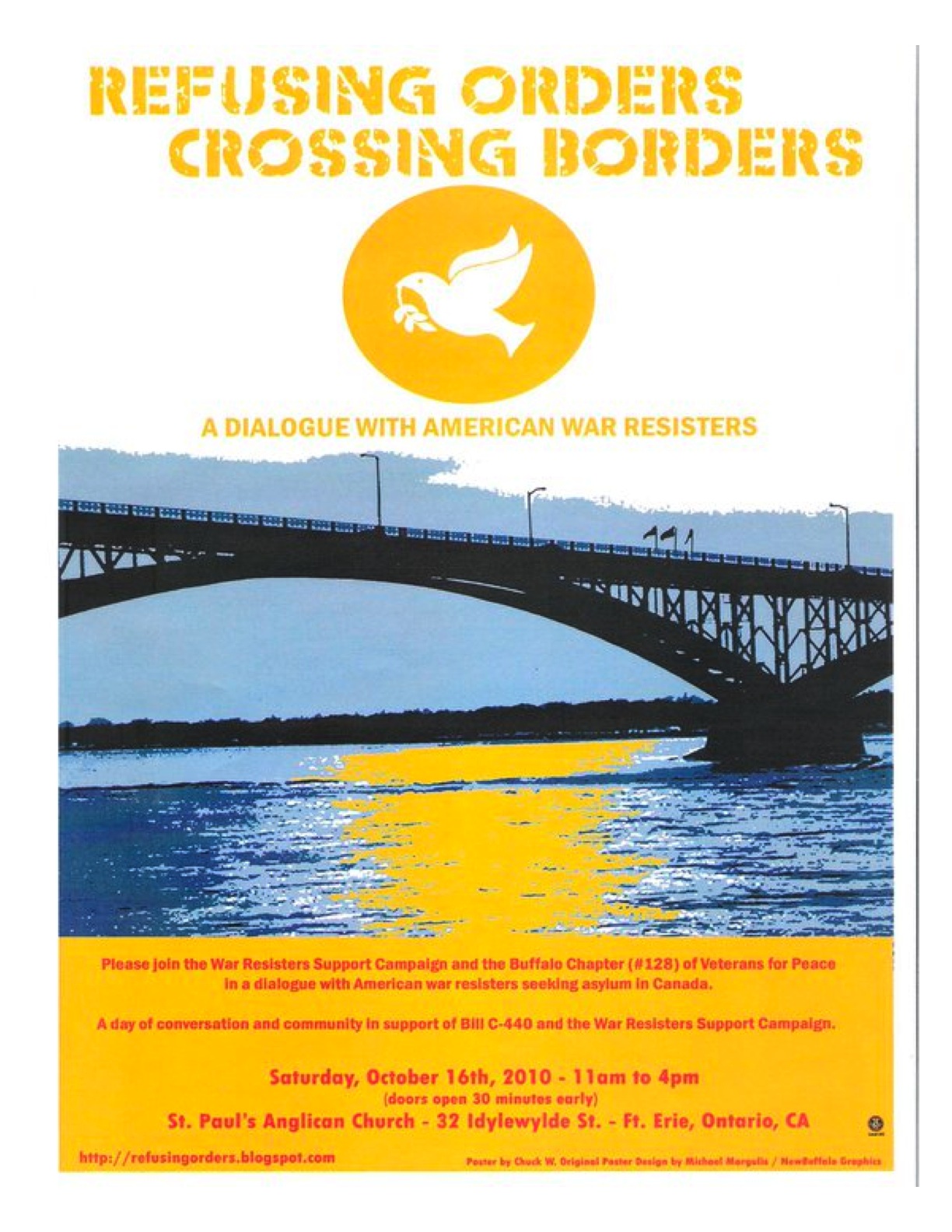
The event, titled “Refusing Orders, Crossing Borders” <http://refusingorders.blogspot.com/> , will take place on Saturday, October 16 from 11:00 a.m. to 4:00 p.m. ET, at St. Paul’s Anglican Church, 32 Idylewylde Street, Fort Erie, ON.
Supporters from both Canada and the US will have the opportunity to meet former US military personnel who have chosen to come to Canada rather than participate in the Iraq War.
This day-long event promises an opportunity for dialogue with these young men and women, to hear about why they made the choices they did – the personal and legal struggles they face – and to look at ways in which supporters can help them in their cause.
The following US war resisters are expected to be present at the event:
Joshua Key, Jeremy Hinzman, Phil McDowell, Chuck Wiley, Kim Rivera, Corey Glass, Dale Landry, Dean Walcott, Justin Colby, Ryan Johnson, Chris Vassey, and Jules Tindungan.
A bus will be departing Toronto for Fort Erie at 8:00 a.m. on Saturday, returning at 7:00 p.m. Journalists interested in reserving a seat on the bus please call 416-598-1222.
– 30 –
For further information:
Michelle Robidoux, spokesperson, War Resisters Support Campaign, 416-856-5008;
Ken Marciniec, communications volunteer, War Resisters Support Campaign, communications@resisters.ca, 416-803-6066.
BACKGROUND
———-
Associated Press: ‘Combat in Iraq is not over, and we should not uncritically repeat suggestions that it is’
Memo from the Associated Press’ standards editor
From: Kent, Tom
Sent: Thursday, September 02, 2010 5:30 PM
Subject: Standards Center guidance: The situation in Iraq
http://www.ap.org/pages/about/pressreleases/pr_090310a.html
Colleagues,
Many AP staffers are producing content that refers to the situation in Iraq. It might be a local story about Iraq veterans, an international diplomatic story that mentions the Iraqi conflict or coverage on the ground in Iraq itself.
Whatever the subject, we should be correct and consistent in our description of what the situation in Iraq is. This guidance summarizes the situation and suggests wording to use and avoid.
To begin with, combat in Iraq is not over, and we should not uncritically repeat suggestions that it is, even if they come from senior officials. The situation on the ground in Iraq is no different today than it has been for some months. Iraqi security forces are still fighting Sunni and al-Qaida insurgents. Many Iraqis remain very concerned for their country’s future despite a dramatic improvement in security, the economy and living conditions in many areas.
As for U.S. involvement, it also goes too far to say that the U.S. part in the conflict in Iraq is over. President Obama said Monday night that “the American combat mission in Iraq has ended. Operation Iraqi Freedom is over, and the Iraqi people now have lead responsibility for the security of their country.”
However, 50,000 American troops remain in country. Our own reporting on the ground confirms that some of these troops, especially some 4,500 special operations forces, continue to be directly engaged in military operations. These troops are accompanying Iraqi soldiers into battle with militant groups and may well fire and be fired on.
In addition, although administration spokesmen say we are now at the tail end of American involvement and all troops will be gone by the end of 2011, there is no guarantee that this will be the case.
Our stories about Iraq should make clear that U.S. troops remain involved in combat operations alongside Iraqi forces, although U.S. officials say the American combat mission has formally ended. We can also say the United States has ended its major combat role in Iraq, or that it has transferred military authority to Iraqi forces. We can add that beyond U.S. boots on the ground, Iraq is expected to need U.S. air power and other military support for years to control its own air space and to deter possible attack from abroad.
Unless there is balancing language, our content should not refer to the end of combat in Iraq, or the end of U.S. military involvement. Nor should it say flat-out (since we can’t predict the future) that the United States is at the end of its military role.
———-
Canadian immigration officials told to flag U.S. war resisters <http://www.thestar.com/news/canada/article/843379–canadian-immigration-officials-told-to-flag-u-s-war-resisters>
August 3, 2010 – Toronto Star
Federal Court of Appeal rules in favour of U.S. war deserter <http://www.canada.com/news/Federal+Court+Appeal+rules+favour+deserter/3243410/story.html>
July 6, 2010 – Postmedia News (formerly Canwest News Service)
U.S. deserter has trouble coping with what he saw in Iraq <http://www.stcatharinesstandard.ca/ArticleDisplay.aspx?e=2619098>
June 11, 2010 – St. Catharines Standard
U.S. marine seeks refuge in Port Colborne <http://wellandtribune.ca/ArticleDisplay.aspx?e=2631421>
June 19, 2010 – Welland Tribune
Deserter pins blame on U.S. government <http://www.calgarysun.com/news/columnists/bill_kaufmann/2010/05/28/14166376.html>
May 27, 2010 – Calgary Sun
Why a resister chose Canada over the war in Iraq <http://www.thestar.com/comment/article/742512>
December 24, 2009 – Toronto Star
Deserters have a right to stay in Canada <http://www.sudburystar.com/ArticleDisplay.aspx?archive=true&e=1503173>
March 31, 2009 – Sudbury Star
(Visit Niagara At Large at niagaraatlarge.com for more news and commentary on matters of interest to residents in our greater binational Niagara region.)
 Niagara At Large
The invasion of Iraq is a text book case of what not to do when a country is supposedly liberated, when Europe was liberated the infrastructure ie the police and parts of the military were kept in business , same in Japan general Mac Arthur used the bureauxcrats and kept some order, no anarchy, but the dimwits running the Bush war room ,Cheney and Rumsfeld dissolved the Army ,Police and the whole infastructure, shear madness, so when the looting of the ammunition dumps and bombs and missiles fell into the hands of lawless people we had total chaos, those bombs were then used on allied troops. IED explosive devices set off by remote control, Re “The Hurt Locker” this is what happens when stupid polititions run something, they get a lot of people killed..
LikeLike
forgive my spelling I broke my bi-focals.
LikeLike
While I agree with the notion that Saddam had to go, and there is one less tyrant in the world today because of it. Mr Jardine makes some interesting points. However he does not go far enough, if the politicians had listened to Patton we probably would not have had a cold war. Heck if not for Politicians and diplomacy we probably would not have had a first world war..
As for these “war resisters” there are a few fine points that we miss. These are military personnel they signed on the dotted line to follow orders and be deployed where there political masters say they are to go. As long as their orders are lawful they are obliged to follow them.
As it stands, both our Countries are in a state of war. Though you would not know it, unlike previous wars there was not a national mobilization of the people. This fact none the less should not be forgotten and the actions of these “war resisters” is an act of lawlessness. I would not use such a benign label but rather call them what they really are, “deserters”
LikeLike