
Niagara At Large is pleased to post this piece by the chairman of Niagara, Ontario’s regional government as he finishes his final weeks in office this fall after announcing his decision to retire from politics earlier this year.
In the piece, Partington chronicles challenges and achievements, and he calls for reform of the way we are governed municipally, including a fewer number of local municipalities than the 12 we now have in Niagara – a suggeston at least some across the region may view as controversial or unacceptable.
At the end of the article, we encourage you, our readers, to share your views in the comment boxes below.
By Peter Partington, Chairman, Niagara Region
My impending departure from Regional politics, after serving two terms as Chair, coincides with the 40th anniversary of Niagara Region, an entity still in its infancy as governments go, but nonetheless as important as ever in terms of the essential services it provides to residents and to Niagara’s many and diverse communities.
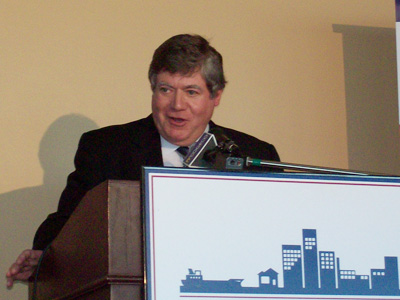
Niagara Regional Chairman Peter Partington. File photo by Doug Draper
Providing services that range from a safe water supply to policing, from waste collection to transportation, from helping seniors stay in their homes as long as possible to attracting job-creating investment, Niagara Region is playing a vital role in building a prosperous, vibrant region in which all can participate and succeed.
Priorities Consistent with Chamber of Commerce Report
Regional Council has achieved much during its four-year term, guided by a business plan focused on key priorities that include economic prosperity, community and social well-being and inter-municipal transportation.
These priorities are consistent with many of the recommendations contained in the recently released report by the St. Catharines – Thorold Chamber of Commerce, Supporting Prosperity Through Effective Government. Working with Niagara’s business community to create an attractive climate for business continues to be an economic imperative and a regional government priority.
Property Taxes and Development Charges
Of the current Council’s many achievements, I am particularly proud of our record on taxes. The 2010/11 budget includes a tax freeze, and during the past five years Council held tax increases to an average of just over one per cent per year – a significant achievement given ongoing financial pressures.
I am also proud of Council’s work in approving a new schedule of development charges. The new rates will almost double our revenues from $8 million to $15 million, and reflects more accurately what it costs the Region to support good development. The rate increases were long overdue and they’re still lower than the provincial average.
Stable taxes and reasonable development charges help keep and attract employers. Studies indicate Niagara is one of the most affordable areas in North America to do business, and Niagara Region is committed to making sure the region is an attractive place to start and expand a business and create jobs.
New Business Investments
Niagara’s economy continues to evolve and adapt to the changing global marketplace. Earlier this year, Biolyse Pharma celebrated the opening of its new multimillion dollar high-tech production facility in St. Catharines. As well, GM Canada announced a $235 million dollar investment in its St. Catharines engine plant. This investment will translate into 400 direct jobs in our region. And both Brock University and Niagara College are expanding to accommodate more students, bringing jobs and exciting new research activities that will support Niagara’s changing economy.
$67 million in Infrastructure
The Region is making important investments in infrastructure to support business activities. Last year we leveraged our investment of $33 million to secure $67 million in economic stimulus and other program funding. This allowed us to move forward on a number of infrastructure projects:
· A new wastewater plant in West Niagara will mean increased capacity for business, residential and tourism growth.
· Upgrading of the Niagara District Airport, including a new terminal building, will make it more attractive, functional and accessible.
· The expansion of Highway 406 to East Main Street in Welland – a project that is central to the Region’s Grow South strategy.
· The proposed construction of a major East-West corridor in South Niagara is now at the environmental assessment stage. This project will open up this part of the region for economic development and save time and money for commuters and businesses.
Inter-municipal Transit Starts in 2011
Regional Council also made significant strides to improve inter-municipal transit, endorsing and funding a three-year pilot project that will, starting next year, create hourly bus service between St. Catharines, Niagara Falls and Welland with additional links between Niagara Falls and Fort Erie and Welland and Port Colborne. Moving forward on this long-standing issue will enhance the mobility of residents which is important for economic growth. It will address the needs of post-secondary students, workers who commute, and enhance the options for visitors to get around the region.
Increased Social Assistance Caseloads
Many residents continue to feel the effects of the global recession. Although signs of recovery are emerging, last year our social assistance caseloads increased by 20 percent. The Region is working hard to re-integrate social assistance recipients into the workplace through a variety of employment and job training programs. Each year we help hundreds of individuals and families get back on their feet.
While the Region has achieved much, there is still work to do.
Reducing Municipal Government in Niagara
I hope the next Regional Council will examine other needed reforms, including how Niagara is governed. I agree with the St. Catharines-Thorold Chamber and most residents that Niagara is over-governed for our population size. Achieving a more reasonable number of municipalities – between six and eight – would be difficult to achieve, but the status quo is not an acceptable option. There is simply too much municipal government in Niagara.
As we move forward into an age of both economic and social globalization, local government is no longer simply about roads, social services and garbage collection.
Long-term planning, partnerships, and most importantly vision, are what will keep Niagara moving forward in a way that helps strengthen our communities and improves the lives of individuals.
As Niagara Region celebrates 40 years of providing valuable programs and services, I wish to acknowledge my fellow Councillors and the Regional staff who demonstrate daily how much they care about this great region. My thanks to them and to the many individuals and organizations committed to building a bright and prosperous future for all.
(Visit Niagara At Large at www.niagaraatlarge.com for more news and commentary on matters of interest and concern to residents in our greater binational Niagara region.)
 Niagara At Large