
By Don Alexander
The Niagara Escarpment Plan is marking its 25th anniversary this year.
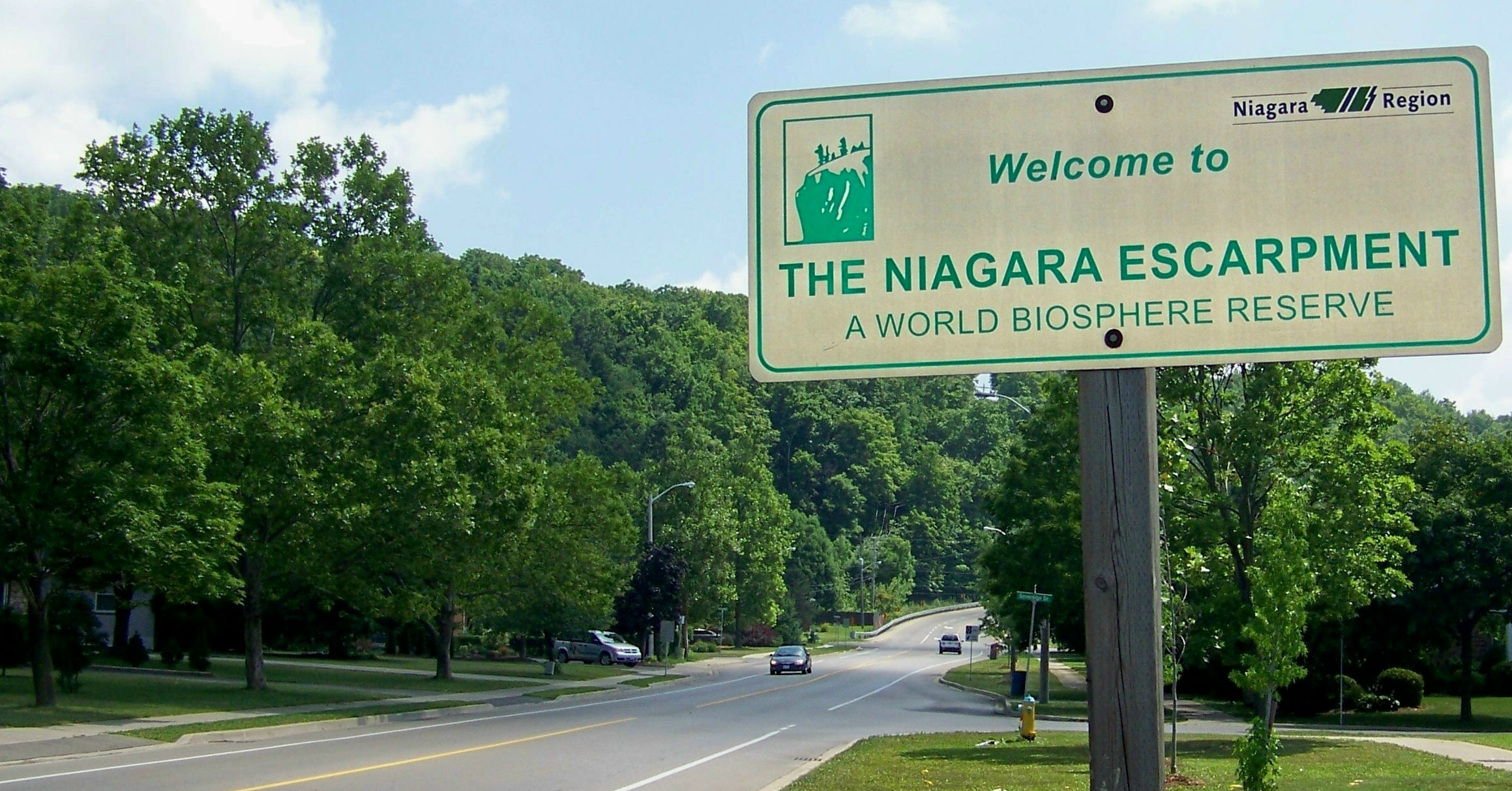
A sign promoting the Niagara Escarpment's designation as a globally significant biosphere with the verdant slopes of the escarpment looming behind in St. Catharines, Ontario.
It has also been 15 years since the Niagara Escarpment and its plan area were named a United Nations Biosphere Reserve.
The provincial legislation establishing the Niagara Escarpment Commission and its planning responsibilities was adopted in 1973 and that, along with the U.N. designation a decade and a half ago, are anniversary years that we should measure and mark.
For the Niagara Escarpment itself and its natural systems, time is measured over decades, centuries and eons.
I think of the Niagara Escarpment as a place where time is of a different order than everyday. That is what makes it special for many of us. It is sometimes described as a “sacred space” where people go into the natural setting to reflect. The pace slows.
Consider the formative years of the escarpment!
Limestone evolved from coral beds of seas … glacial ice cover … ten thousand years ago the land form we know today emerged behind the retreating glaciers. Change came slowly. Very slowly.
In the past century, the pace changed. Faster. The very landscape, forests, and waterways were now easily changed with increasingly capable machinery. We could now build houses and highways anywhere. The escarpment cliffs and remoteness no longer provided a kind of protection.
Protection would now come through purposeful human effort.
The Niagara Escarpment Plan establishes “maintenance of the escarpment and land in its vicinity substantially as a continuous natural environment, and to ensure such development occurs as is compatible with the natural environment.”
The Niagara Escarpment legislation and plan provide a framework for change that is helpful to the environment and ecology of the escarpment area.
Over the years, it fosters new ways of keeping the length of the Niagara Escarpment special.
Time brings us new landmarks for managing change in the plan area..
-Recently the Bruce Trail Association became the Bruce Trail Conservancy. It had onlyf handshake agreements to establish the best routes for the trail. Now, as a land conservancy, it has the added ability to negotiate land purchases and land easements with owners. Over time the Bruce Trail will meet the goal of having an ensured and maximum route for the trail system.
-Recently new lands are being added to the Niagara Escarpment plan area. Gaps in the Hamilton/Halton area are being added. At the same time a land owner near Georgian Bay has chosen to have his large 80 hectare rural acreage added to the adjacent plan area.
The owner also offered some of his land to the Bruce Trail Conservancy for a side trail.
-Recently the Niagara Escarpment Biosphere Reserve established a “Cooperation Plan”. It provides a way for community organizations to engage in the Biosphere goals of biodiversity-conservation, sustainable-development, research and education.
-Recently the many parklands along the length of the escarpment have established a networking organization so they can learn and share from each other. Management plans have now been established by many of the parks in the Niagara Escarpment Parks and Open Space (NEPOSS) system.
Perhaps the Niagara Escarpment area is a special “time zone”, reminding us that there are many ways to measure time.
A long time ago–one thousand years ago–a tiny cedar tree gained a roothold in the crevice of a rock face on the escarpment. That ancient cedar and others like it, still thrive.
More recently–about fifteen years ago–those cedar trees were recognized by the erection of a metal and stone sculpted representation on the campus of Brock University in St. Catharines.
Don Alexander is a St. Catharines resident, a former Niagara regional councillor and one of 17 Commissioners on the Niagara Escarpment Commission.
(Click on Niagara At Large at www.niagaraatlarge.com for more news and commentary on matters of interest and concern to our greater binational Niagara region.)
 Niagara At Large
This is a wonderful historical review, and an informed review of the Commission. More power to it, to preserve what it can preserve, despite every attempt by past and current governments, to dismiss concerns about the natural bounty we all enjoy. Gail B
LikeLike
This is an excellent review. At this time it would be right to honour Mel Swart, also the founder of the Preservation of Agricultural Lands Society. His heroic efforts 25 years ago made the Escarpment Plan reality, through negotiations with Dennis Timbrell in the last weeks of the Progressive Conservative government of Frank Miller.
LikeLike