
By Doug Draper
While we’ve been watching a environmental and economic catastrophe unfold on and along the waters, wetlands and beaches of the Gulf of Mexico, the world’s largest reserve of freshwater – the Great Lakes -may soon face a catastrophe of their own.
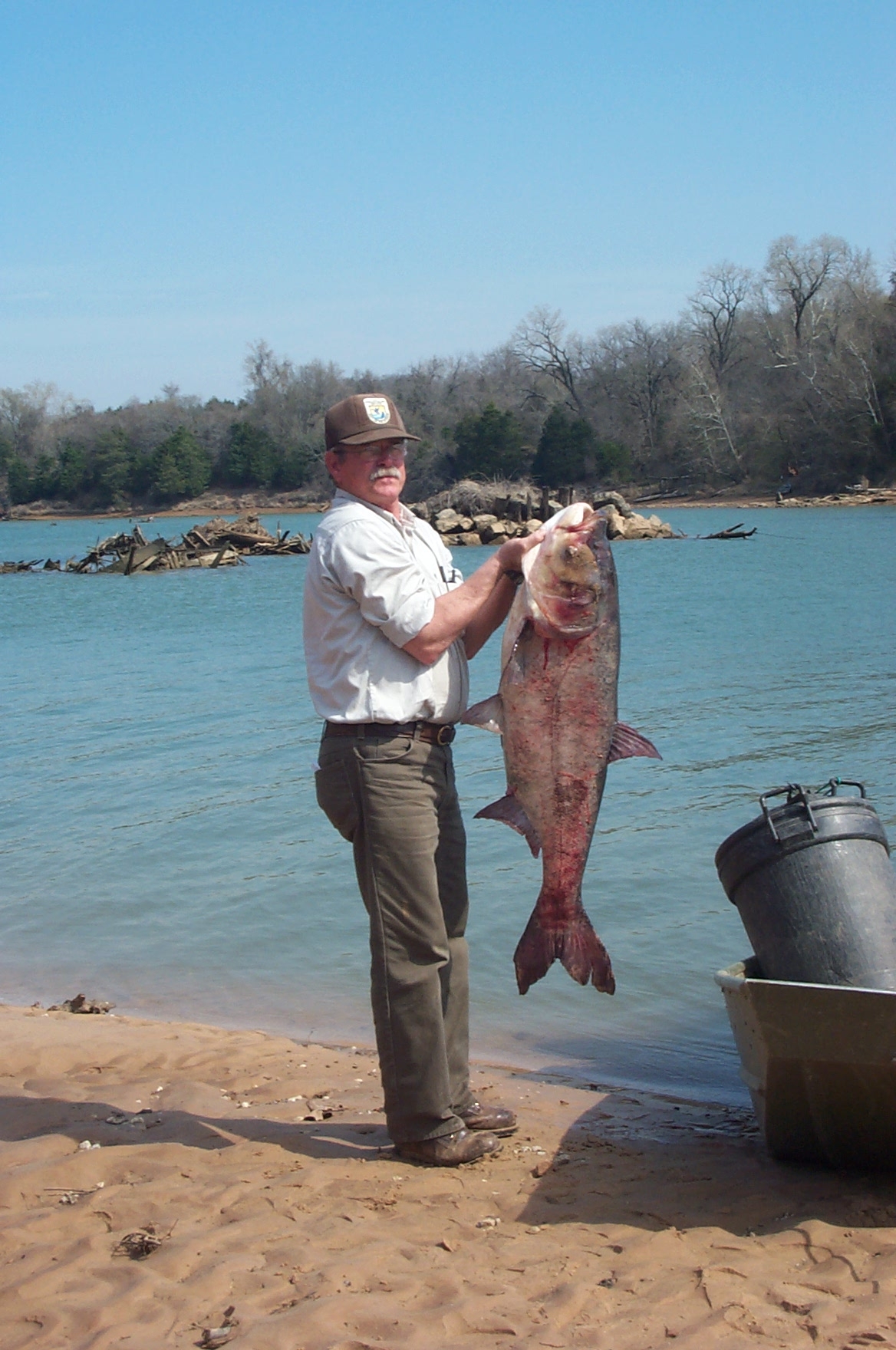
This Asian carp was caught in the upper Mississippi watershed near Chicago and Lake Michigan. Photo from the U.S. Fish and Wildlife Service.
This one would not come in the form of oil gushing from a well but from a voracious fish that could virtually destroy a Great Lakes fishery worth billions of dollars annually to communities on both sides of the Canada/U.S. border.
The fish of concern are Asian carp and just as their name implies, they were alien to North America until they were imported to this continent in the 1970s to control the growth of algae in aquaculture pools (fish farms) in the southern U.S. where they eventually managed to escape to the Mississippi River and migrate north to tributaries connected to the Great Lakes. U.S. agencies have been using submerged electrical barriers in an effort to keep the fish from entering Lake Michigan near Chicago.
Then this June, according to recent reports in the Associated Press and other media, spawning Asian Carp have been found in the Wabash River near Fort Wayne, Indiana where nothing more than a floodplain separates them from the Maumee River and Lake Erie.
This latest discovery has coalitions of environmental and other citizen groups in both countries and on all sides of the Great Lakes renewing their call to the U.S. government to build physical barriers to separate the lakes from waters where, if the fish get in and grow in numbers, they have the potential to out compete native species for food and ultimately displace them.
“Lake Erie is well over a billion-dollar fishing industry and in Ohio, a $10.75 destination stop,” said Kristy Meyer, director of Agricultural & Clean Water Programs for the Ohio Environmental Council, in a media release circulated July 1 by the a U.S.-based citizens group called the Alliance for the Great Lakes. “Now, more than ever, (U.S.) state and federal agencies have to stop the finger-pointing and get their act together before these natural wonders become desolate carp ponds.”
“Agencies aren’t finding the fires, let alone putting them out fast enough,” Jennifer Nalbone, a member of the Buffalo, New York-based Great Lakes United representing citizens groups in the U.S. and Canada, stated in the same media release. “We need Asian carp prevention elevated to the president (Barack Obama) now.”
“We’re being outmaneuvered by a fish and can’t afford to play catch-up,” added Alliance president Joel Brammeier. “We need leadership to anticipate, align and activate on where the carp are going to be – not where they’ve already been.”
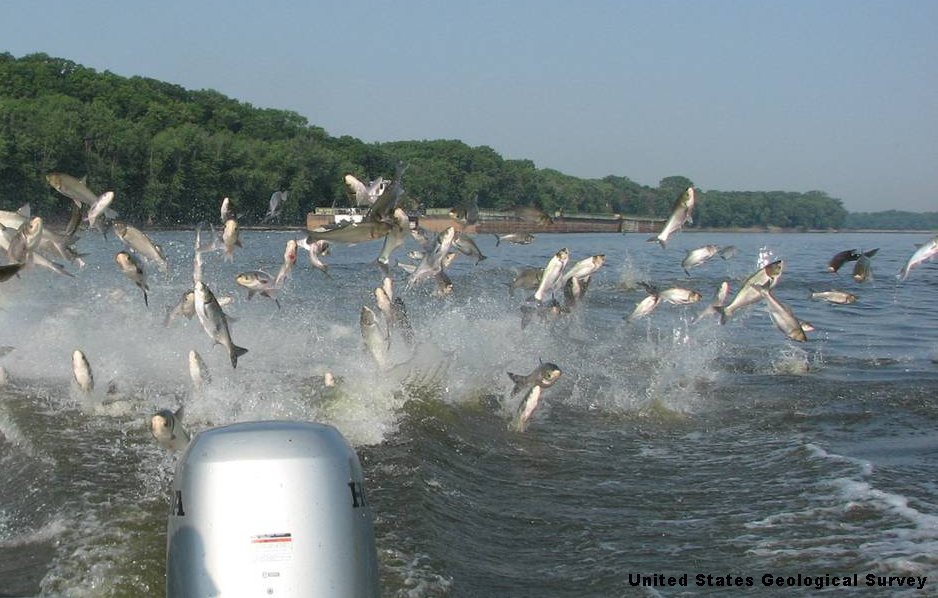
Asian carp leap in the wake of a motorboat in the upper reaches of the Mississippi River watershed. Photo from United States Geological Survey
Along with being prolific eaters and breeders, Asian Carp can grow more than three feet long, weigh 40 pounds and jump as high as eight to 10 feet from the surface of the water when startled by a boat motor or other activity in a water body. There have been reports of serious injuries suffered by people struck by the leaping fish.
One body that has not been as vocal as others when it comes to the possible devastating impact Asian carp could have on the Great Lakes is Canada’s federal government. Canadians may wish to contact their federal MPs and press for more involvement on their part in working with their U.S. counterparts to block the migration of the fish to lake waters.
(Click on Niagara At Large at http://www.niagaraatlarge.com for more news and commentary on matters of interest and concern to residents in our binational Niagara region.)
Niagara At Large is posting, below, the media release circulated by the Alliance for the Great Lakes on this matter this July 1. You can also learn more about this and other Great Lakes issues by visiting the Alliance’s website at www.greatlakes.org and Great Lakes United’s website at www.glu.org.
For Immediate Release Contact: Joel Brammeier Thursday, July 1, 2010 773-590-6494 jbrammeier@greatlakes.org
Asian Carp Spreading, Threaten to Trump Feds The discovery of spawning Asian carp in the Wabash River shows the crisis is advancing on multiple fronts and demands aggressive and immediate action to deal with the Asian carp crisis, says a coalition of national and Great Lakes groups.
The carp were found downstream of a floodplain that separates the Wabash from the Maumee River and Lake Erie, near the city of Fort Wayne, Ind., according to recent press and congressional statements.The discovery and acknowledgment of the finding by the Asian Carp Regional Coordinating Committee comes a week after the committee announced a live Asian carp was found just six miles from Lake Michigan in Chicago’s Lake Calumet.
The 3-foot-long, 20-pound sexually mature male was the first Asian carp found beyond the last locks protecting the Great Lakes, and miles beyond the electric barrier meant to keep the devastating fish out of the lakes.The discovery of a spawning population of Asian carp in the Wabash River is of particular concern because of the possibility the Wabash could flood into the Maumee River in Indiana. The Maumee River flows to Lake Erie and is identified by carp specialists as an ideal habitat for Asian carp.
“There is a lack of coordination and transparency in the current system and this current finding in the Wabash River highlights the breakdown in this system,” said Kristy Meyer, director of Agricultural & Clean Water Programs of the Ohio Environmental Council. “Lake Erie is well over a billion-dollar fishing industry and in Ohio, a $10.75-billion destination stop. Now, more than ever, the state and federal agencies must stop the finger-pointing and get their act together before these natural wonders become desolate carp ponds.”
The groups say the latest finding signals the immediate need for effective leadership on a crisis that has moved well beyond the control of the federal agencies tasked with handling it.
“We’re being outmaneuvered by a fish and can’t afford to play catch up,” said Joel Brammeier, president and CEO of the Alliance for the Great Lakes. “We need leadership to anticipate, align and activate on where the carp are going to be — not where they‘ve already been.” “The battle to protect the Great Lakes from the Asian carp is now being fought on multiple fronts, and we need a strategy that reflects that,” said Andy Buchsbaum, regional executive director of the National Wildlife Federation’s Great Lakes office. “The clock is ticking, and we need to get this process back on track. We have solutions. It’s high time we used them.”
The groups emphasized their support for legislation introduced Wednesday by U.S. Sens. Debbie Stabenow (D-Mich.) and Richard Durbin (D-Ill.), and U.S. Rep. Dave Camp (R-Mich.) The bill calls on the U.S. Army Corps of Engineers to expedite and complete a study within 18 months on the feasibility of permanently severing the Mississippi River and Great Lakes basins. The physical separation of the two major watersheds is seen as the only permanent solution to keeping Asian carp and other invasives from traveling between them.
“We applaud Sens. Stabenow, Durbin and U.S. Rep. Camp in calling for swift action to protect the Great Lakes from the threat of Asian carp,” said Max Muller, program director for Environment Illinois. “A physical barrier to prevent the spread of these invasive giants is imperative, and study on the best approach should begin immediately. We cannot afford any further delay if we are to avoid a nightmare scenario in the Great Lakes.
“Henry Henderson, Midwest director for the Natural Resources Defense Council, said: “This new discovery shows just how quickly invasive species problems can spiral out of control. We now see direct threats to two of the Great Lakes. We cannot afford foot-dragging and confusion about the problem or the solutions. It is time for focused, determined action, which requires direct and firm engagement from the White House.”
Coalition members sent a letter to President Obama Tuesday calling on him to appoint a “federal incident commander” to oversee and coordinate the federal response to the carp crisis. The groups say the federal response has fallen far short of expectations and has had numerous costly missteps, among them:
* The corps’ delay in starting a congressionally ordered and funded separation study, originally authorized in 2007. * Failure to quickly and completely disclose environmental DNA evidence of Asian carp in Lake Michigan and the Chicago Waterway System, despite having collected data since summer 2009.
* Suggesting that other invasive pathways, such as bait trade and intentional release, could be responsible for carp presence despite obvious evidence of wild populations.* Failure to develop a channel-by-channel plan for the Chicago Waterway System, where eDNA evidence has shown Asian carp to exist.
* Questioning the science and veracity of eDNA evidence.* Failure to continue eDNA testing during June despite multiple positive hits in the Chicago Waterway System above the electric barrier in spring 2010. No eDNA monitoring is currently being conducted by the corps.”Agencies aren’t finding the fires, let alone putting them out fast enough,” said Jennifer Nalbone, director of Navigation and Invasive Species for Great Lakes United.
“We need Asian carp prevention elevated to the president now.”Jill Ryan, executive director of Freshwater Future, agrees. “With so much at stake and the fish moving toward us on multiple fronts, now is the time for clear leadership to coordinate the efforts to track and stop these fish from establishing in the Great Lakes,” she said.
“Our Great Lakes provide so much to our economies, our recreation and our way of life that we can’t let a lack of leadership allow these fish to win the day.”“Indiana must take no chances that the Wabash River could provide an escape route for Asian carp and appropriate steps must be taken soon,” said John Goss, executive director of Indiana Wildlife Federation.“This new discovery ups the ante,” said Glynnis Collins, executive director of Prairie Rivers Network.
“We need an aggressive, thorough short-term response, while moving with urgency and purpose toward the only permanent solution to this crisis: physical separation of the Great Lakes and Mississippi River system.”The coalition includes the Alliance for the Great Lakes, Environment Illinois, Freshwater Future, Great Lakes United, Healing Our Waters-Great Lakes Coalition, Indiana Wildlife Federation, National Wildlife Federation, Natural Resources Defense Council, Ohio Environmental Council, Prairie Rivers Network and Sierra Club.
Contact:Alliance for the Great Lakes: Joel Brammeier, 773-590-6494Environment Illinois: Max Muller, 503-706-4738Freshwater Future: Jill Ryan, 231-348-8200Great Lakes United: Brent Gibson, 613-482-1324 x509Indiana Wildlife Federation: John Goss, 317-875-9453National Wildlife Federation: Jordan Lubetkin, 734-904-1589Natural Resources Defense Council: Josh Mogerman, 312-651-7909 Ohio Environmental Council: Kristy Meyer, 614-638-8948Prairie Rivers Network: Glynnis Collins, 217-344-2371More info at: http://greatlakes.org/WabashRiver
 Niagara At Large
The bad news is very bad, the Army Corps of Engineers have refused to step in and do any thing to stop this invasive species of fish, they turned down the City of Chicago who asked for their help in putting electric grids in the Chicago River they are within metres of the Great Lake system, and some say they have already breached what was already in place,we are doomed to the loss of our salmon and natural lake species,too little too late, reminds me of the killer bees from South America.
LikeLike
As usual, we stupid humans had to interfere where we didn’t belong. All we ever do is mess things up. Why don’t we ever learn?
LikeLike