
Publisher’s Note – The City of Thorold, Ontario may be known to many as a tired old Welland Canal community of faded, rusting paper mills and other industry.
But Thorold is also a community rich in beautifully built heritage buildings and homes and Hiertage Thorold LACAC – Local Arichtectural Conservation Advisory Committee – has been one of the most active volunteer groups of its kind in the region to have as many of these properties as possible designated as provincially significant heritage sites.
Heritage Thorold celebrated two more heritage designations of historic homes in the community this June 26 and the following article by heritage advocate Pamela Minns provides some information about them.
Communities on both sides of the Niagara River in our greater binational region have a rich inventory of heritage sites of interest to residents and visitors alike, and Niagara At Large would be pleased to post articles on them. You can contact our publisher, Doug Draper, at drapers@vaxxine.com for further information on posting articles and photos of noteworthy heritage properties on this site.
By Pamela Minns
Each time we approach the matter of designating yet another important property in Thorold, I am amazed at the historical significance of these properties and the quality of the architecture we have in this city.
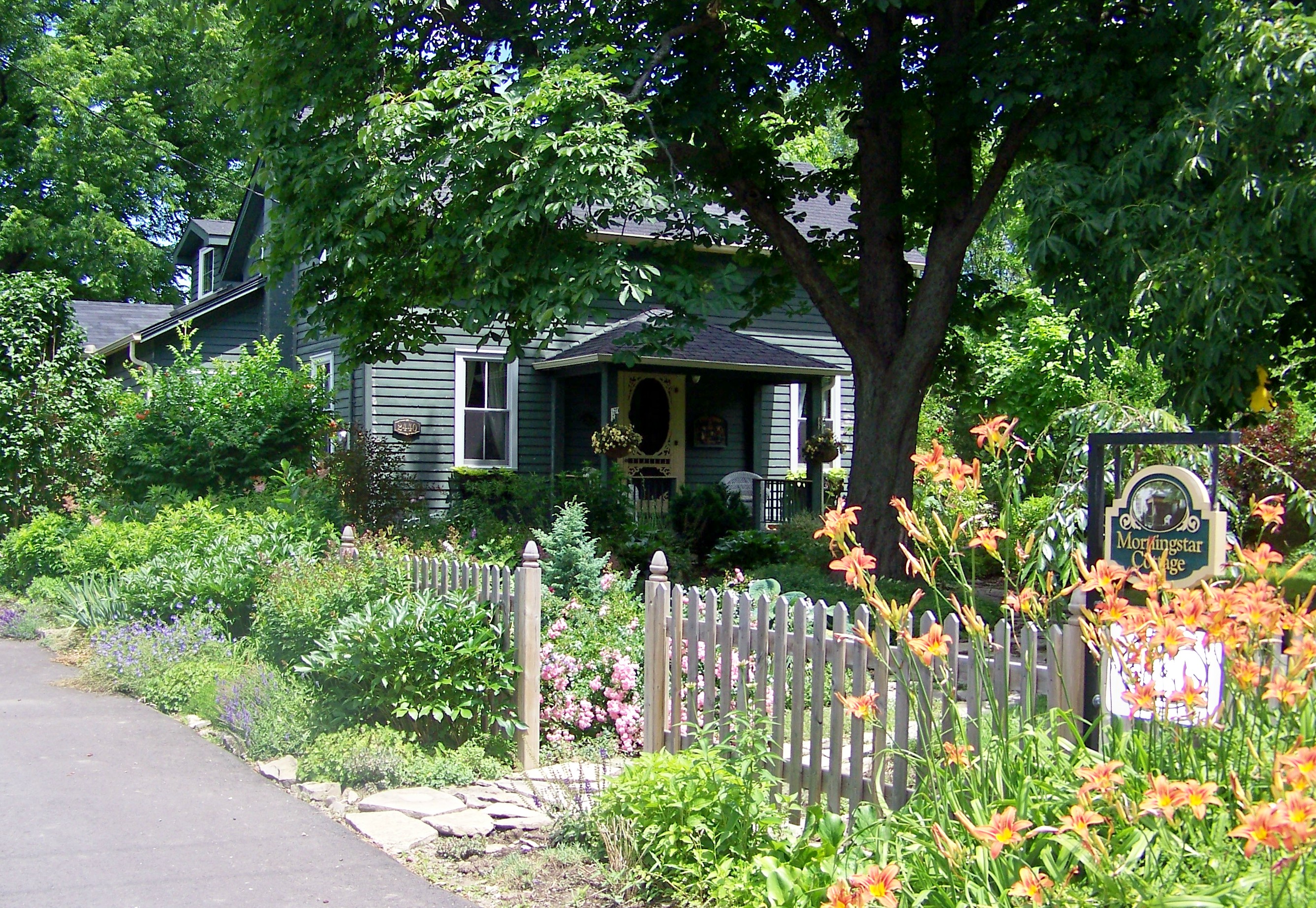
The 180-year-old Decew-Young House, now the 'Morningstar' bed and breakfast, was one of two historic homes recently designated as heritage properties in Thorold, Ontario. Photo by Doug Draper
Two more such properties were designated under Part IV of the Ontario Heritage Act on June 26th, 2010, and both of them reach back into our history to tell a story. DeCew Road on which these homes are located, follows the line of the former Mohawk Trail – an important east-west route used by native peoples above the Niagara Escarpment.
We congratulate the owners of these properties for taking steps, through designation, to protect these important sites for future generations to understand and appreciate. We have reason to be proud of our City and its extremely rich heritage. The full story on these houses can be seen in the Reference Department of our local library.
The De-Cew-Young House circa .1830
(with evidence of an earlier circa 1815 cottage in the east wing)
at 2440 DeCew Road (presently a B&B)
The house is located near two local heritage sites that were once part of the small community of DeCew Town. About a quarter mile to the east are the remains of the DeCew House (formerly John DeCew’s imposing stone house), and a half mile to the west is the restored Morningstar Mill at the picturesque DeCew Falls.)
The DeCew House was the destination made famous by Laura Secord during the War of 1812 when she trekked from Queenston, Ontario to warn British Leuitenant James FitzGibbon, the officer in charge of the military outpost there, of an impending attack by Americans.
The house is an Ontario Cottage of timber construction with a rubble stone basement.
The exterior is clad in the original mid-nineteenth century weatherboarding with decorative beaded corners and deep fascia boards below the eaves. Within the east wing of the three-bay cottage there is evidence of a smaller building, circa 1815. The rubble stone basement also contains evidence of this earlier structure, with full and hand-hewn half timbers.
Built by John DeCew, who purchased the land in 1812, this small timber-framed house may have been used to accommodate workers or a general store or blacksmith shop for the community of DeCew Town. Philip Young and his wife Mary owned the property for more than 20 years and it was probably they who enlarged the house to its present three-bay, one and one-half storey configuration with a one storey kitchen wing to the rear.
On the second floor there are a number of early nineteenth century details present, such as an opening for a ladder for access from the first floor, an interior wooden door with a Georgian Cross and Bible panel, folk faux oak graining on doors and mouldings, and a very early c.1800 Suffolk latch.
In 1792 John DeCew built one of the first sawmills in the Nassau District of Upper Canada. He also built a log cabin and shortly after he added a linseed oil mill. In 1798 John married Catherine Docksteder in Niagara and they had 11 children. John served as assessor, collector and warden for Thorold Township. He was also a founding member in 1800 of the Niagara Library, the province’s first circulating library, and a director of the Niagara Agricultural Society in 1804.
DeCew’s successful milling business enabled him to begin construction of a new stone house just north of his mills on the other side of the Mohawk Trail. War was declared and DeCew assumed command of a company of the 2nd Lincoln Militia. During the conflict his stone house was occupied by James FitzGibbon and men of the 49th Regiment. It was to this house that Laura Secord made her famous walk.
With the return of peace, DeCew began expanding his milling operations. His other enterprises included a school, church, blacksmith shop, workers’ houses, etc. and the settlement became a recognized hamlet called DeCew Town. It was during this time that the original smaller, wood-framed cottage with the rubble stone basement found in the east wing of the three-bay house at 2440 DeCew Road was constructed.
1840 DeCew Road circa 1922
This stone house that has occupied the extreme northwest corner of Lot 52 in the former Township of Thorold for some 90 years is a greatly significant link between the early history of Thorold Township and its changing face in the 20th century. Part of the house sits atop land originally set aside more than two centuries ago for a possible township road.
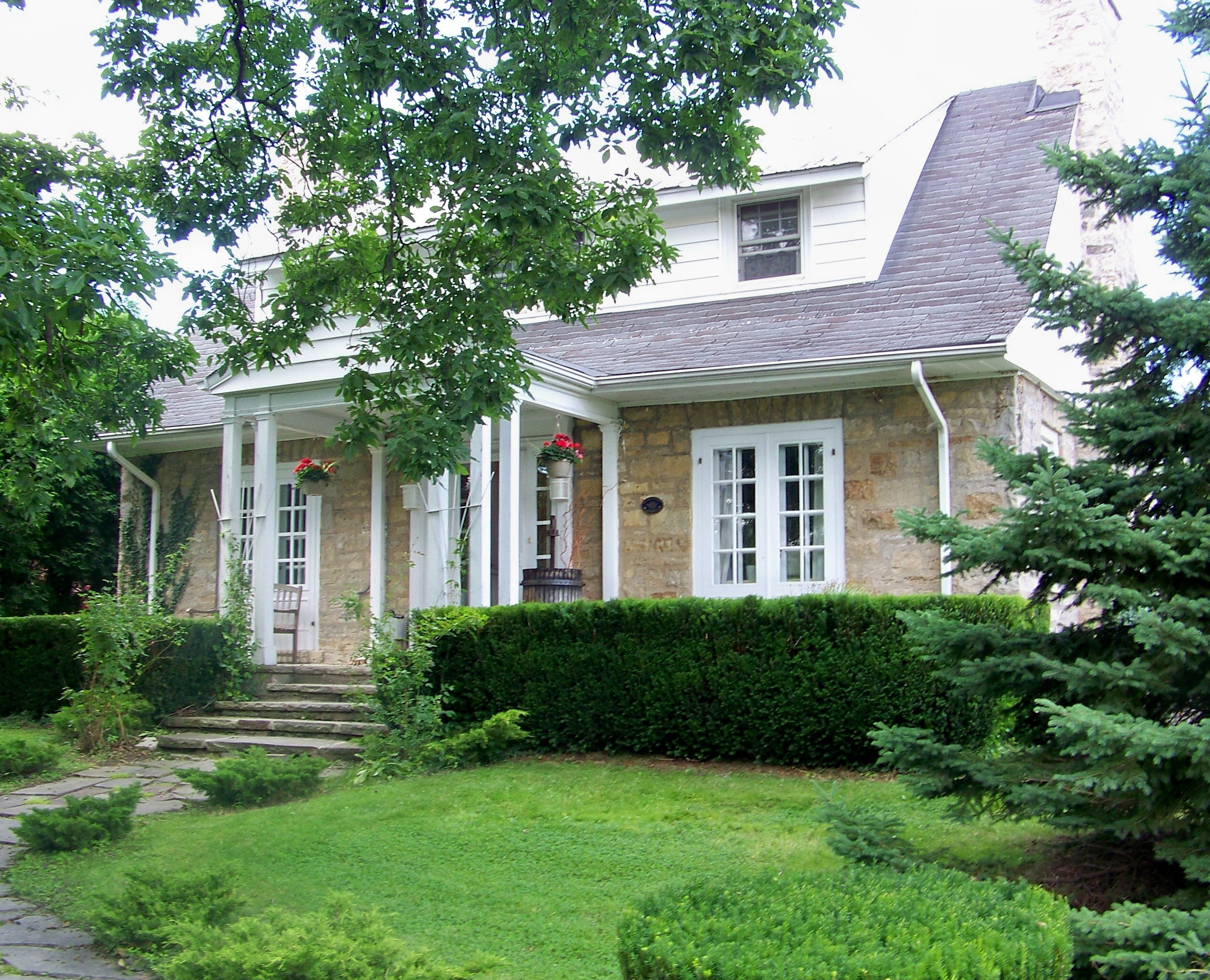
The historic Griffiths home in Thorold, Ontario. Photo by Doug Draper
The architectural style of this house is predominantly Colonial Revival but features elements of other styles as well, apparently the preferences of the original owner/builder George Griffiths who designed the house himself, bringing together an eclectic and harmonious mix of style elements that collectively give the house its individuality.
This house is unique in its use of stone as the building material for the first storey. The French doors flanking the central front door are more typical of Victorian or Regency Cottage styles, while the porch, portico and entranceway are Neo-Classical. The house is constructed of limestone which came from the ruins of the roadhouse which once stood at the intersection of Beaverdams and DeCew Roads. The upper part of the house is clad in siding with stone chimneys on either side of the house.
This home was built on land once part of one of Thorold Township’s many prosperous homestead farms, but this property, since 1922, has been residential and not agricultural. Home to members of the Griffiths family for the better part of the 20th century, the house is particularly notable for its long association with this intriguing family of socially concerned and active community builders, particularly Gertrude Knapp, socialist and activist, whose ongoing and valuable contribution to her community’s political and social development received local and provincial recognition. 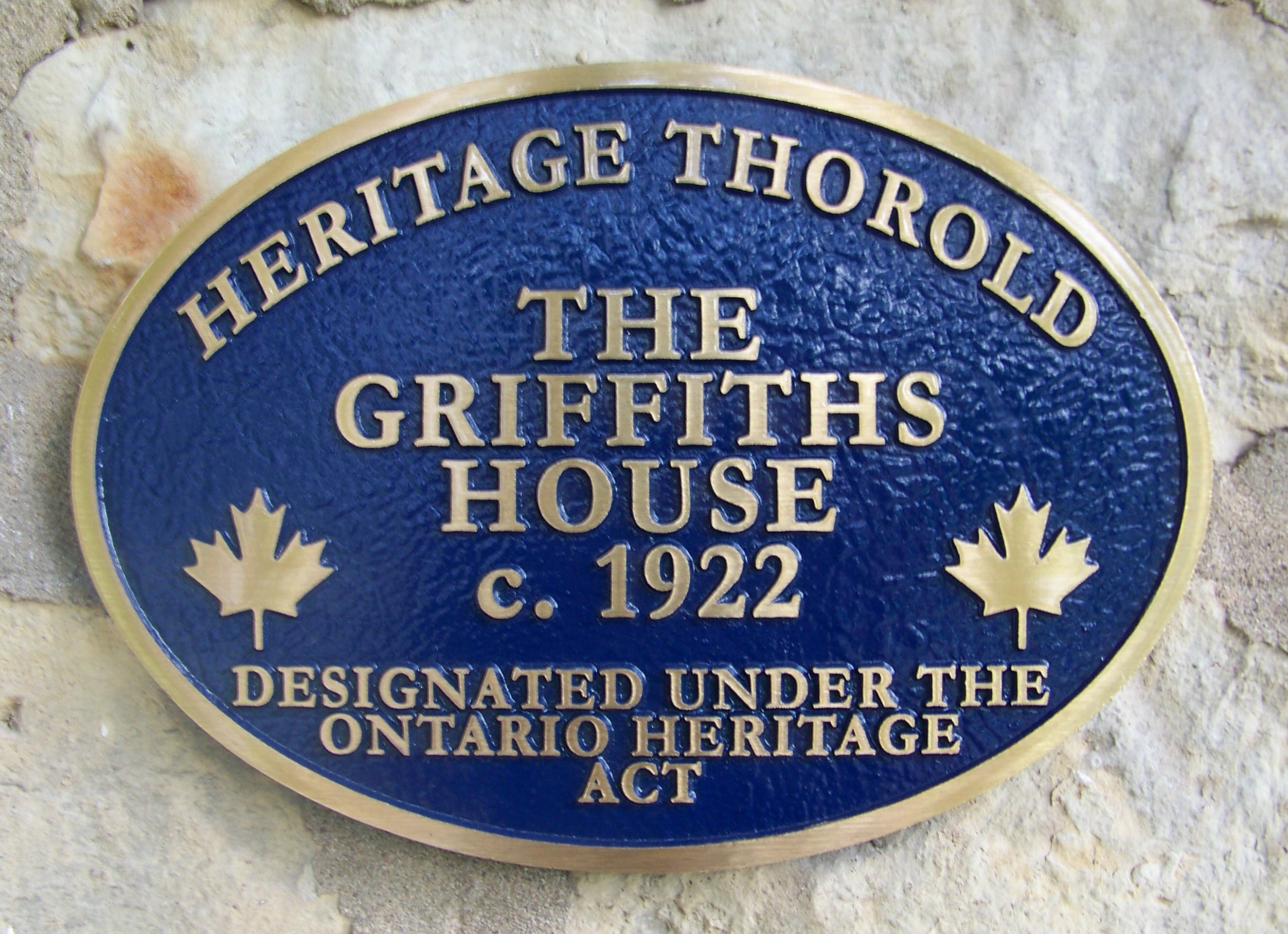
These properties were researched by Melanie Battell and Nancy Cameron; we thank them for their excellent work in researching these extremely interesting and important sites in our City. Let’s all be proud of our heritage.
Click on Heritage Thorold LACAC at www.heritagethorold.com for more information on heritage sites in this community.
(Pamela J.Minns is a Thorold resident and longtime advocate for protecting and preserving heritage sites across our greater Niagara region.)
(Click on Niagara At Large at www.niagaraatlarge.com for more news and commentary on matters of interest and concern to residents in our greater binational Niagara region.)
 Niagara At Large