
By Brent Gibson
The founding of Earth Day 40 years ago marks one of several milestones in the formation of an environmental movement.
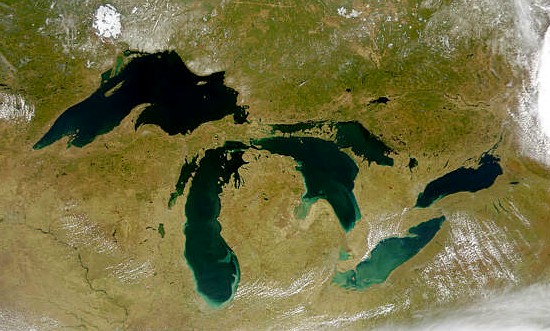
Our Great Lakes from space. Photo from NASA archives.
In the Great Lakes, the first Earth Day came less than one year after the Cayahoga River caught fire for the 13th time. The fire itself was small – it lasted only 30 minutes and caused $50,000 of damage. But, for the Great Lakes, the burning of the Cayahoga was the spark that enflamed a smouldering concern over the health of these waters.
In 1969 and 1970, the Great Lakes were in terrible shape. Lake Erie was being strangled by excessive algae growth, caused by phosphorous-loading from sewage, fertilizer runoffs, and industrial discharges. The excessive algae, boosted by the added nutrients, eventually died. As it decayed, oxygen was drawn from the water and fish suffocated.
Meanwhile, chemical contamination, such as that from DDT, dioxin, PCBs was causing deformities and harming wildlife.
This pollution led to closed beaches, hurt fisheries, harmed human health (specifically those who ate contaminated fish and wildlife, such as aboriginal populations), and meant water had to be highly purified for drinking.
Since then we’ve made some good progress curbing algae growth in the lakes by reducing phosphorous discharges, and industrial pollution is not nearly what it used to be.
Of course, many challenges remain. Invasive species continue to spread across the lakes and inland waters, our wasteful and energy-hungry water use is pumping greenhouse gases into the atmosphere, and a toxic legacy pollutes communities across the region.
Even today, on this Earth Day Eve, we helped release a report that shows facilities are still pumping hundreds of millions of kilograms of toxic and cancer-causing chemicals into the Great Lakes every year.
Anyone who works to protect the lakes knows that, at times, it is difficult to see beyond the bleak picture that arises when the problems confront you every day. And these ongoing challenges make for easy evidence to the naysayers who criticize activities like Earth Hour and Earth Day as simple fodder for our myopic memories.
Yes, there is a fleeting quality to these events. But, when so much of my work is foccused on convincing people that regulatory and legal advancements will lead to a cleaner and healthier Great Lakes ecosystem, the photos of a community group cleaning up their local river or the students creating art to highlight their concern for the environment are the images that can rally even greater numbers to the cause.
The magic of Earth Day isn’t the publicity stunts that will grab headlines for a day and paint the world green for 24 hours. It is the greater context that it provides for talking about environmental issues. It is meeting people at a clean up event who care as much as you do about where they live. It is offering a frame to excite people about the natural world that surrounds them, and to spark their appreciation of what makes this Earth a unique home.
And, most of all, Earth Day is a reminder that every day offers a chance to make things better.
(Brent Gibson is director of communications for Great Lakes United, a Buffalo, New York-based Canada/U.S. not-for-profit coalition individuals and organizations around the Great Lakes, dedicated to their protection and preservation. Click on Great Lakes United’s new blog site at www.glu.org/en/blog for more news from the coalition and information on how to contact it with your views and concerns.)
(Click on www.niagaraatlarge.com for Niagara At Large for more news and commentary on matters of interest and concern to our greater binational Niagara region.)
 Niagara At Large