
By Doug Draper
Of all the threats to a Great Lakes ecosystem so vital to our lives and the economic welfare of our communities across the greater Niagara region, few continue to wreak more havoc than the invasion of alien species in and around our lake waters.
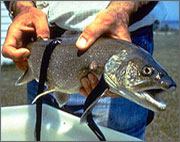
Sea lamprey - an invasive species in our Great Lakes - suck the living fluids from a lake trout. Photo courtesy of U.S. Fish and Wildlife Service.
From the sea lamprey that threatened to wipe out the recreational and commercial fishery in the last half of the 20th century, to the Asian carp now on the verge of finishing off a fishery worth hundreds of thousands of jobs and many billions of dollars to the economies of the United States and Canada, the number of invasive species now populating or on the verge of populating the Great Lakes basin now total more than 180.
It has already been well documented how many hundreds of millions of dollars annually just one alien creature like the zebra mussel can do. This Asian creature, that caught a free ride to the Great Lakes in the ballast waters of ocean vessels in the 1980s, has clogged industrial and municipal water lines, and vacuumed up no end of plankton and other aquatic life that make up a critical part of the foodchain for native fish and birds in the lakes basin.
Yet governments on both sides of the Canada/U.S. border seem reluctant to take all the actions necessary to combat the invaders already in our lakes and prevent others like the Asian carp – possibly the greatest threat to the survival of our native fishery to date – from getting in. Samples of DNA from these voracious fish have already been detected in the southern most waters of Lake Michigan, indicating that they may have already broken through from the upper Mississippi River watershed.
Niagara At Large is sharing a media released, dated March 24, by the Canada/U.S. not-for-profit coalition, Great Lakes United, on the subject of invasive species and the pressing need to bring their numbers under control before it is too late. You can read the release by clicking ‘keep reading’ at the end of this sentence.
As Seaway opens, Great Lakes still at risk from invasive species
Buffalo, N.Y. and Ottawa, ON — As the Great Lakes-St. Lawrence Seaway prepares to open for its 51st season, conservation groups are once again calling for protections from aquatic invasive species introduced and spread from ballast water of commercial vessels.
“Invasive species continue to take a staggering financial toll on people, businesses and communities,” said Jennifer Nalbone, director of navigation and invasive species for Great Lakes United. “Each year, on the eve of a new shipping season, we call on the nation and the shipping community to slam the door on this problem, because it will only get worse and more costly.”
Invasive species introduced by foreign vessels cost the eight-state region in the U.S. alone at least $200 million per year in damages and control costs. The No. 1 way non-native species enter the Great Lakes is through ballast water discharge of foreign vessels. Lakers, vessels that never leave the Great Lakes, do not introduce new invasive species from overseas but can spread species from lake to lake. Despite recent progress last year, including a rulemaking proposed by the U.S. Coast Guard, and the emergence of state regulations under the U.S. Clean Water Act, sophisticated ballast water treatment and technology has not yet been implemented onboard foreign vessels or lakers. Currently the most stringent regulations for foreign vessels coming to the Great Lakes are two physical methods of management: ballast water exchange, which has been required in the Great Lakes region since 1996, and flushing of empty tanks (for vessels termed “no ballast on board”), which was imposed by Canada in 2006 and the St. Lawrence Seaway in 2008.
The shipping industry is responsible for over 65 percent of invasive species introductions since the opening of the Seaway in 1959. U.S. states across the Great Lakes region began passing laws mandating that foreign ships treat their ballast water after continued failure by the federal government to put in place national ballast water protections. While the pending U.S. Coast Guard rule offers some hope for a strong, uniform national program, the rule is not yet finalized. The shipping industry has vigorously challenged in court state regulations to stop invasive species from entering the Great Lakes and has also begun to lobby Congress for loopholes that could delay implementation by lakers of the pending Coast Guard rule.
“For those of us living along the St. Lawrence River, it’s hard to watch the ships start coming in as a new Seaway season starts, knowing that more still needs to be done to clean up ballast tanks,” said Jennifer Caddick, executive director for Save The River. “The shipping industry must do its part by adopting—rather than fighting—solutions that prevent the introduction and spread of invasive species into the Great Lakes and other U.S. waters.”
Stopping aquatic invasive species is a pillar of Great Lakes restoration and economic recovery. The Brookings Institution found that restoring the Lakes will bring the eight-state region at least $2 in economic benefit for every $1 investment. In November 2009 U.S. President Obama signed into law the historic Great Lakes Restoration Initiative which allocated $475 million dollars towards lake restoration programs in the eight Great Lakes states. It focuses investments in solutions to control aquatic invasive species, clean up contaminated sediments, restore wetlands and other habitat that protect water quality, prevent flooding, and provide the foundation of the region’s outdoor economy.
“The nation is making great strides to advance Great Lakes restoration and economic recovery,” said Jeff Skelding, campaign director for the Healing Our Waters-Great Lakes Coalition. “Investing in restoration projects now while shutting the door once and for all on invasive species will create jobs and lay the foundation for long-term prosperity.”
For more information:
More information about ways the shipping industry and Seaway can improve their environmental performance: www.abetterseaway.com.
More information on efforts to restore the Great Lakes: www.healthylakes.org
Contacts:
Jennifer Nalbone, Great Lakes United: 716-983-3831; jen@glu.org
Jeff Skelding, Healing Our Waters-Great Lakes Coalition: 410-242-2704; jskelding@nwf.org
Jennifer Caddick, Save The River: 315-686-2010; jennifer@savetheriver.org
(Click on www.niagaraatlarge.com for Niagara At Large and more news and commentary on matters of interest and concern to our greater binational Niagara region.)
 Niagara At Large
Doug Draper is to be commended for drawing the public attention to this important issue. Part of the reason for the lack of more public interest is that only a tiny minority of the population understand the devastation which the introduction of the Sea Lamprey to the Upper Great Lakes caused in in 1933. Few understand that events right here in Niagara played a major role in this. If the Welland Canal had not been enlarged in 1933 as a step in the St. Lawrence Seaway, this disater would not have happened. The St. Catharines Museum recently contributed to this lack of public understanding by publishing a book lauding the architect of the design of this canal, for whom Port Weller is named. I don’t think someone who played such a major role in this fiasco is worthy of such an honour. If the disaster of 1933 was better understood, the public would be clamouring right now for the Lake Michigan entrance of the Chicago Ship and Sanitary canal to be firmly cemented in.
LikeLike
The 111th Congress has recieved a report detailing the cost to retrofit mainly foreign ships with ballast water technology. It suggest the cost of foreign manufactured goods may rise. This could help to make manufacturing again cost competative in the U.S. if we act quickly. There are now many new ballast water systems. New legislation with a strict timeline to clean the water should not allow, approval until long term testing can be proven safe. Testing needs to be done to ensure that diverse systems using different chemicals will not have unexpected reactions if discharged in close proximity of one another nor effect other species besides aquatic’s, such as birds, seals etc. Although the shipping industry has claimed to want uniform ballast water legislation such as h.r.2830 they have already started in their attempt to hinder the purposed Coast Guard plan, even though those who understand the problem know it is far to weak to begin with. Those who care should address their politician now to take a strong position, and fight for our future and stop our politicians from holding this up, as was done by Senator Boxer’s phony claim over states rights in 2008, The idea that individual state laws are adequate and can be enforced when the Coast Guard has their own agenda, or when another states laws make it cheaper for ports in their state, is absurd. Being that h.r.2830 passed by the house 395-7 only to be held up by one Senator and not addressed for the last year and a half has caused many to precieve the bill (h.r.2830) as Rep Oberstar has stated in reference to it: “BULLSHIT.”
LikeLike