
News from the American-based public interest group Alliance for the Great Lakes
(A Brief Note to this from Niagara At Large publisher – Former Ontario Liberal MPP for Niagara Falls and now councillor in that city put at least two if not three private member’s bills on the floor of the provincial legislature, calling for public access to the waterlines of beaches along our Great Lakes, but then premier Dalton McGuinty, along with the leaders and members of the other two mainstream parties, the Conservatives and NDP, didn’t give a fig.
How interesting that in the United States, a country usually far more protective of private property rights than Canada, continues to rule in favour of shoreline/beach access for the public, not only in the Lake Michigan area, but in other regions like Massachusetts, etc.)
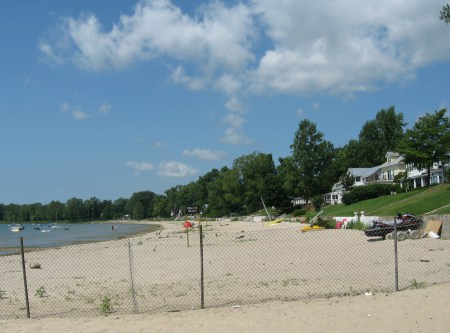
This fence, installed by private homeowners right down to the waterline of Lake Erie in Fort Erie, Ontario, is a way of sayingto public beach walkers; ‘Do your walking somewhere else.’
Chicago, Illinois, July 29th, 2015- TheAlliance for the Great Lakes, along with Save the Dunes, the state of Indiana and Long Beach Community Alliance, have prevailed in landmark litigation that upholds Indiana’s public trust protections — including the public’s right to recreate on its portion of the Lake Michigan shoreline.
Indiana has long recognized and endorsed the public trust doctrine as applied to its water bodies. Under this doctrine, the state of Indiana holds title to the shore of Lake Michigan below the ordinary high-water mark in trust for the public to enjoy for recreation and other uses.
Two lawsuits were brought by a handful of beachfront residents of Long Beach, Ind., who claimed that they, not the public, own the Lake Michigan beach below their properties down to the water’s edge and that they can exclude the public from the shore.
The Alliance for the Great Lakes and Save the Dunes joined the lawsuits as intervening parties to protect their members’ right to walk, sit, fish, bird-watch and play along the Indiana beach — activities long held as part of the public trust.
A key decision was delivered earlier this week. Judge Richard Stalbrink of the Superior Court ruled in our favor agreeing that the state of Indiana owns the shores of Lake Michigan below the ordinary high-water mark and holds that property in trust for the public’s protected uses, regardless of whether the beach is currently covered by water.
Stalbrink concluded that “private landowners cannot impair the public’s right to use the beach below the OHWM for these protected purposes,” and that to hold otherwise would “deny the public from enjoying Indiana’s limited access to one of the greatest natural resources in this state.”
Our win in this case is enormously important for two reasons. First, the public trust doctrine and the state’s title to the lakeshore are important to conservation efforts on the shoreline of Lake Michigan. Regulation of potentially damaging construction and other activities, and the integrity and continuity of the shoreline ecosystem, are greatly facilitated by public ownership.
Second, as Judge Stalbrink recognized in his opinion, the lakeshore below the ordinary high-water mark is a critically important public resource. If the beachfront residents had prevailed in their lawsuits, the public’s historic right to freely use the Indiana lakeshore would be gutted and our invaluable connection to the shore of Lake Michigan would be forever changed.
The Alliance for the Great Lakes and Save the Dunes were represented in the case by the Conservation Law Center, located in Bloomington, Ind., and this landmark win would not have been possible without the persuasive arguments of the center’s legal team. We also thank our fellow interveners, the Long Beach Community Alliance, as well as the Indiana Attorney General for their cooperation and collaboration in defending the public trust on Indiana’s Lake Michigan shoreline.
The Alliance for the Great Lakes is the largest organization dedicated solely to protecting and restoring the Great Lakes. We work hand in hand with tens of thousands of volunteers, advocates and supporters around the region to pursue protective policies, advance on-the-ground action, and educate our communities.
Learn more at www.greatlakes.org.
(Niagara At Large now invites all of you who care or dare to share your first and last name with a comment to weigh in below.)
 Niagara At Large
There are PRIVATE BEACHES and there PUBLIC BEACHES. Read “Who Owns The Beach” a paper by Ron Stewart. The Crown owns the bed of the waters in most all cases – not for non navigable streams. The public may walk along the lap line (wet sand on beach created by the waves) without trespassing.
Waterways like roads are passage ways. You do not sit, block, park, obstruct navigable waterways. Some farms owning non navigable creeks can fence off the waterway to keep their cattle in.
You would not want people to use your private yard.
If you front the lake, own the land and/or have legal easement right to use the beach for recreation and pay the high tax privilege for that beach than you would not want your property expropriated without compensation either.
Common Law does not give even the government the right to expropriate private ownership of land without just compensation.
There is a difference between Private and Public Property.
Sent from my BlackBerry device on the Rogers Wireless Network
LikeLike
It is time the public have complete access to the beach area. Wasaga Beach is an example of how the sandy beaches are occupied.
LikeLike
Doug, There are laws already in place for walking along the shores of our Great Lakes. Kim Craitor was wrong with his bills as is the US. Why don’t you and the government and the people educate yourselves?
Sent from my BlackBerry device on the Rogers Wireless Network
LikeLike
When I have walked along Lake Erie with my feet IN THE WATER….perfectly legal by law….. I have had residents turn their dogs loose on me. (There are also laws in place regarding dogs running loose and if I am in the water and attacked I have the right to defend myself.) I advise them that if I am harmed they WILL hear from a lawyer. Perhaps such people NEED TO EDUCATE THEMSELVES. They have NO RIGHT to threaten anyone who is walking in the water. Some feel they own every grain of sand and ignore the fact that people ARE allowed to walk to the high water line. Many of the fences extend well INTO the water. If that doesn’t send a nasty (and illegal) message, what does? Perhaps those who feel they can buy privilege should move to the Arctic Ocean shores where I doubt anyone will “soil” their private reserves.
Of course people pay a premium for lakeshore property….for the VIEW, BREEZE, ready ACCESS to the lake and, I suppose, for some notion of arrogant prestige. That does not mean they are entitled to private fiefdoms.
If someone is drunk or destructive or lets their dogs run loose (illegal) and poop on the beach, the police can be called, as can be done in any location. Other than that, I really doubt some old couple strolling on the beach up to the high water mark will do great harm or interrupt their reverie. Even their footprints won’t last to mar the tranquility of the scene. I have cousins on the lakeshore and they have NO PROBLEM with people strolling on “their” beach. They actually chat with them and are hospitable and nobody has ever caused a problem.
Craitor is wrong, laws are wrong, only selfish property owners are right. Walking on the water’s edge is not going into your fridge and taking a beer. Just because some practice has been tolerated for a long time does not make it just. It seems these days that every so called privilege can be bought.
LikeLike