
A Commentary by Niagara Conservationist John Bacher
At a February 19th, 2014 meeting of the Niagara Peninsula Conservation Authority’s board of directors, there was a significant victory for conservationists.
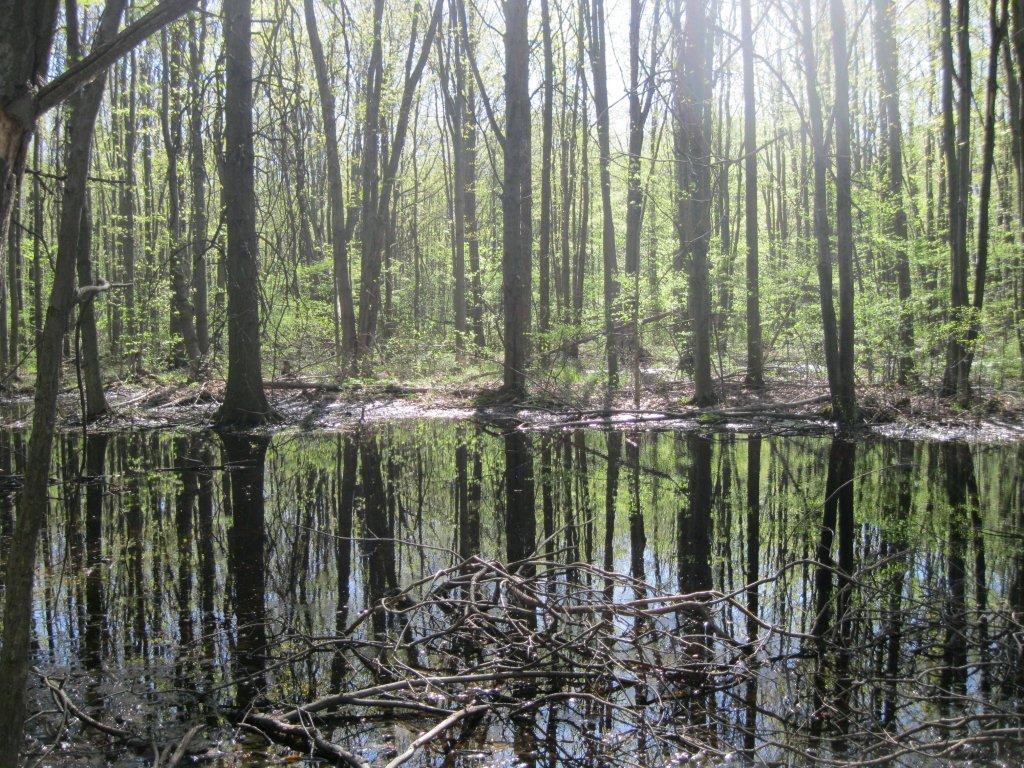
One oof many wooded, wetland areas in the Niagara watershed that could be open season for developers if the Niagara Peninsula Conservation Authority loses its decades-old resolve too defend them as an important piece of a health environment for all of us. Photo courtesy of John Bacher
Despite its persistence in a revised draft, by a unanimous vote, the NPCA’s board voted to remove references to the possible “disposal” of its properties in the final Strategic Plan. The board pledged never to sell any of its 36 conservation areas in a Niagara watershed that takes in all of the Niagara Region in Ontario and eastern portions of Hamilton and Haldimand County.
However, the board’s discussion was not without debate.
It was pointed out that the author of this policy on disposal was absent from the meeting. In his absence, the rationale for the policy was explained – that land sales would go into a fund to acquire other properties.
For those familiar with debates over land acquisition and disposal over the last five years, the revelation of the details of disposal plans made the board’s decision against selling properties even more significant.
There are real dangers in using the purchase of land to justify the sale of existing properties.
There has been enormous debate at the Niagara Regional Council level over the acquisition of lands surplus to the needs of a developer planning to build a condominium on former Easter Seals Camp in the south Niagara Township of Wainfleet. While this proposal may have merit, it would be a real tragedy for existing conservation lands, such as the Cave Springs Conservation Area in north Niagara, which might have been acquired through such a formula as a possible site of a wine promotion extravaganza.
Apart from blessedly being amended to stop the sale of existing properties, the Strategic Plan now approved remains a developer’s blueprint. What is most revealing is the contrast in the land acquisition between the Easter Seals property and the Ramsey Road woodlot in Niagara Falls.
One of the unfortunate ways in which new Strategic Plan handcuffs the NPCA is its criteria for land acquisition. It now prohibits it from acquiring provincially significant wetlands and lands within urban boundaries. This criteria would prevent the authority from purchasing the Ramsey Road Woodlot, an extensive swamp forest. It is within the urban boundaries of Niagara Falls and is designated as a provincially significant wetland. This was the consequence of an OMB appeal. This gave the Ministry of Natural Resources, access to the site to do a wetland evaluation.
Revealingly, while disputing the NPCA’s purchase of existing protected wetlands within urban boundaries, the Strategic Plan has criteria that permits the purchase of other types of protected lands.
The lands which the developer of the Easter Seals property wants to sell to the NPCA are like the Ramsey Road woodlot, are currently protected. The difference is
that the criteria of the Strategic Plan, allows the Easter Seals land to be acquired. This is because there is nothing in the plan that prohibits the sale to the NPCA. The site is outside of urban boundaries, as is all of Wainfleet. It is also protected as it has habitat for an endangered species, the Fowler’s Toad. The area is also impacted by being within the hazard land building prohibitions against Great Lakes storm surge, being along the shores of Lake Erie.
While the NPCA can no longer acquire provincially significant wetlands according to the Strategic Plan, it can acquire similarly protected areas impacted by storm surges from the Great Lakes. The land acquisition criteria of the strategic plan is nothing more than a formula to purchase from developers when they want to, and avoid lands which they seek to hold on to in the hopes of down rating lands in the future.
The developers’ agenda also revealed itself in the NPCA board’s debates over the demise of its watershed plans. These plans, which are mandated by the Niagara Regional Council’s Water Quality Protection Strategy, became suspended during the Strategic Plan exercise. The reason given for this is financial priorities. During this time the NPCA board decided to embark on the costly process of developing a Strategic Plan, with massive studies never given to the public, while closing down watershed planning, whose results are all put on line.
The two watershed plans which were closed down in the middle of their development, the Lower Welland River watershed plan and the Ten Mile Creek, Beaverdams and Shriners Creek all revealed details that disturbed developers. Much of the land rendered undevelopable as a result of the re-evaluation of wetlands south of Oldfield Road in Niagara Falls, are in the Lower Welland River watershed planning area. Table 9 of the doomed northern Niagara Falls watershed plan revealed that lands currently zoned and designated for agriculture, are the last wildlife corridor between the eastern Niagara Escarpment east of the Welland Canal and Welland River.
The trauma of the staff firings and debate over the Strategic Plan over the last three years shows the need for conservationists to be more actively involved. Citizen involvement largely from naturalists clubs across Niagara, stopped plans for sale of authority properties. Public agencies need to hear from those who are concerned for the care of the earth, not just those obsessed with schemes to turn a quick profit.
John Bacher is a Niagara, Ontario resident and a veteran activist for the protection of green spaces in the region.
(Niagara At Large invites you to share your views on this post. A reminder that we only post comments by individuals who share their first and last name with them.)
 Niagara At Large
I know I should not say anything. But having said that, here I go. Why would we trust the trustee ot the NPCA to do anything in the public trust? My understanding, flawed though it may be, is that the NPCA has packed its board of directors with friends of developers, so that the issue of ‘disposing’ of properties has become possibly corrupted. The NPCA has, as their council, a lawyer known well to developers in Niagara.
LikeLike
What bothers me about the new Strategic Plan is that it fails to prioritize the acquisition of all land in the Region that has significant ecological value to justify its conservation. This does not mean the NPCA intended to purchase and administer that land. What it would mean is that the NPCA recognizes as its primary purpose the conservation of ecologically valuable land whether it be privately owned or belonged to Parks Canada, the Ontario Ministry of the Environment or the municipality. At the moment there seems to be some doubt as to whether, in spite of its title, the NPCA does have conservation as its primary focus.
LikeLike